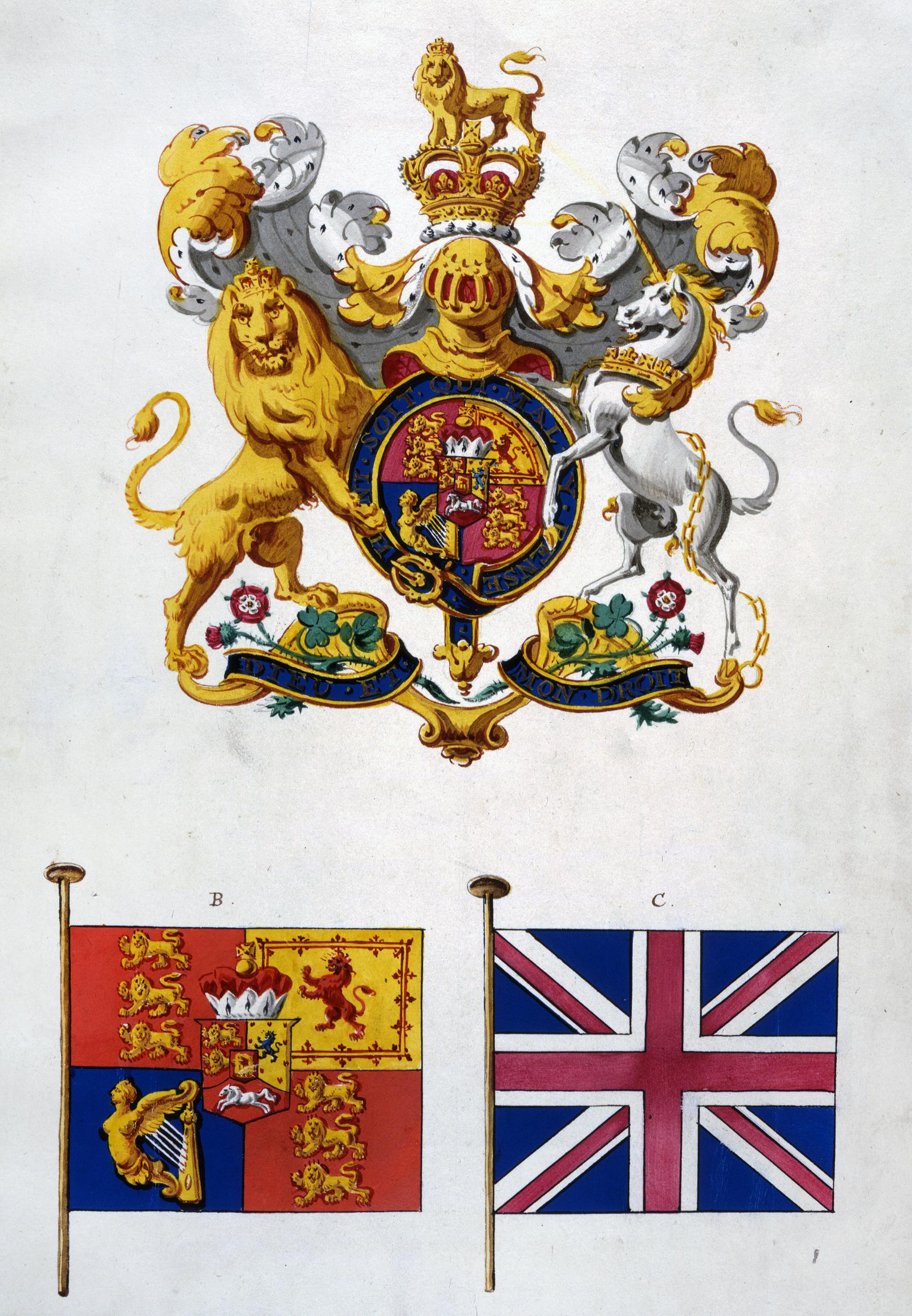
When a major change takes effect on 1st January, it rarely happened by accident. The first of January is the bureaucrat’s date of choice - clean, legible, symbolic. It says: the old arrangement ended yesterday; this is the new one. It makes choosing the appropriate events for this blog series somewhat of a challenge, but I have to take my pick regardless. The Acts of Union between Great Britain and Ireland is as important changes as any, and it took effect on exactly this day in 1801, and the choice was entirely deliberate. At midnight, the Kingdom of Great Britain and the Kingdom of Ireland ceased to exist as separate entities and the United Kingdom of Great Britain and Ireland took their place.
The new Parliament of the United Kingdom met for the first time on 22 January 1801. It contained the existing members of the Westminster Parliament plus 100 Irish MPs, drawn from the last sitting of the Irish House of Commons by a combination of formula and lot. A hundred Irish constituencies were simply abolished - most of them pocket boroughs, whose patrons each received £15,000 as compensation for the property they were deemed to have lost. Four Irish bishops rotated through the House of Lords, and 28 Irish representative peers joined it for life. The Irish Army was merged into the British Army. In the same month, George III quietly dropped the English claim to the French throne that had appeared in the royal title since Edward III, replacing it with the new style: King of the United Kingdom of Great Britain and Ireland.
And the Union Flag changed. The flag that had flown since 1606, combining St George’s Cross and St Andrew’s Saltire, gained a third element: the diagonal red cross of St Patrick, fitted into the existing design in alternating quarters. The flag that has represented the United Kingdom ever since was stitched together that January.
The road to January 1801 ran through the blood of 1798. The Irish Rebellion of that year, in which United Irishmen inspired by the French Revolution rose against British rule, was crushed with considerable brutality - estimates of the dead range from 10,000 to 30,000, as well as a French expeditionary force of 1,000 soldiers landed at Killala Bay to assist the rebels too late and too weakly to matter. For the British government under William Pitt the Younger, the rebellion settled the argument. Ireland under its own parliament, theoretically independent since the Constitution of 1782, had nearly become a back door for French invasion. The solution was to close the door: dissolve the Irish Parliament, absorb Ireland into a unified legislature at Westminster, and govern the whole from a single centre.
The case made publicly was more elevated. Catholic emancipation - the right of Catholics, who made up the great majority of the Irish population, to sit as MPs - was discussed as part of the deal. The existing Irish Parliament was exclusively Anglican, despite governing an overwhelmingly Catholic country. Union with Britain, the argument went, would allow Catholics to sit in the United Kingdom Parliament, where they would be a minority and therefore less threatening to the Protestant establishment than they would be in an Irish parliament of their own. Wealthy Irish Catholics, shut out of political life for generations, backed the union on the strength of this expectation.
What no one advertised was how the Irish Parliament was persuaded to vote for its own dissolution. The first attempt failed. In January 1799, the Irish House of Commons rejected the union motion by 109 votes to 104. Pitt came back. Between the two votes, peerages, honours, and promotions were distributed with unusual generosity to wavering members. The government also bought out the owners of pocket boroughs who feared losing their seats. Henry Grattan, who had won Ireland’s legislative independence in 1782 and opposed the union as an act of coercion, resigned from the Irish Parliament in protest before the second vote was held. The second vote passed in June 1800, by 158 to 115. The Acts received royal assent in July and August. The date of effect was chosen: 1st January 1801.
This was not the union that completed something straightforward. The union of England and Scotland in 1707 merged two genuinely separate kingdoms with distinct legal systems, separate churches, and a long history of conflict. That union required Scotland to surrender a parliament that had been sovereign in practice as well as name. The Irish case was different. Ireland had been under English overlordship since the twelfth century, subject to the English Crown since 1542, governed through a parliament that had only recently won nominal independence, and constitutionally subordinated to Westminster through mechanisms like Poynings’ Law, which required British approval of Irish legislation for most of the preceding three centuries. The 1801 union completed the British Isles project rather than beginning it. It was, in that sense, less a merger than a formalisation. ∑ The Catholic emancipation that underpinned Irish Catholic support for the union did not materialise. George III refused it. He argued, with some legal ingenuity, that granting full political rights to Catholics would violate his coronation oath to uphold the Protestant religion. Pitt resigned over the issue, though he returned to office shortly afterward. Catholic emancipation did not pass until 1829, under different governments and a different king, and only after a sustained political campaign by Daniel O’Connell that demonstrated what Irish Catholic organisation could accomplish even within the union’s constraints. The Catholics who had backed the union in the belief that it would deliver emancipation promptly were kept waiting twenty-eight years.
The union lasted in its original form until 1922, when most of Ireland seceded following the War of Independence. What remained became Northern Ireland, still part of the United Kingdom. The Acts of Union of 1800 are still technically in force for that portion of the island, though heavily amended; they were repealed in their entirety in the Republic of Ireland in 1983.
January 1st was chosen because it made the change feel clean and inevitable - a line drawn in the calendar, before and after. The architects of the union could pick the date because they controlled the process. What they could not schedule was the debt the new arrangement carried from its first day: a Catholic majority promised emancipation and denied it, a parliament abolished through the distribution of titles and cash, a union built on a foundation its largest constituency had reason to doubt almost immediately. The United Kingdom of Great Britain and Ireland came into being exactly on time. It was the rest of the arrangement that ran behind schedule.