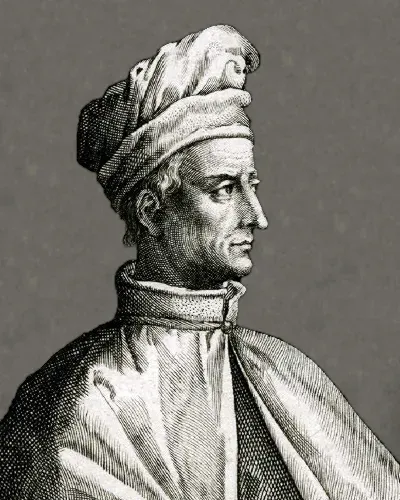
On 10 May 1497, Amerigo Vespucci allegedly departed Cádiz on his first voyage to the New World. If true, he reached the mainland of Central America over a year before Columbus, who made it to the South American coast only in 1498. There is one problem: the 1497 voyage almost certainly never happened. The letter that records it is a probable forgery, the itinerary is geographically incoherent, and most modern historians have quietly discarded the whole episode. None of which prevented a German cartographer from naming two continents after Vespucci in 1507. Columbus found the place. Vespucci got the credit. The Americas were named after a man who may not have visited them until two years after he claimed.
Vespucci was a Florentine merchant working in Seville in the service of the Medici, managing their commercial interests in the shipping business. He was not an explorer by trade. He got onto ships because that was where business was in the 1490s. His genuine voyages — the ones historians actually credit — began in 1499, when he sailed with Alonso de Ojeda along the northern coast of South America. He reached present-day Venezuela. He was back in 1501 with a Portuguese expedition that charted much of the Brazilian coast. These are the voyages that matter.
The 1497 voyage exists in a single source: a letter to Piero Soderini, gonfaloniere of Florence, first printed around 1504 and subsequently circulated across Europe. In it, Vespucci describes a four-voyage career beginning in May 1497. The letter is almost certainly not what it claims to be. The itinerary for the 1497 trip describes landfall on the Central American mainland, then a 67-day voyage along an impossibly extensive coastline, returning via the Bahamas — an achievement requiring a speed and range that the ships of the time could not have managed. The chronology of Vespucci’s documented activities in Seville during the relevant period also makes a transatlantic absence difficult to fit in. The Soderini letter was probably a garbled, unauthorised compilation of Vespucci’s actual accounts, rearranged by a publisher who either misunderstood what he had or was happy to embellish it for a market hungry for New World narratives.
None of this was clear in 1507. What was clear, to anyone reading the accounts attributed to Vespucci, was that he had grasped something Columbus never publicly admitted: that the lands across the Atlantic were not Asia. Columbus died in 1506 insisting that Cuba was a peninsula of China and that the rivers pouring out of Venezuela were the rivers of Eden. He never stopped being wrong. Vespucci, by contrast, wrote in his 1503 pamphlet Mundus Novus — “New World” — that the southern continent was “more densely peopled and abounding in animals than our Europe or Asia or Africa,” and that it was a land “which our forebears made absolutely no mention of.” He was stating the obvious by that point to anyone who had looked carefully at the coastlines, but stating it clearly, in Latin, in a document that was reprinted across Europe within two years, was what made the difference. The naming rights in history tend to go to whoever writes the memo.
Martin Waldseemüller was a cartographer at the gymnasium at Saint-Dié-des-Vosges in Lorraine. In 1507, he and a colleague produced a large printed world map — the Universalis Cosmographia — that was the first to show the Americas as landmasses separated from Asia. On that map, he labelled the southern continent “America,” after Americus Vespucius, the Latinised form of Vespucci’s name. In an accompanying text, he explained the logic: Europe was named after a woman, Asia after a woman, Africa after a woman — so this new fourth part of the world ought to be named after the man who discovered it. He meant Vespucci. He had, in all likelihood, read the Soderini letter, including its dubious 1497 voyage. The map was a sensation. Copies spread through the learned centres of Europe. The name America stuck to both continents before anyone with the authority to correct the record thought to do so.
The Spanish Crown, to its credit, tried. It had no interest in conceding that a Florentine had beaten its admirals to the mainland. The name “America” was not officially used in Spanish territories for a very long time; Spanish maps tended to say “Indias Occidentales,” the West Indies, for decades. Waldseemüller himself retreated in a revised map of 1513, labelling the landmass simply “Terra Incognita” and crediting the discovery to Columbus. It was too late. The 1507 map had already done the work. A name applied to an object with enough authority, at the right moment, to the right audience, is almost impossible to dislodge.
Vespucci spent his last years in the Spanish bureaucracy. Charles I appointed him Pilot Major of the Casa de Contratación in Seville in 1508 — the official responsible for examining and licensing pilots, standardising charts, and maintaining the padrón real, the master map of the known world that all Spanish navigators were supposed to follow. In that role he had genuine influence on the methods and knowledge of an entire generation of navigators. He died in Seville in 1512. He knew the continents had been named after him. He did not leave a record of what he made of it.
What is strange, in retrospect, is that the whole edifice rests so heavily on a letter that was probably not authentic. History is full of names that stuck for bad reasons — Constantine’s Donation, the Protocols of the Elders of Zion, the forged charters of half the monasteries in medieval Europe — but most of those names did not become the standard designation for two entire continents containing a third of the world’s population. Columbus had the priority, the ships, the royal backing, and the documented voyages. Vespucci had a pamphlet, a compliant German cartographer, and the correct analysis of what had actually been found. That turned out to be enough. Two continents carry his name. The man who first set foot on them — if he ever set foot on them in 1497 at all — is remembered as the one who got there second.