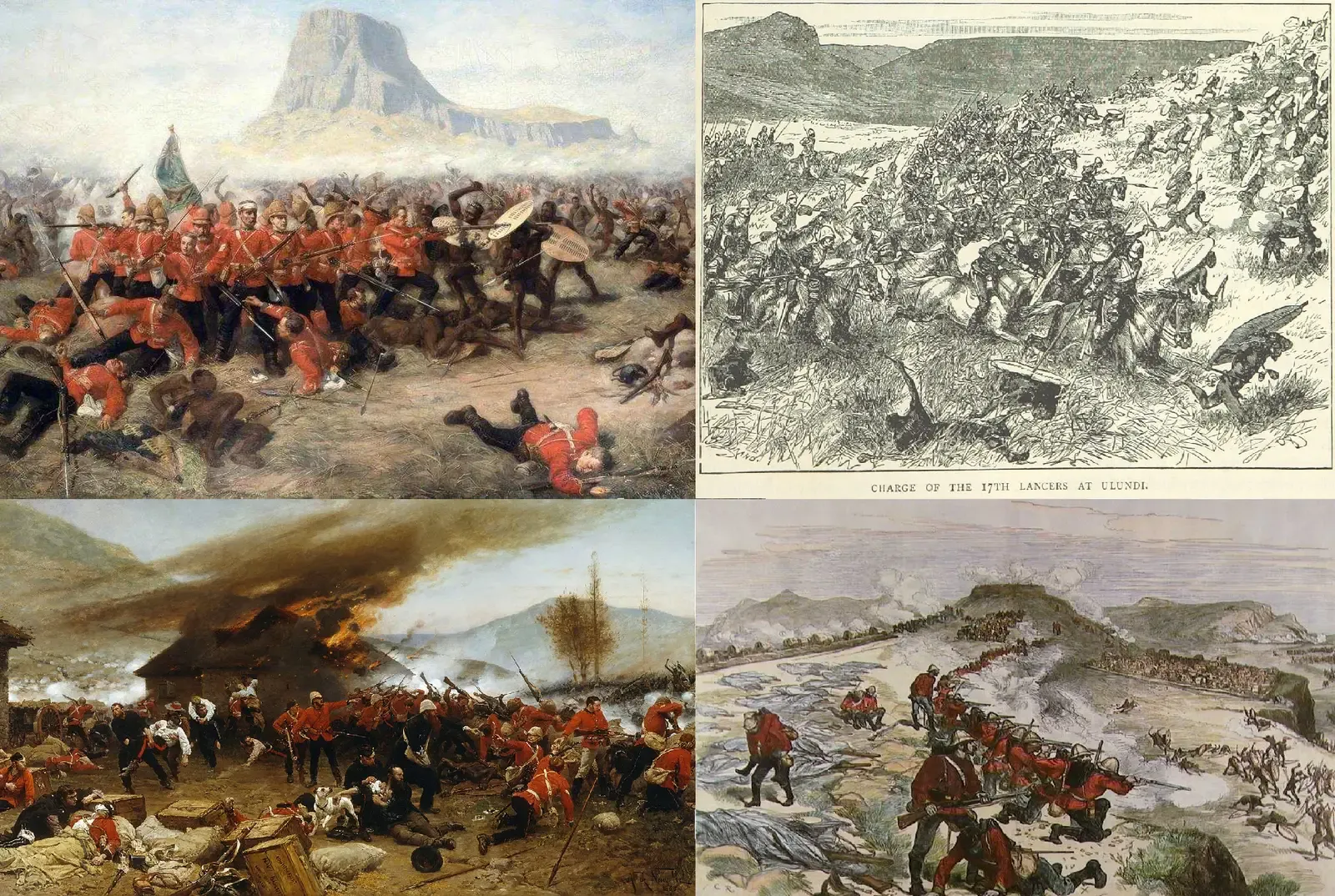
There is a version of the Anglo-Zulu War in which the British are straightforwardly the villains. That version is mostly correct, especially in the modern anti-colonial climate. But it begins too late. It tends to start with Lord Chelmsford’s columns crossing the Buffalo River on 11 January 1879, and skips the sixty years of expansion, displacement, and killing that created the kingdom his army had come to dismantle.
The Zulu state that Chelmsford faced was not old. It had been built on conquest in living memory, through a period the Zulu call the Mfecane - loosely, “the crushing” - and the Sotho call the Difaqane - “the scattering.” Between roughly 1815 and 1840, Shaka kaSenzangakhona turned a small clan on the Thukela River into the dominant power in southern Africa. He did it with military reforms of considerable ingenuity and at a cost of extraordinary violence.
Shaka reorganised fighting-age men into age-based regiments - amabutho - forbidden to marry until he granted permission, which he withheld for years. He replaced the throwing assegai with the shorter, stabbing iklwa and forced close-quarters combat by cutting off retreat. The result was a war machine that destroyed neighbouring chiefdoms not merely to raid their cattle but to absorb their young men into new regiments and subjugate the rest. Peoples who resisted were annihilated. Peoples who surrendered became Zulu. The distinction between the two outcomes was not always wide.
The destruction and displacement were vast. As Shaka’s armies swept outward, neighbouring kingdoms were forced into motion - attacking the next people along to take what they needed to survive, who in turn attacked the next, producing a cascade of violence that reached from the Cape Colony to what is now Tanzania. Estimates of deaths vary - some historians put the toll in the hundreds of thousands - but the demographic data for the region is too thin for certainty. What is clear is that large stretches of land were depopulated, entire chiefdoms dissolved, and communities that had existed for generations scattered or erased. The Nguni, the Sotho, the Tswana, the Swazi - all reshaped by pressures that originated from the Thukela River. Out of the wreckage, new polities formed: the Basotho kingdom in the mountains of what is now Lesotho, the Ndebele kingdom pushed north into Zimbabwe. Violence had rearranged the map.
The Mfecane also, inadvertently, cleared the ground for European settlement. When the Boers made their Great Trek out of the Cape Colony in the 1830s and 1840s, they moved into territories disrupted and partially depopulated by decades of Zulu-driven upheaval. This made conquest considerably easier. The image of an “empty interior” that the trekkers relied upon to justify settlement was partly an artefact of the Mfecane itself. The Zulu expansion did not cause Boer and British colonialism; it shaped the landscape through which colonialism spread.
By the 1870s, the Zulu kingdom under King Cetshwayo had approximately 40,000 warriors under arms. Cetshwayo was not reckless - he had watched what happened to African kingdoms that crossed the British - but he would not dismantle an army that was the foundation of Zulu political life. This put him on a collision course with Sir Henry Bartle Frere, the British High Commissioner for Southern Africa, who had been sent to create a federated South Africa under British control - a project made urgent, in London’s eyes, by the discovery of diamonds at Kimberley in 1867 and the need to impose political order over the competing claims of Boer republics and independent African kingdoms. Frere wanted the Zulu military broken, and he was prepared to manufacture the justification. In December 1878, he issued Cetshwayo an ultimatum that included the disbandment of the amabutho within thirty days. He knew it was impossible to meet. When the deadline expired, Chelmsford crossed the Buffalo River with three columns.
At Isandlwana, on 22 January 1879, approximately 20,000 Zulu warriors fell on a British encampment that Chelmsford had not bothered to fortify. He had, in fact, ridden away from the camp that morning on a different mission, certain the Zulu would not attack in daylight. They attacked in daylight. In roughly two hours, 1,329 British soldiers and allied troops were dead - including 52 officers of the 24th Regiment of Foot. The British lost two artillery pieces, a thousand rifles, and 400,000 rounds of ammunition. It was the worst defeat the Victorian Army suffered against any indigenous force during the century.
The news reached London on 11 February. Disraeli’s government was mortified. Parliament had not sanctioned the war. Frere had acted on his own authority, gambling that a quick victory would precede any inconvenient questions. It had not been quick and it had not been victorious, and the political damage was immediate. Frere survived, barely; Chelmsford kept his command and spent the next five months trying to salvage what his overconfidence had cost.
He got his chance at Ulundi on 4 July 1879. The British formed a square - 5,000 men, four sides, artillery inside - and let the Zulu charge it. Around 1,500 Zulu warriors were killed; the British lost 13. Cetshwayo was captured in August, hiding in a forest in the north of his kingdom. The victors did not annex Zululand outright but partitioned it into thirteen chieftaincies under men who owed their authority to British appointment. The arrangement guaranteed civil war. It delivered one within two years.
The Zulu who survived found themselves, within a decade, providing much of the labour for the diamond mines at Kimberley and later the gold mines of the Rand. The kingdom Shaka had built by absorbing defeated peoples into his armies ended with its own people absorbed into the labour economy of British South Africa. A state created through conquest was dismantled by a larger one, its population put to work extracting the mineral wealth that had made conquest worthwhile. The circularity is almost architectural.
What the Mfecane makes clear - what the whole sequence makes clear, from Shaka’s assegais to Frere’s ultimatum - is that the capacity for organised, expansionary violence, for displacing people, burning settlements, subjugating the defeated, and calling the result an empire, is not a European invention. Shaka’s armies were doing exactly this to their neighbours sixty years before Chelmsford crossed the Buffalo River. This is not a defence of what Frere engineered or what Chelmsford executed. It is a correction to the story that assigns historical agency only to one side and reserves the status of victim permanently to the other. Every empire in this story - Zulu, British - built itself the same way: by deciding that someone else’s land and someone else’s labour were available for the taking. The British had more guns and longer supply lines. The difference was logistical, not moral.