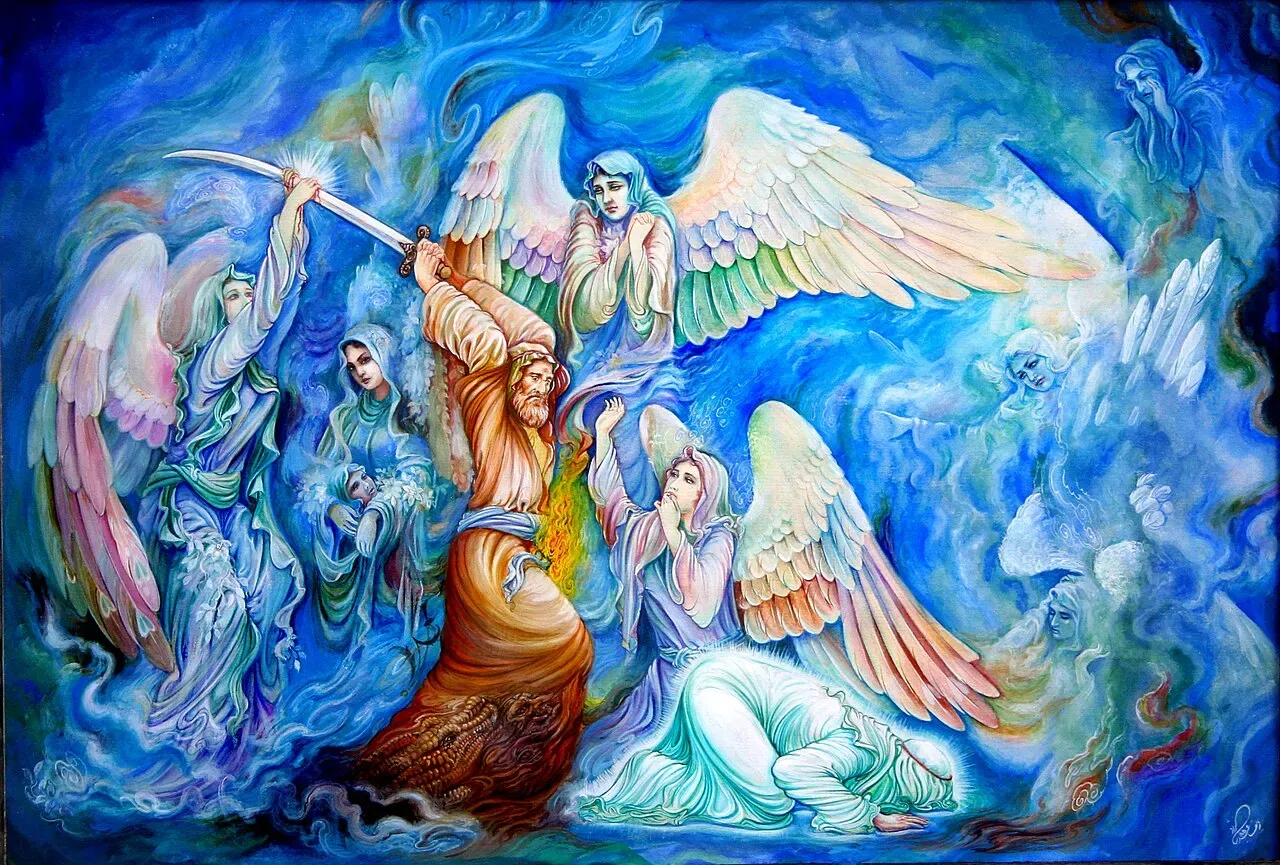
The man who killed Ali ibn Abi Talib was not his enemy. Abd al-Rahman ibn Muljam was a Kharijite - one of the faction that had fought under Ali’s own banner until he agreed to something they could not forgive: negotiation. At the Battle of Siffin in 657, after months of inconclusive fighting along the upper Euphrates, Ali had accepted a proposal to submit the question of who should govern the Islamic world to human arbitration. The Kharijites - the name means “those who depart,” and they lived up to it - walked off the battlefield and declared him an apostate. God’s will was not something men arbitrated. The caliph who had allowed it deserved to die.
The attack was coordinated. There were three targets: Ali in Kufa, Mu’awiya ibn Abi Sufyan in Damascus, and Amr ibn al-As in Egypt. Three Kharijite assassins were sent simultaneously, intending to end the civil war by eliminating every prominent actor in it. Only the attempt on Ali succeeded. Mu’awiya survived a wound to his thigh. Amr ibn al-As happened not to attend prayer that morning - his deputy led in his place, and it was the deputy who died. Ali rose before dawn on 26 January 661 to lead prayers at the Great Mosque of Kufa. Ibn Muljam stepped forward and struck him across the head with a sword coated in poison. Ali died two days later. He had been caliph for four years and five months, and had spent most of that time at war with other Muslims.
Ali ibn Abi Talib had a claim to the caliphate that no subsequent caliph could match on paper. He was the Prophet’s cousin, his son-in-law, the husband of Fatima and father of Hasan and Husayn. He had converted to Islam as a child - by most accounts the first male to do so - and fought at Badr, Uhud, and every major early engagement. When Muhammad died in 632, a council chose Abu Bakr. Then Umar. Then Uthman. Ali accepted each succession without open contest, though the sense of displacement accumulated across twenty-four years. When Uthman was murdered in 656 by mutinous soldiers from Egypt who accused him of governing through his Umayyad relatives, Ali was elected caliph within days. It was the worst timing in Islamic history.
He inherited an empire already splitting open. Aisha, the Prophet’s widow, backed a coalition against him, arguing he had failed to pursue Uthman’s killers. Her army met Ali’s outside Basra in November 656 at the Battle of the Camel - named, with grim specificity, for the animal Aisha rode, around which the fighting concentrated. Ali won. Aisha was escorted back to Medina without harm. But a caliph had fought and killed other Muslims in an open field battle. No one killed at Badr or Uhud had died at Muslim hands. The precedent was new and it was damaging.
Mu’awiya, Uthman’s cousin and governor of Syria for twenty years, refused to recognise Ali and demanded formal justice for the murder. Ali refused to try men who had since sworn allegiance to him. At Siffin in 657, their armies spent months manoeuvring along the Euphrates before the fighting began in earnest. When Mu’awiya’s men raised Qurans on their spears - calling for the text to judge what swords had not resolved - Ali’s troops stopped fighting and demanded he accept arbitration. He did. The Kharijites watched, decided it was unacceptable, and left. The arbitration itself went badly: whatever the process was supposed to produce, it produced nothing that favoured Ali and a great deal that consolidated Mu’awiya. Ali returned to Kufa having lost ground politically while being prevented from winning the military campaign he had been fighting.
He spent his remaining years fighting the men he had enraged and failing to dislodge the man he had not been allowed to defeat. At the Battle of Nahrawan in 658 he crushed the main Kharijite force. The survivors scattered. A few of them began planning assassinations.
Ali’s instructions after he was struck down have been quoted across fourteen centuries as Islamic legal principle taken to its limit. If he died, the man who had struck him should receive one retaliatory blow - no more, and his body should not be mutilated. When Ali died on 28 January, his son Hasan had ibn Muljam executed with a single sword stroke. The instruction was followed precisely.
Ali’s body was buried outside Kufa in secret, the location kept quiet for decades to prevent desecration. When the site was eventually acknowledged, it became Najaf in modern Iraq. The Imam Ali Mosque built over the tomb is now one of the holiest sites in Islam, visited by several million pilgrims a year, most of them Shia.
Hasan, Ali’s son, was elected caliph in Kufa within days of his father’s death. He held the position for roughly six months before negotiating a settlement with Mu’awiya and stepping aside. The terms included a financial arrangement and a provision - which Mu’awiya had no intention of honouring - that succession would revert to Ali’s line when Mu’awiya died. Mu’awiya moved his capital to Damascus and ruled as the first caliph of the Umayyad line, founding the hereditary system that governed the Islamic world for the next ninety years. Sunni Muslims call 661 the Year of the Jama’a - the Year of Unity, meaning the end of civil war under a single caliph. Shia Muslims do not use the term.
That discrepancy in naming captures what Ali’s death actually produced. For the Sunni tradition, he is the fourth of the Rightly Guided Caliphs, a man of outstanding piety who governed in impossible circumstances and died for it - honoured, mourned, and succeeded. For the Shia tradition, he was the divinely designated heir to the Prophet, the rightful leader whose murder is the central catastrophe of Islamic history. Everything that came after - every caliph not of his bloodline, every dynasty from the Umayyads through the Abbasids - lacked legitimate authority. The “Partisans of Ali,” Shi’at Ali, were already a political faction before his death. His assassination turned them into a religious community with its own theology, its own reading of the early caliphate, and its own understanding of what martyrdom means.
There are approximately 1.8 billion Muslims in the world today, of whom roughly 10 to 15 percent are Shia. The political geography of the contemporary Middle East is partly organised along the fault line Ali’s death opened: Iraq, Iran, Lebanon, and Bahrain all have Shia majorities or large minorities; the region’s conflicts have all drawn energy from a division that a poisoned sword in a Kufa mosque made structural and permanent in 661.
Ibn Muljam believed he was correcting a wrong. Ali had betrayed God by submitting to arbitration at Siffin, and God’s law did not recognise political compromise. What the assassin produced was something far more durable than anything the arbitration itself had decided. The negotiations at Siffin settled nothing about who should rule. Ibn Muljam’s sword, swung before dawn on the 17th of Ramadan, made the division within Islam theological, constitutional, and unresolvable by any means short of agreement that has not come in thirteen and a half centuries. The man who killed the last Rashidun caliph for refusing to let a sword decide the matter had, in the end, settled the matter with a sword.