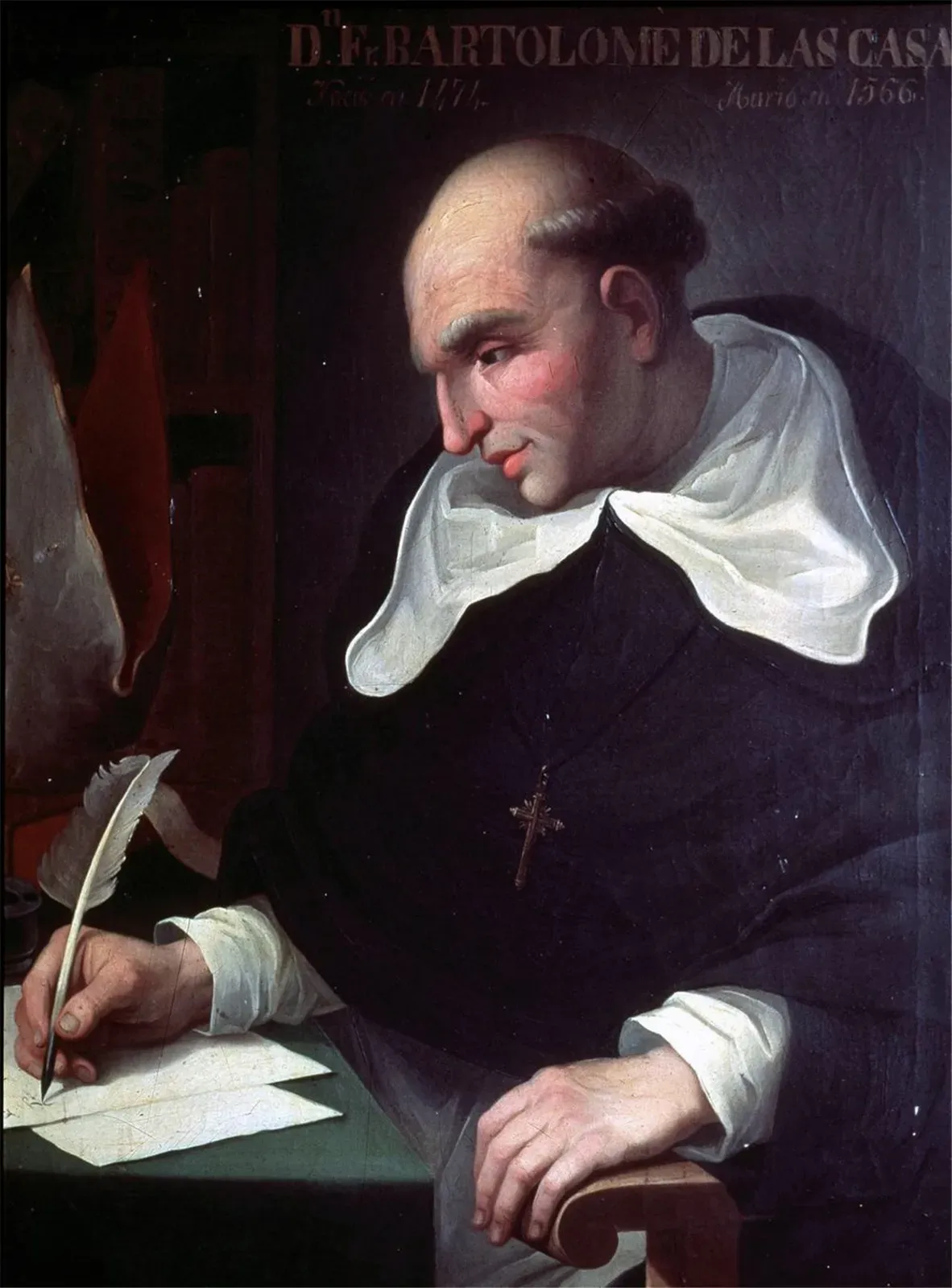
On 18 July 1566, Bartolomé de las Casas died in Madrid at something like eighty-one, having spent the better part of half a century telling the Spanish Crown that its conquest of the Americas was a crime. He had the credentials to say it. He had been there for the crime. He arrived in Hispaniola in 1502 as a settler’s son, took an encomienda of his own, joined the campaigns that tore through Cuba, and watched Spanish soldiers burn, hang, and work Indigenous people to death for gold that barely covered the cost of shipping it home. Then he changed sides, and for the rest of his life he never really stopped prosecuting the world he had helped build.
That arc is why he still unsettles people. Saints who were always saints are easy. Las Casas was an encomendero first.
He was born in Seville on 11 November 1484, into a merchant family that had already caught the Atlantic fever. His father sailed with Columbus on the second voyage and came home with a young Indigenous boy as a gift for his son - Las Casas’s first encounter with the Americas, staged in a Seville courtyard as a curiosity. In 1502 the family crossed for good with Nicolás de Ovando’s fleet. Bartolomé took land in Cibao, joined slave raids, and when the Dominicans arrived in Santo Domingo and started refusing confession to encomenderos, he argued against them. He was, at that point, on the side of the men with the Indians.
What broke him was Cuba. In 1513 he went as chaplain with Diego Velázquez and Pánfilo de Narváez, and he saw the massacre of Hatuey and the casual slaughter that followed the campaigns at Bayamo and Camagüey. “I saw here cruelty on a scale no living being has ever seen or expects to see,” he wrote later. He was still awarded a rich encomienda on the Arimao River for his trouble. The conversion came the next year, preparing a Pentecost sermon from Ecclesiasticus, when the text about unjust gain finally lodged somewhere he could not ignore. He gave up the encomienda. When the other colonists laughed him off the island for saying they should do the same, he took the only route that mattered in that empire: he went to Spain to lobby the king.
He met Ferdinand on Christmas Eve 1515. The king died a month later. Las Casas kept going anyway - to the regents, to the young Charles, to anyone who would sit still long enough to hear that the Indies were being emptied of people. He got an official title out of it, Protector of the Indians, and a salary of a hundred pesos a year, which was roughly the market rate for making yourself hated by every Spaniard west of Seville. The Hieronymite commissioners sent to reform the islands took one look at the encomenderos and decided radical change was impractical. Las Casas accused them of complicity and had to take refuge in a Dominican monastery. That pattern would hold for decades: he won paper victories in Spain and watched them dissolve on contact with colonial reality.
He also made a mistake that still trails him. In his early memorials he proposed importing African slaves to spare Indigenous labourers, assuming - as most Europeans of his generation did - that African captivity was the lawful spoil of just war. The Portuguese were already running that trade with a brutality he had not yet bothered to investigate. He later retracted the position in the Historia de las Indias, writing that Black slavery was as unjust as Indian slavery and that he judged himself guilty of ignorance. The apology is in the record. So is the original proposal. Anyone looking for a clean biography will not find one here, and I don’t think they should pretend to.
His attempt to invent a better colonialism failed on its own terms. In 1520 he won a grant to settle the Venezuelan coast at Cumaná with Spanish peasants and peaceful trade instead of soldiers and encomiendas. Slave raiders from Cubagua wrecked the groundwork before he arrived. The peasants deserted. While he was away complaining to the Audiencia, Caribs burned the settlement and killed four of his men. His enemies treated the disaster as proof that Indians only understood force. Las Casas treated it as proof that Spain could not stop sabotaging itself long enough to try anything else. He entered the Dominican order in 1522 and spent a decade mostly out of public view, writing, studying Aquinas, and refusing to let the subject go.
When he came back, he came back sharper. In Guatemala he helped turn the so-called Land of War into Verapaz - True Peace - by sending Christian Indigenous merchants ahead with songs and doctrine instead of steel, converting chiefs at Atitlán and Chichicastenango without an army. He fought the Franciscans over mass baptisms of thousands in a day, insisting that a conversion without understanding was invalid. Pope Paul III’s bull Sublimis Deus in 1537, declaring Indians rational beings who must be brought to the faith peacefully, had Las Casas’s fingerprints on it whether or not his name was on the parchment.
The political peak came in 1542. Before Charles V and the Council of the Indies he delivered the atrocity narrative that would later be published as the Brevísima relación de la destrucción de las Indias - A Short Account of the Destruction of the Indies. On 20 November the emperor signed the New Laws: no new Indian slaves, no Indians as carriers where alternatives existed, and a phased death of the encomienda as holders died and their grants reverted to the Crown. Colonists rioted. The viceroy of New Spain declined to enforce the laws. Within three years the worst of them had been walked back. Las Casas, newly consecrated Bishop of Chiapas, arrived in his diocese in 1545 and immediately refused absolution to encomenderos who would not free their slaves, including on their deathbeds. Shots were fired at him. He lasted about a year before leaving for Spain, never to return to his see.
Then came Valladolid. In 1550 and 1551 he faced Juan Ginés de Sepúlveda before a panel of theologians and jurists in what remains one of the strangest spectacles in imperial history: an empire pausing, at least on paper, to ask whether its own wars of conquest were just. Sepúlveda argued that Indians were natural slaves in Aristotle’s sense, sinners against natural law who needed Spanish masters to become civilised. Las Casas answered that they were fully human, that their societies equalled or surpassed many European ones, and that only peaceful preaching could confer any legitimate Spanish title in the New World. The judges never issued a clean verdict. Both men claimed victory. Conquistadors kept conquering. But the debate itself matters. Empires do not usually put their plunder on trial in public, even in inconclusive form. Las Casas forced that hearing into existence by being too loud, too connected, and too well documented to ignore.
The Short Account, published in Seville in 1552, outlived every court victory he won. Protestant printers in the Netherlands, England, and France translated it eagerly and used it to paint Spanish Catholicism as uniquely blood-soaked - the Black Legend that Spanish nationalists have been trying to scrub off the furniture ever since. That afterlife has done Las Casas no favours with his own country’s right, which spent the late nineteenth and early twentieth centuries calling him a traitor, a madman, and a fabricator. Modern demographers discard most of his population figures as the usual sixteenth-century inflation, then largely accept his qualitative picture: the conquest was violent, the exploitation was murderous, and European disease did the rest of the killing on a scale no sermon could stop. He exaggerated numbers. He did not invent the corpses.
There is a newer line of attack, too, and it is not entirely wrong. Some historians argue that Las Casas was still an imperial operator - that his peaceful towns and tribute systems were meant to make extraction more efficient, and that replacing Indigenous religion with Christianity was its own colonialism, softer only in the sense that a cage can be softer than a sword. I think that critique names a real limit. He never argued that Spain should leave. He argued that Spain should stay differently: as a missionary crown over free vassals, not as a machine for turning people into gold. That is reform, not abolition of empire. It was also, in the world he actually inhabited, the most radical programme a man with access to Charles V could push without being hanged for treason.
He spent his last years in a rented cell at the College of San Gregorio in Valladolid, still taking petitions from Indigenous nobles, still blocking attempts to make encomiendas hereditary property, still finishing the Historia de las Indias he had begun in 1527. He signed the manuscript over to the college in 1561 with instructions not to publish it for forty years. It waited three hundred and fourteen. He died on 18 July 1566, having made himself impossible to celebrate cleanly and impossible to dismiss.
That is the real reason he remains controversial. The colonists hated him for defending Indians. Later Spanish patriots hated him for handing Protestants their best atrocity pamphlet. Modern readers distrust him for the African slavery proposal, for the numbers, for the fact that he wanted a Christian empire rather than no empire at all. What none of those camps can quite get rid of is the central fact: a man who had owned the system wrote the most sustained indictment of it that the sixteenth century produced, and he kept writing it until the day he died. Empires generate plenty of victims. They rarely generate witnesses this determined to testify against themselves.