The night before the second day at Bannockburn, Robert the Bruce held a council of war. The English army - probably 20,000 men at minimum, with heavy cavalry in numbers Scotland could not match - had survived the first day’s reverses and still sat across the carse. The standard advice from Bruce’s commanders, according to later accounts, was to withdraw. They had proved they could hold ground. The English could be harassed, starved of forage, bled by raids. A pitched battle in the open against a force that size was not necessary.
Bruce decided to fight. That decision, and what happened on the next day of 24 June 1314, settled the trajectory of Scotland for the next seven centuries.
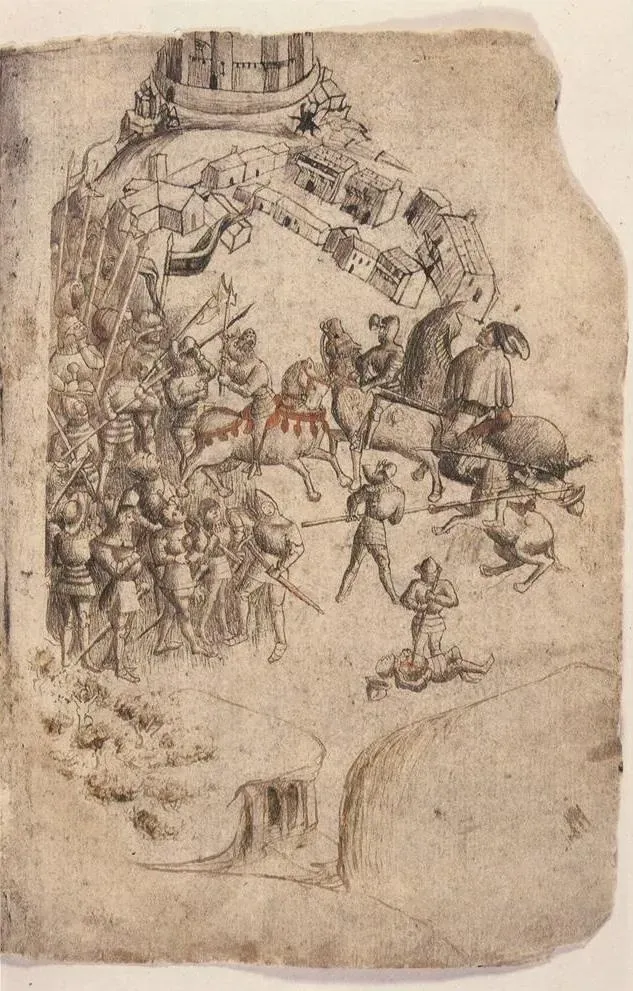
The battle had started the day before with a moment that passed into legend almost immediately. On 23 June, as the English vanguard approached the New Park south of Stirling, Sir Henry de Bohun spotted Bruce riding ahead of his men on a grey palfrey - lightly armoured, conspicuously identifiable. De Bohun levelled his lance and charged. Bruce, on a horse he later called “not a great destrier,” had one axe. He waited, sidestepped the charge at the last instant, and split de Bohun’s helmet with a single blow. The axe handle broke from the impact. Bruce’s council expressed concern about the risk he had taken. He expressed concern about his broken axe handle. The story may have improved in the telling, but the core - an English knight charging a Scottish king who killed him with an axe and then complained about the equipment - contains enough specificity that it probably happened roughly as described.
That skirmish was not the battle. The battle was the following morning, when Bruce deployed his schiltrons - dense formations of spearmen - and used them to advance rather than stand still. William Wallace had tried schiltrons defensively at Falkirk in 1298 and watched them get destroyed by English archers once his cavalry fled. Bruce solved the archer problem through terrain: he had positioned his forces where the carse and the Bannock Burn hemmed the English cavalry’s room to manoeuvre, and he moved his spearmen forward before the archers could find their range. The English cavalry, charging into advancing infantry on constricted ground, could not develop the shock force that medieval heavy horse needed to be effective. The formations did not break.
The English army had roughly 2,000 men-at-arms and a cavalry arm that should have decided the battle inside thirty minutes. Instead, packed onto the carse with the Forth at their backs, the cavalry charges folded into the schiltrons. When the group of camp followers on the ridge behind the Scots appeared on the horizon - servants and non-combatants who seem to have come forward from curiosity or enthusiasm - portions of the English army interpreted them as a fresh reserve and began to break. The collapse, once it started, was total. Edward II fled from the field; the chronicles record him riding hard for Dunbar before the pursuing Scots could catch him.
English casualties were severe. Around 700 knights and men-at-arms were killed or captured. Infantry losses are harder to count but were significant. The Scots lost, by some accounts, two knights. The disparity is almost certainly flattered in the retelling, but the direction it points is correct: an army fighting in chosen terrain, with a commander who understood how to neutralise cavalry, had beaten a force several times its size.
The practical consequences were immediate. Stirling Castle surrendered the following day - its commander, Sir Philip de Mowbray, had promised neutrality once the relief army arrived, and it had arrived and been destroyed. Bothwell, Dunbar, and Jedburgh fell within months. Bruce’s wife Elizabeth de Burgh and his daughter Marjorie, held by the English since 1306, were exchanged for captured nobles. The Scottish king had hostages worth exchanging. That was itself a new situation.
The war did not end at Bannockburn. It ended fourteen years later, with the Treaty of Edinburgh-Northampton in 1328, after sustained Scottish raids into northern England - Cumberland, Northumberland, Yorkshire - had made the English northern counties nearly ungovernable and the English crown repeatedly unable to mount a credible counteroffensive. Bruce died the following year, having secured formal recognition of Scottish independence while he was still alive to see it. Bannockburn was the moment the English stopped believing they could crush Scotland quickly and started calculating the cost of continuing.
What is worth resisting, in thinking about Bannockburn, is the nationalist mythology that calcified around it in the centuries after. The battle became the centrepiece of Scottish identity: Burns put it into verse in “Scots Wha Hae” in 1793, and “Flower of Scotland” is essentially a retelling of the schiltron advance. None of this is wrong, exactly, but it tends to compress a messy, contingent conflict into a decisive confrontation between civilisational principles that the participants would not have recognised. Bruce spent the early years of his reign hiding on islands off the Antrim coast with a handful of followers. He was not an obvious symbol of national destiny. He was a survivor, a tactician, and a politician who spent eighteen years outlasting a series of English kings who consistently underestimated what it would cost to subdue a country that refused to stay subdued.
Edward II, the man who lost Bannockburn, had inherited from his father one of the best-equipped armies in Europe. He managed to deliver it onto constricted ground with both flanks compromised, apparently without reconnoitring the terrain, against an opponent who had been studying that exact ground for years. He was not the last general to discover that numbers and equipment mean less than expected when the ground is working against you.
The night before the battle, the sensible advice was to retreat. Bruce chose to fight, on ground he had chosen, with formations he had redesigned. The schiltrons held. That was enough.