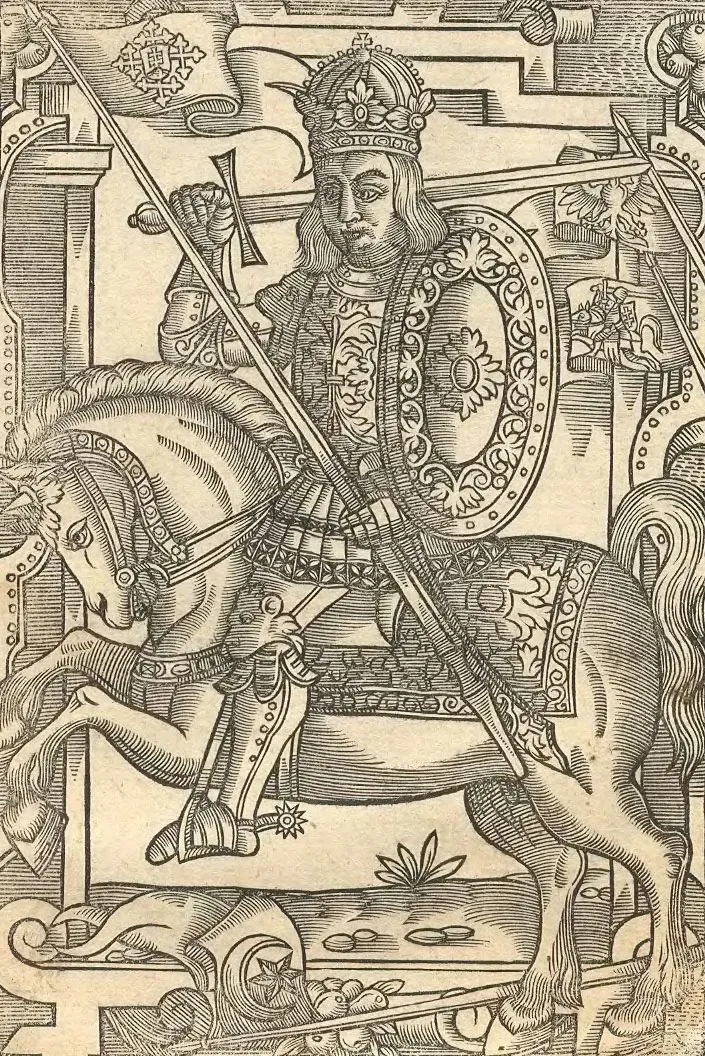
On 13 July 1260, on the marshy southern shore of Lake Durbe in what is now Latvia, the Livonian Order lost the largest battle it would ever fight in the thirteenth century, and it lost it partly because it refused to hand back a few prisoners to the men fighting on its own side. The Order’s own conscripted allies looked at that refusal, decided the war was no longer theirs, and walked off the field in the middle of the fighting. What was left of the crusading army was surrounded and cut to pieces. By evening, the Livonian master was dead, the Prussian marshal was dead, and something like 150 knights of the Order lay dead alongside them - a toll that dwarfed anything the knights had suffered in a single engagement before or would suffer again for the rest of the century.
The Livonian Order was not, strictly speaking, an independent institution. It was born out of a previous catastrophe. Bishop Albert of Riga had founded a military order called the Brothers of the Sword in 1202 to garrison his new Baltic bishopric with permanent troops rather than seasonal crusaders, and for three decades those Sword Brothers carved out a theocratic state across Livonia and Courland. Then, in 1236, Samogitians and Semigallians wiped out roughly half the order and killed its master at the Battle of Saule. The survivors had no bargaining power left. In 1237 they were folded into the Teutonic Order - the larger, better-resourced crusading order already fighting its own war against the pagan Prussians further south - and reconstituted as an autonomous branch, run by its own Livonian master but formally answerable to the Teutonic Grand Master in Prussia. That merger is why an army camped at Memel in 1260 could call on knights from both Livonia and Prussia in the same campaign, and why the pope who blessed it and the vassal contingents who marched in it spanned two supposedly separate crusading fronts that were, by then, one and the same order. It is also why the men riding into the swamp at Durbe were not the first Livonian force the Samogitians had gutted. They were the second.
The campaign had started, as these things usually did, with an attempt to finish an old argument by force. The Livonian Order had been fighting the Samogitians since 1253, when the newly crowned King Mindaugas of Lithuania signed away parts of Samogitia to the knights in exchange for their recognition of his title - a transfer the Samogitians themselves had never agreed to and had no intention of honouring. Seven years of raids, truces, and broken truces followed. A 1257 clash near the new castle at Memel had already cost the Order twelve knights. By 1259 the Samogitians were raiding into Courland and beating Livonian forces at Skuodas, which was enough to encourage the neighbouring Semigallians to rise up as well. The Order responded the way it always responded to a losing position: it asked Rome for more crusade. On 25 January 1260, Pope Alexander IV issued a bull blessing a fresh campaign, and Livonian master Burkhard von Hornhausen set about assembling an army large enough to settle Samogitia for good.
What he assembled was substantial on paper: something in the region of 8,000 men, 190 of them belted knights of the Order, drawn from Livonia, from the Order’s Prussian branch, and from vassal contingents of Danes, Swedes, and Old Prussians. It marched first for Georgenburg, a Samogitian-besieged outpost the knights wanted to relieve, then changed course when word arrived that a Samogitian raiding force, perhaps 4,000 strong, was pillaging Courland instead. Hornhausen turned his column to intercept them. The two armies found each other on the shore of Lake Durbe.
They never got the clean set-piece the knights were built to fight. The coalition Hornhausen led into the marsh was already fraying before a single blow landed. The Danish contingent from Estonia refused to dismount their heavy warhorses for ground that was plainly unsuited to them - swampy lakeside terrain is not cavalry country, and everybody in that army except, apparently, the Danes seemed to know it. Then came the argument that actually broke the army. The Curonians fighting alongside the Order had kinsmen among the Samogitians’ prisoners, taken in the raids that had brought this army here in the first place, and they asked Hornhausen to negotiate their release before the fighting started. He refused. The Curonians did not stay to fight for a cause that would not spend five minutes negotiating for their own people. They abandoned the field, and one chronicler, Peter von Dusburg, went further and accused them of turning on the knights from behind as they left. The Estonians and the rest of the local levies followed them off within moments. What remained of the crusading force - the knights, the German men-at-arms, whoever hadn’t already walked - was left standing in a swamp, encircled, and destroyed.
The scale of the loss is what separates Durbe from every other Baltic defeat the Order absorbed that century. Burkhard von Hornhausen himself was killed. So was Heinrich Botel, the Prussian land marshal - the second-highest military office the Order possessed, gone in the same afternoon as its supreme commander in Livonia. Around 150 knights died with them, alongside hundreds of the sergeants, mercenaries, and low-ranking soldiers who made up the rest of the army. For comparison, the next-worst defeat the knights suffered in the thirteenth century, at Aizkraukle two decades later, cost them 71 knights - less than half. Durbe was not a bad day. It was the single worst day the Order had in a hundred years of fighting.
News of a beaten, decapitated Order travelled fast, and it detonated exactly the kind of chain reaction that a crusading order built on the assumption of its own invincibility could least afford. The Great Prussian Uprising broke out that same year and ran for fourteen, dragging the Teutonic Order into a defensive war for its own heartland. The Semigallians fought on for thirty years before surrendering. The Curonians held out until 1267. Even the islanders of Oesel rose up, though that revolt was crushed within a year. Barely three weeks after Durbe, on their way home from another raid, the same Samogitian and Curonian forces caught and beat a Livonian detachment again near Lielvārde, for good measure. Twenty years of Livonian conquest came apart in months, and it took the Order roughly thirty years to claw back the ground it had held before Hornhausen ever left Memel.
The political fallout reached further than the battlefield. Mindaugas’s own nephew, Treniota, used the disaster to talk the king into repudiating his Christianity and his peace with the Order outright - a policy reversal that made sense militarily and cost Mindaugas dearly in the end. Three years later, in 1263, Treniota assassinated his own uncle and seized the Lithuanian throne for himself, and the country he now ruled reverted openly to paganism. The man who had turned a battlefield catastrophe for the Germans into a strategic opening for Lithuania spent that opening murdering the king who had made the winning possible. Lithuania would not accept Christianity again as a state until 1386, and by then it governed one of the largest territories in Europe - built, in no small part, on the breathing room bought at Durbe, by a coalition army that never got the chance to fight as one force, because its own commander decided a handful of prisoners weren’t worth the trouble of freeing.
Eighteen years earlier, on a frozen lake not far to the north, a different Livonian campaign against a different set of adversaries had come apart for reasons of terrain and overreach rather than treachery - the battle on the ice that ended the Order’s push into Novgorod. Durbe was worse, and for a more instructive reason. Nobody needs a thawing lake or a clever ambush to lose an army. A commander who cannot be bothered to keep his own coalition’s trust will manage the job just fine on his own, on perfectly ordinary, unfrozen, treacherous ground.