The Battle of the Little Bighorn has the kind of name that sticks without obvious cause. It sounds decisive. It sounds final. People repeat it partly because other people have, the way celebrity names circulate long after the original reason has faded. It is worth asking directly whether the battle actually mattered - or whether we are just passing along a famous story because it has always been famous.
It mattered. In a way that makes the victory terrible.
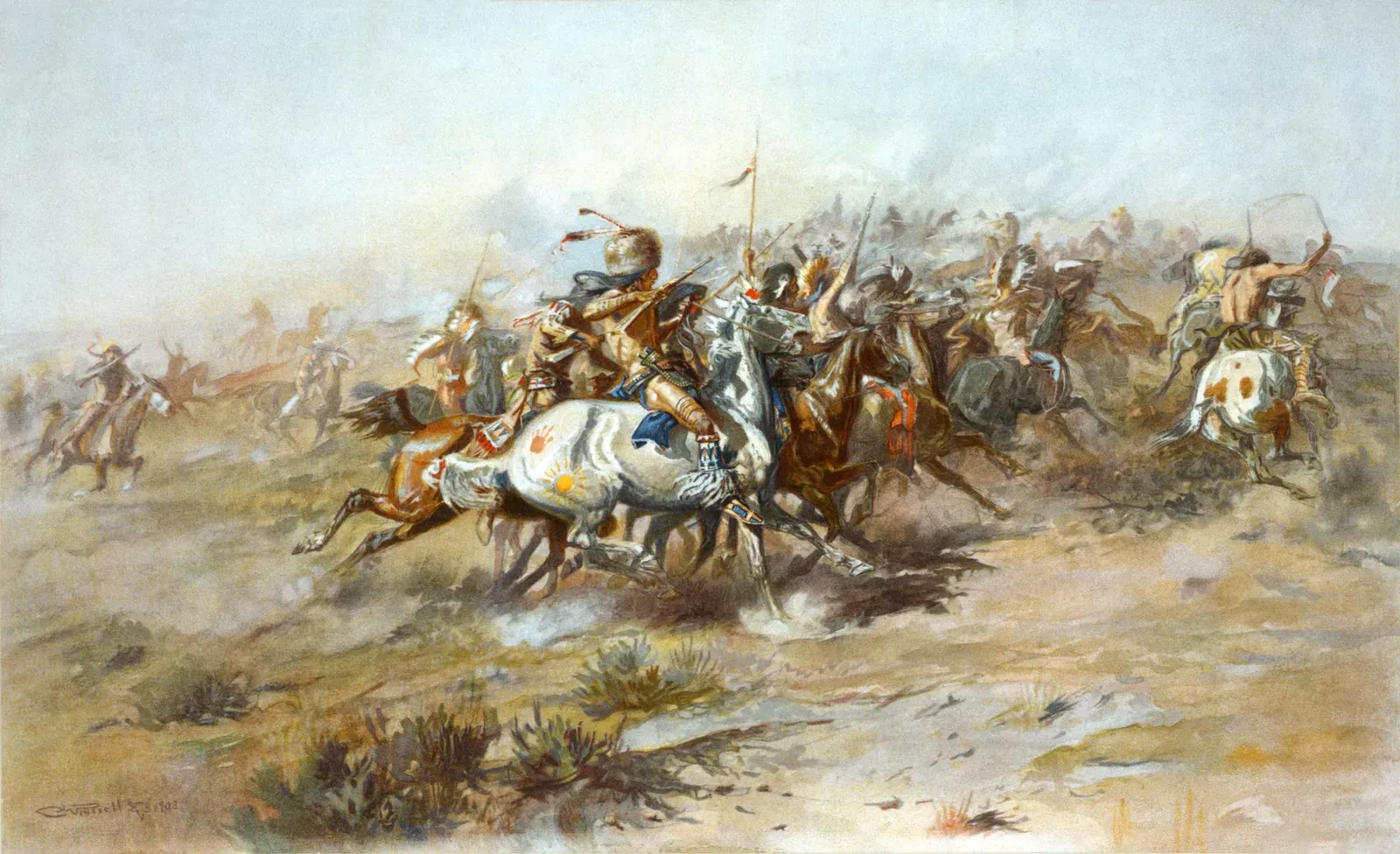
On 25 June 1876, Lieutenant Colonel George Armstrong Custer split his 7th Cavalry column and attacked a Lakota, Cheyenne, and Arapaho encampment in the Little Bighorn valley in present-day Montana. He expected a few hundred warriors. There were roughly 5,000. The detachment he personally led - around 210 men - was surrounded and killed. The rest of the regiment survived with heavy casualties. The engagement lasted about an hour. It was the most complete destruction of a U.S. Army unit by Indigenous forces in the history of the Plains wars.
Within a year, the Lakota had lost the Black Hills and most of the leadership that had won the battle was dead, exiled, or confined to reservations.
The connection between those two facts is the point.
Before 1876, the legal situation favoured the Lakota, at least on paper. The Fort Laramie Treaty of 1868 had guaranteed the Black Hills - Pahá Sápa - as part of the Great Sioux Reservation, entirely off limits to non-Indians. In 1874, the Army sent an expedition to investigate rumours of gold. The expedition was commanded by Custer. He found gold, reported it, and prospectors poured in illegally. The U.S. government tried and failed to buy the Hills; the Lakota were not selling. By 1876 the government wanted the land, could not legally take it, and was looking for leverage.
Custer’s death provided the leverage.
The news broke on 4 July 1876 - Independence Day, the centennial of the republic - while celebrations were underway in Philadelphia. The shock was genuine and the political reaction was swift. Custer was famous, theatrical, blond, dead at 36. The phrase “Custer’s Last Stand” was in circulation within days. Congress met and passed legislation requiring “hostile” Lakota bands to cede the Black Hills as a condition for continued food rations on the reservations. The commission sent in September 1876 did not negotiate; it presented a document and told the assembled leaders that if they did not sign, rations would be cut. Congress ratified the agreement in February 1877. The Black Hills were gone.
Meanwhile, the Army intensified its winter campaigns. General George Crook and Colonel Nelson Miles pursued the remaining free bands through the autumn of 1876 and into 1877 with a political mandate the battle had made almost impossible to oppose. Sitting Bull retreated north into Canada with several thousand followers. Crazy Horse surrendered at Fort Robinson in May 1877 and was killed there the following September - a bayonet through him during what the Army described as a struggle. By the winter of 1877, the people who had surrounded and destroyed Custer’s column were dead, in Canada, or on reservations under military supervision.
The military logic is straightforward: a stunning tactical victory produced a political catastrophe. Before the battle, there were voices in Congress and in the press that argued for treaty compliance, for negotiated solutions, for acknowledging that the seizure of the Black Hills was legally indefensible. After the battle, those voices had nothing left to stand on. Custer as martyr made western expansion his posthumous vindication. The cause of the Lakota became, in public memory, the cause that had killed him.
That is the battle’s actual legacy, and it is not a small one. It marks the moment the U.S. government stopped pretending to honour treaty obligations to the Plains nations and started acting purely on the logic of military occupation. The framing did real work: “Custer’s Last Stand” placed the Lakota in the role of attackers rather than defenders. A “last stand” implies a final, desperate resistance to something inevitable, not a successful defence of land the U.S. government had guaranteed by treaty in 1868. The language has been doing political work for 150 years.
Some of the battle’s fame is self-sustaining, the way celebrity fame is. The name is dramatic. The story is cinematic. Custer is a figure built for mythology - reckless, vain, with cavalry-length hair and a spectacular death. The 5,000 warriors who killed him are easier to narrate as a backdrop than as people defending a specific legal right against an army that had already decided to ignore it. But the celebrity comparison only goes so far. Celebrity fame runs on nothing in particular. The fame of the Little Bighorn runs on the Black Hills, which the Lakota are still trying to get back.