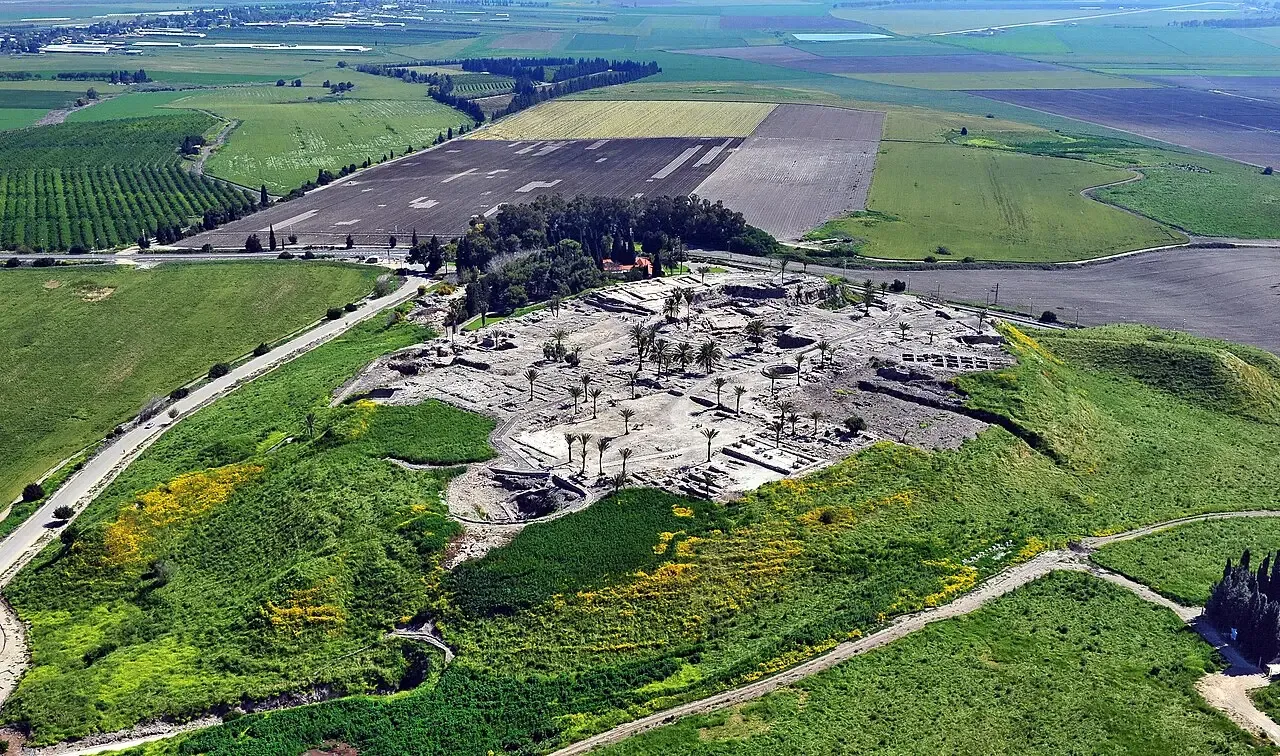
There were battles before Megiddo. Thousands of them, presumably — armies assembling in river valleys, city-states grinding against each other across the ancient Near East for centuries before 1457 BC. Smaller, less organised bands and tribes fought each other for millenia before that. We know almost nothing about any of them. What we have are ruins, arrowheads, the occasional mass grave. The Battle of Megiddo is different because a scribe named Tjaneni was present, kept notes, and had those notes inscribed on the walls of the Temple of Karnak at Thebes. The result is the first military engagement in history that can be reconstructed in something approaching operational detail: three possible routes of advance, a command decision that surprised both the enemy and his own generals, a battle, a siege lasting seven months, and a list of spoils exact enough to count the horses. Every military history written before this point is inferred. Here it is written down.
The occasion was a rebellion. Thutmose III had been Pharaoh of Egypt’s 18th dynasty since 1479 BC, though for the first twenty-two years of his reign he had been effectively sidelined by his co-regent and stepmother Hatshepsut, who ran the kingdom herself and kept him occupied with military apprenticeship rather than power. When Hatshepsut died, some time around 1458 BC, Thutmose finally ruled alone — and promptly discovered that the Canaanite city-states of the Levant, which Egypt nominally controlled, had formed a coalition under the king of Kadesh and were in open revolt. The coalition had assembled at Megiddo, a fortified city sitting astride the Jezreel Valley on the Via Maris, the coastal trade route linking Egypt to Mesopotamia. Control Megiddo and you control the road between continents.
Thutmose marched north from Egypt in the spring with an army of perhaps ten thousand men and reached Yehem, roughly twelve miles south of Megiddo, in about three weeks. There the advance stopped while the route forward was debated. Three roads led to Megiddo. Two were broad, predictable, and relatively safe: the western road through Djefti and the eastern road through Taanach, both circling around the Carmel Ridge. The third was the Aruna Pass — a narrow defile through the ridge that ran almost directly to Megiddo but required the army to march in single file for several kilometres, strung out and vulnerable to ambush. The Egyptian commanders made their position clear. The Aruna road was tactically insane. If the Canaanites stationed a force at the northern end of the pass, the army could not fight or retreat effectively. They recommended one of the longer routes.
Thutmose overruled them. He had assessed, correctly, that the Canaanite coalition was also thinking about those three roads, and had reached the same conclusion his generals had. The Aruna Pass was the one road any sensible commander would avoid. Therefore it was the one road through which a surprise was still possible. He took his army through the defile himself, at its head, with explicit instructions for the column to maintain close order and not to halt for any reason until the whole force was through and deployed on the other side. The Karnak Annals record that Thutmose emerged onto the plain near Megiddo at noon, that the column took several hours to clear the pass, and that no Canaanite force was waiting. The coalition had indeed concentrated its troops on the other two roads. The Egyptian army assembled unmolested on the plain, camped for the night, and attacked at dawn.
The battle on 16 April was over quickly. The Annals describe the Canaanite forces fleeing before the Egyptian charge, abandoning their horses and chariots and scrambling up the walls of Megiddo on ropes and improvised ladders — some sources specify that clothing was used to haul soldiers up who could not reach. The rout was complete, but the victory was not, because the Egyptian soldiers stopped to loot the enemy camp. Thutmose had the Canaanite coalition trapped in the open and failed to prevent Megiddo from being reinforced. The Annals record his frustration: had his troops not paused to plunder, the city would have fallen that day. Instead, the Egyptians dug a siege perimeter — a circumvallation the Annals describe as a ditch and a wooden wall — and settled in for seven months until starvation forced the city’s surrender in late 1457 BC.
The record of spoils compiled after the fall of Megiddo reads like an inventory: 340 living prisoners, 83 hands cut from the dead (the standard method of counting enemy casualties), 2,041 horses, 191 foals, 6 stallions, 1 chariot decorated in gold belonging to the King of Megiddo, 892 chariots belonging to his allies, 200 suits of armour, 502 bows, 7 tent poles of cedar “worked with silver.” The scribe who made this list was not composing propaganda. He was filing a quartermaster’s return. That specificity — the particular number of foals, the tent poles with their silver inlay — is what separates the Megiddo record from anything that came before it. The Egyptians were recording in order to administer. The battle happened to be part of the administration.
What the battle began could not have been anticipated from the field at Megiddo. Thutmose III would campaign in the Levant and Nubia for the next twenty years, leading seventeen more expeditions and pushing Egypt’s northern border all the way to the Euphrates River. By the time he died in 1425 BC, the Egyptian empire was larger than it had ever been. The king of Kadesh who had organised the Canaanite coalition had been defeated, his city-states brought to heel, their children sent to Egypt as hostages who would grow up in the Egyptian court and go home sufficiently Egyptianised to govern on Pharaoh’s behalf. The 17th century BC model of independent Canaanite city-states competing among themselves was over. For decades, they reported to Thebes.
The location was not accidental. Megiddo sat on the only practical pass through the Carmel Ridge for any army moving between Egypt and the north. Whoever held it controlled the Via Maris and therefore the movement of goods, armies, and information across the entire eastern Mediterranean littoral. This made it a recurring site of confrontation across the following three thousand years — Egyptians, Assyrians, Persians, Greeks, Romans, Crusaders, Ottomans, and the British under General Allenby in 1918 all fought in the vicinity of that valley. The Hebrew name for the site is Har Megiddo — the hill of Megiddo — which the Book of Revelation renders as Armageddon, the appointed location for the final war between good and evil. The place became synonymous with ultimate catastrophe not because a theologian invented the image, but because enough armies had converged there over enough centuries that it acquired the reputation through accumulation.
None of them left a record as detailed as Tjaneni’s. His Annals, inscribed on the walls of Karnak, survive well enough that the route of march, the command decision at Yehem, and the inventory of captured horses can be read today. Thutmose III did not think he was inaugurating military history. He was fighting a rebellion and keeping accounts. The scribe did the rest.