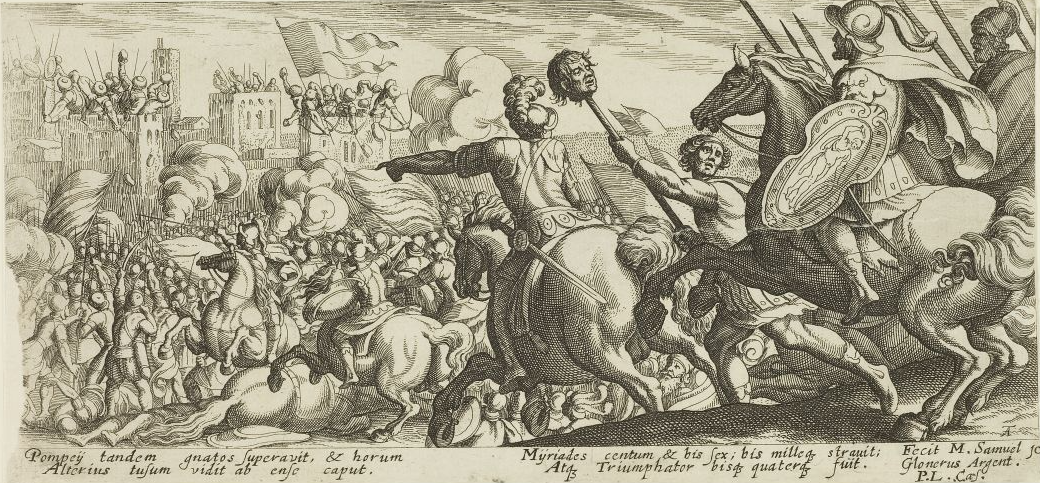
On 17 March 45 BC, Julius Caesar stood on a plain in southern Spain and told his men he would walk into the front line himself if they did not advance. He was fifty-five years old, the master of the Roman world, and the most decorated general of his generation. His legions were giving ground on a hillside held by thirteen Pompeian legions. According to the sources, he grabbed a shield from one of his retreating soldiers and made his way forward on foot. The line held. The fighting continued for another several hours. By evening, roughly 30,000 Pompeians were dead in the field, and Titus Labienus — once the finest officer in the Roman army, once Caesar’s own man — lay among them.
Caesar won. He said afterwards that he had fought many times for victory, but at Munda he had fought for his life. He preserved it this time, but he had only a year left.
The road to Munda was the road to the end of everything. Pompey the Great had been dead since 48 BC, drowned in a skiff off the Egyptian coast after Pharsalus. Cato had died at Utica. The conservative cause had been scattered at Thapsus in 46 BC, and its remnants had retreated to Hispania, where Pompey’s sons — Gnaeus and Sextus — reassembled the survivors, raised fresh legions, and prepared to fight one more time. They were joined by Titus Labienus, who had served Caesar through eight years of the Gallic Wars and defected to Pompey when the civil war began. Labienus knew exactly how Caesar fought, which made him uniquely useful to his enemies, and uniquely dangerous.
With his typical speed, Caesar covered the 2,400 kilometres from Rome to Hispania in under a month, arriving in December 46 BC. He spent the winter manoeuvring across southern Spain, taking towns, cutting supply lines, fighting skirmishes. The Pompeians, led by Labienus and Gnaeus Pompeius, knew better than to offer him a decisive engagement on ground of his choosing — they had all seen what happened at Pharsalus. But by early March, the situation had become untenable. Key cities were defecting. Soldiers were planning to desert. Gnaeus Pompeius broke camp and marched south to Munda.
The two armies met on 17 March. The Pompeians took the obvious position: their backs to the walls of the town, their line on slightly elevated ground, daring Caesar to attack uphill. Caesar, who had more cavalry and could not afford a long stalemate, obliged. His eight legions, among them the veteran Tenth, advanced across flat ground and up the slope into a Pompeian line that would not move. The Republicans fought with particular ferocity that day. Many of them had previously surrendered to Caesar and then rejoined the Pompeians, and they knew they would not be pardoned a second time. Caesar had executed prisoners after Thapsus. These men understood what defeat meant.
For eight hours neither side broke. This was the particular misery of civil war fought between professional armies trained in the same tradition and led by generals who had read the same manuals: both sides knew every trick, and neither could be surprised. Caesar later admitted that the moment came when his line wavered and he felt something he had not felt on a battlefield in decades — not the cold strategic calculation of a commander assessing odds, but something closer to fear. He dismounted and went forward on foot. Whatever its tactical effect, the gesture carried the psychological weight he needed from it.
The battle turned on a misreading. Gnaeus Pompeius, watching Caesar’s Tenth Legion push hard on his left wing, stripped a legion from his own right to reinforce it. Caesar’s cavalry, under King Bogud of Mauretania, saw the weakened flank and attacked. Labienus, commanding the Pompeian cavalry on that side, moved troops across to intercept them. The Republican infantry, watching their cavalry commander ride away from the line, drew the obvious conclusion: Labienus was retreating. The logic cascades quickly on a battlefield. The Pompeian legions broke. Within minutes, what had been an ordered line became a rout. Thirty thousand men died in the subsequent slaughter. All thirteen Pompeian standards were captured, the traditional mark of a destroyed army.
Labienus was killed in the rout and buried by Caesar’s order — the former general given a soldier’s dignity by the man he had spent four years trying to kill. Gnaeus Pompeius escaped the field but was hunted down and killed within weeks. Sextus Pompeius, youngest of Pompey’s sons, remained at large in the hills, but he had no army. After Munda, as Plutarch records, there were no more conservative armies left to challenge Caesar. The civil war that had begun when he crossed the Rubicon in 49 BC was over.
Caesar returned to Rome and celebrated a triumph. This was where the winning became complicated.
Plutarch writes that the triumph over Spain “displeased the Romans beyond anything.” Not a triumph over Gauls, not a victory over the Pontic king who was despatched in a phrase — veni, vidi, vici — but a public celebration of having destroyed the sons of Gnaeus Pompeius Magnus. Pompey, whatever his political failings, had been one of Rome’s own. He had triumphed three times, cleared the Mediterranean of pirates, and pacified the East. His children were Romans, fighting for what they believed was the Republic. Their deaths were not the kind of thing you paraded through the streets with a laurel wreath and a chariot. It felt like a family argument conducted at the cost of 30,000 corpses, and then turned into a party. The Roman people attended. They were not, from the accounts, entirely sure they should have.
Caesar became dictator for life. He announced plans to campaign against Parthia in revenge for Crassus, and against the Dacians on the northern frontier. He accepted honours that made men who respected republican forms uncomfortable — a golden throne in the Senate, a statue among the kings, a month renamed in his honour. Whether he wanted to become a king in fact, or whether he was simply moving through power the way he always had, without pausing to consider what it looked like from outside, nobody can say with certainty. His contemporaries could not agree either, and they were standing in the room.
What Munda had done, by eliminating the last military opposition, was remove the one justification that had always given Caesar’s extraordinary powers a certain political cover: the emergency. Dictators existed in the Roman tradition for precisely such moments — Cincinnatus leaving the plough to save the Republic, and then going back to the plough. The question nobody could answer, in the spring and summer of 44 BC, was when Caesar intended to go back to the plough. The senators who gathered in the Theatre of Pompey on 15 March drew their own conclusion. He was stabbed twenty-three times. The civil war that followed would take another fourteen years to settle, and when it did, the Republic was gone for good.
Caesar fought at Munda for his life and won. The last victory cleared the field. And when there are no more armies to fight, a general without a war is a question Rome was not willing to leave unanswered.