The conquest of India was built on a formula. Find a powerful regional ruler who has stayed independent. Form alliances with his neighbours, who resent him and would rather see him reduced than see him grow. Bring overwhelming force. Take the capital. Kill or capture the ruler. Install a compliant successor under a treaty of “subsidiary alliance,” which means you handle their foreign policy and station your troops on their territory, and they pay for the privilege. The details varied. The formula did not.
On 4 May 1799, General George Harris applied this formula to the Kingdom of Mysore, and it worked as intended.
The siege of Seringapatam - 5 April to 4 May 1799 - was the final act of the Fourth Anglo-Mysore War, and the fourth time in thirty years that Mysore and the East India Company had fought each other. The difference this time was that Tipu Sultan, who had ruled Mysore since 1782, had run out of room. The Third Anglo-Mysore War had already stripped him of half his territory. His efforts to find European allies capable of matching the British had come to nothing: the French were occupied in Egypt, and Napoleon’s plan to link up with Tipu via the Levant was cut short by Nelson at the Battle of the Nile in 1798. The Marathas and the Nizam of Hyderabad - former rivals who might have been expected to show Mysore some solidarity - chose instead to join the British side. Harris’s combined force of over 50,000 men, which included Arthur Wellesley commanding a reserve column, had Tipu’s 30,000 defenders outnumbered before a shot was fired.
The siege lasted a month. The British batteries worked at night to avoid counter-fire, and by 2 May had opened a practicable breach in the north-west wall of the fortress. Tipu knew the position was untenable. His French military advisers reportedly told him to escape through secret passages and continue the fight from other fortifications. He refused. He had said as much, in a phrase that sounds better in translation than most things said about him since: “Better to live one day as a tiger than a thousand years as a sheep.”
The assault came at midday on 4 May - deliberately timed for the hottest part of the day, when the defenders would be taking refreshment and least expecting an attack. Two forlorn hopes of seventy-six men led the charge. The columns crossed the River Cauvery in water four feet deep, scaled the ramparts, and were inside the walls within sixteen minutes. What made this speed possible was betrayal. Tipu’s own chief minister, Mir Sadiq, had been bought by the British. He withdrew the troops guarding the breach under the pretext of paying them at the exact moment the assault began, and is said to have signalled the waiting British with a white handkerchief. There was a man to be killed for treachery on each side of those walls that afternoon. Mir Sadiq was cut down by Tipu’s own soldiers once his role became clear.
Major General David Baird led the storming party - a man with a particular motivation, having spent forty-four months as Tipu’s prisoner after the Battle of Pollilur nineteen years earlier. The columns swept along the inside of the walls and turned to meet each other. By evening, the city was taken.
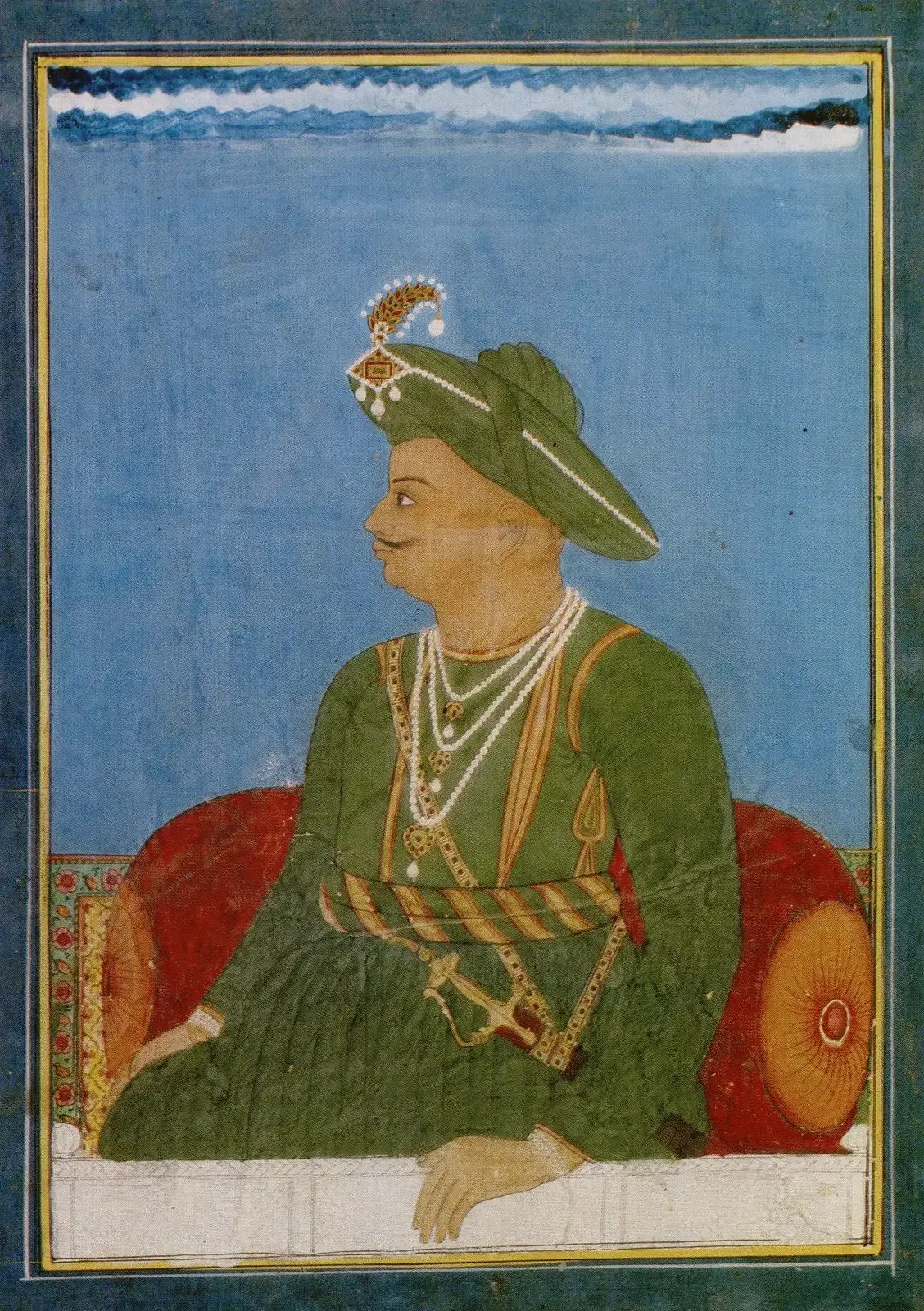
In the gathering dusk, British officers went looking for Tipu’s body. They found him near the Water Gate, identified as the officer who had been firing hunting weapons at the attackers until the end. He was forty-seven years old. Benjamin Sydenham, who examined the body, noted four wounds and described him as “rather corpulent,” with “large full eyes” and an appearance that “denoted him to be above the Common Stamp.” He had lost his turban. There were no weapons near him. When General Harris was told, his response was plain: “Now India is ours.”
It was a reasonable assessment. Tipu Sultan was not the most powerful ruler in India, but he was the last one with the combination of military competence, diplomatic energy, and personal stubbornness to actually resist British expansion rather than accommodate it. He had fought the Company to a draw in the Second Anglo-Mysore War, forcing the Treaty of Mangalore in 1784 - one of the very few treaties in which the Company accepted unfavourable terms. He had modernised his army and pioneered the use of iron-cased rockets with a range of up to two kilometres. The British later copied the technology for use in the Napoleonic Wars as the Congreve rocket. He had sent embassies to France, the Ottomans, the Afghans, and the Afghans’ neighbours. None of it was enough.
The Wodeyar dynasty - the original Hindu rulers of Mysore whom Tipu’s father Hyder Ali had displaced in 1761 - was restored to the throne through a treaty of subsidiary alliance. Krishnaraja Wodeyar III, a child, was crowned king. The British retained control of Mysore’s external affairs and stationed their troops in the kingdom at Mysore’s expense. The formula was complete.
Arthur Wellesley, who commanded the reserve column and was subsequently appointed governor of the captured city, went on to apply what he learned in India at Assaye in 1803, at Salamanca in 1812, and at Waterloo in 1815. Seringapatam was his education.
Bernard Cornwell put a fictional soldier named Richard Sharpe inside those walls for Sharpe’s Tiger, published in 1997. Sharpe is a private who fights through the assault, witnesses the betrayal, and ends up at the Water Gate when Tipu dies. It is a good novel about a real battle, and Cornwell is honest enough about the history to render the conquest with its actual texture - the formula, the allied Indian powers, the treachery, the overwhelming force, the dead ruler found in the dark. The history needs no embellishment. What the novel provides is a human-scale perspective that casualty figures and troop dispositions struggle to supply: a pair of boots on the ground rather than lines on a map.
“Now India is ours.” Harris said it standing over a dead man by a gate in the failing light. It took another hundred and forty-eight years and two world wars before that assessment expired.