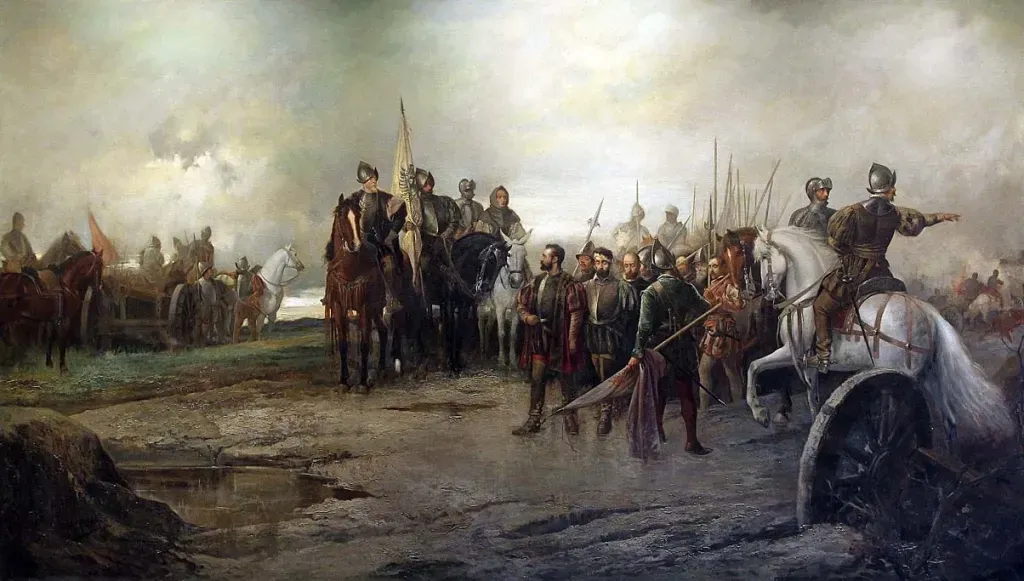
The field at Villalar on the morning of 23 April 1521 was wet. It had rained through the night and kept raining into the battle. The Comunero infantry, cold and badly fed, with powder soaked through, arrived in no condition to fight. The royalist cavalry under the Constable of Castile caught them strung out along a muddy road and broke them in under an hour. Juan de Padilla, Juan Bravo, and Francisco Maldonado - the three captains the rebel towns had entrusted with their army - were taken alive. The next morning, on a makeshift scaffold in the village square, all three were beheaded. Padilla reportedly told Bravo, just before the axe came down, that this was the day they would earn the name of knights. It may or may not have been said. What was unambiguously true was that their execution ended the most serious domestic threat to Habsburg rule in Spain for the next two centuries, and that it had come within a hair of going the other way.
The king they were fighting was seventeen when he landed at Villaviciosa on the Asturian coast in September 1517. Charles of Ghent - later Charles I of Spain and Charles V of the Holy Roman Empire - was the grandson of Ferdinand of Aragon on one side and the Emperor Maximilian on the other. His mother, Joanna, was the reigning queen of Castile, confined at Tordesillas on grounds of mental illness that were always more convenient than medically established. His father, Philip the Handsome, had died eleven years earlier. Charles was, on paper, the joint sovereign of Castile alongside his mother, and the sole king of Aragon after Ferdinand died in 1516. He had not set foot in the country until he was sixteen. He spoke Flemish and French. His Castilian was, by every contemporary account, essentially nonexistent.
This mattered more than might be obvious. The Castilian elite had spent the years since Isabella’s death in 1504 running the country with minimal supervision, under regencies first of Ferdinand and then of Cardinal Cisneros. They were not particularly looking for a king. They were certainly not looking for a Flemish teenager surrounded by a retinue of Burgundian courtiers who treated the highest offices of Spain as their personal patronage pool. Within months of arrival, Charles had handed the Archbishopric of Toledo - the richest see in Christendom - to Guillaume de Croÿ, a twenty-year-old Flemish nephew of his chief minister, who did not speak Spanish, had never been to Spain, and would not reside in his diocese. The Chancellorship went to Jean le Sauvage, another Fleming. The King’s closest adviser, William de Croÿ the elder, Lord of Chièvres, ran policy and was widely believed to be running it chiefly for the enrichment of himself and his countrymen. The Castilian towns noticed. The Cortes, summoned at Valladolid in 1518 to recognise Charles as king, did recognise him, but also presented a long list of grievances about foreign office-holding that the court politely received and ignored.
Then, in January 1519, Maximilian died, and the Imperial election was open. Charles wanted the Empire. So did Francis I of France. So, briefly, did Henry VIII of England. The contest was decided by seven German electors who expected to be paid, and Charles paid them handsomenly - something in the region of 850,000 florins, most of it borrowed from the famous Fuggers of Augsburg against the security of his Spanish revenues. He was elected in June 1519. He now had to go to Germany to be crowned, and he needed Spain to fund the trip and the Imperial administration that would follow. In March 1520, he summoned the Cortes to Santiago de Compostela and La Coruña - deliberately chosen cities in the far northwest, distant from the main centres of urban opposition - and demanded an extraordinary grant of taxes. The deputies who voted in favour were, by several accounts, bribed. The ones who resisted were pressured, threatened, or replaced. The grant was approved. Charles sailed for Germany in May. He left as regent the Cardinal Adrian of Utrecht - another Fleming, his former tutor, later Pope Adrian VI, and an able man who was nevertheless the worst possible choice of face to present to a country already furious about foreign rule.
The revolt began in Toledo before Charles’s ship had even left Spanish waters. Juan de Padilla, a young nobleman of the city, took control of the municipal government in May 1520 and expelled the royal officials. Segovia followed within days, with Juan Bravo leading the rising and the corregidor hanged from a tree. By July, most of the major cities of central Castile - Toledo, Segovia, Salamanca, Ávila, Burgos, Zamora, Valladolid - had risen, expelled the royal authorities, and formed a federation they called the Santa Junta. They met first at Ávila, then at Tordesillas, where they attempted to persuade Queen Joanna to assume her legal powers and govern in place of her absent son. Joanna, characteristically, refused to sign anything. Whether from genuine illness or considered judgement, she would not repudiate her son. The rebels lost their single most valuable constitutional argument. They continued without it.
What they wanted, at the outset, was not unreasonable and not even particularly radical. They wanted foreign office-holders removed. They wanted the King to reside in Spain. They wanted the extraordinary taxes cancelled. They wanted the Cortes reformed so that its deputies could not be bribed or overruled. Read in isolation, the programme of the Santa Junta of 1520 looks less like a revolution and more like a constitutional petition, and that is how most of its urban backers understood it. What turned it into a war was the unwillingness of Charles to concede any of it while he was trying to finance an Imperial coronation, and the unwillingness of the grandees of Castile - the high nobility, whose estates had been systematically encroached upon by royal power for a generation - to back a movement that, the longer it lasted, sounded increasingly like a threat to their own position as well.
That shift is what killed the Comuneros. Through the autumn of 1520, the movement had been broadly cross-class. By early 1521, it was bleeding nobles. The grandees had noticed that Comunero rhetoric was moving from anti-Flemish to anti-seigneurial, that peasants on some great estates had begun refusing rents on the grounds that the lords were tyrants, and that a general redistribution of privileges was being floated. The royal court wasn’t idle either. The Admiral of Castile and the Constable of Castile - Fadrique Enríquez and Íñigo Fernández de Velasco - had been appointed co-regents by Charles from Germany to reinforce Adrian. They were Castilian, they spoke the language, they were visibly present, and they held the purse strings of the great noble houses. Through the winter, they bought defections, raised a royalist army, and waited for the rebel coalition to fracture. It did.
By April, the Comunero army under Padilla was down to perhaps seven thousand men, poorly equipped, with pay chronically in arrears, and it was retreating from Torrelobatón toward Toro when the royalists caught it at Villalar. The fight was short. A thousand Comuneros were killed or captured. The royalist losses were negligible. The rebellion did not formally end that day - Toledo held out under Padilla’s widow, María Pacheco, until October, and the parallel Germanías revolt in Valencia ran on into 1523 - but the back of it broke on the wet road between Torrelobatón and Toro. Within eighteen months, every major Comunero city had come to terms.
The execution of Padilla, Bravo, and Maldonado the next morning was the kind of thing that fixes a movement in memory better than success would have done. Three captains, beheaded in a row, having lost a battle that had been as much bad weather and betrayal as royalist skill, became the sort of martyrs that later Spanish liberalism would find useful. The modern autonomous community of Castile and León commemorates Villalar each 23 April as its regional day - an inversion almost comic in its cheek, turning a royalist victory over urban rebels into a celebration of Castilian identity against a distant centralising power. The lesson the nineteenth century took from the Comuneros was that Spain had, briefly, entertained the idea of a constitutional monarchy governed by urban representatives, and that the idea had been crushed. That reading flattens a lot of the messier reality - the rebels were not republicans, the towns were not democracies, Joanna was not a viable alternative - but it is not entirely wrong either.
What Villalar preserved was specifically the rule of Charles V in Spain, and it preserved it at exactly the moment when losing would have cost him everything. In April 1521, Charles was in Worms, about to outlaw Martin Luther. In May 1521, his forces invaded French-held Navarre. In 1525, his armies captured Francis I at Pavia. None of that happens if Castile does not fund it. None of that happens if the Santa Junta wins. The most powerful reign of the early modern period, the empire on which the sun did not set, the century of Spanish hegemony that followed - all of it hung, for a few months, on whether a federation of Castilian towns could force a Flemish teenager to come home and govern from Toledo in Spanish. The towns lost on a muddy field outside a village almost nobody had heard of before and nobody remembers now except on one day a year.
It rained the whole day. The powder was wet. The captains were beheaded. The empire continued.