On 10 August 1869, the Albany and Susquehanna Railroad received what its president, Joseph H. Ramsey, had been dreading: a train from the Binghamton end of the line carrying several hundred men equipped with clubs, axe handles, and related implements. Ramsey had sent his own train in the other direction, similarly provisioned. The two trains met near the Belden Hill Tunnel in Broome County, New York - a 2,240-foot bore through solid rock - and the occupants proceeded to attack each other with considerable enthusiasm. It took the 44th Regiment of the New York State Militia to stop it. This was how a corporate takeover worked in 1869.
The prize was a 142-mile railroad from Albany to Binghamton, completed in January 1869, running along the Susquehanna River valley through upstate New York. The geography concealed one significant commercial fact: the line connected the coal fields of north-eastern Pennsylvania to New England markets. Whoever controlled the Albany and Susquehanna controlled that flow of coal. Jay Gould, who with his partner James “Diamond Jim” Fisk already owned the Erie Railroad, understood this immediately.
Gould and Fisk were, by the summer of 1869, already notorious for a particular style of railroad finance: stock manipulation, bribery, and court orders obtained from compliant judges combined into a reliable method of acquiring things that didn’t belong to them. Three years earlier, in the Erie War, they had fought off a takeover bid by Cornelius Vanderbilt using printed share certificates, suitcases of cash, and a midnight flight across the Hudson River to New Jersey to escape arrest. It had worked. The Albany and Susquehanna looked like a similarly tractable problem.
They began buying shares quietly in the summer of 1869. Ramsey noticed and reacted: he issued to his supporters thousands of shares sitting unused on the company’s books, diluting Gould and Fisk’s stake before they could consolidate it. Then - and this detail appears nowhere in orthodox financial history - he had the company’s ledgers removed from his office and buried in the Albany Cemetery. Gould, working through Judge George G. Barnard of the New York State Supreme Court, had Ramsey suspended as president and several directors arrested on fabricated charges. Barnard’s rulings had a reputation for availability at competitive rates. Fisk personally led a group of hired men to storm the A&S headquarters in Albany. An A&S employee disguised as a policeman arrested him and took him to a genuine police station. Fisk obtained a fresh restraining order from Barnard, assembled a new contingent of hired thugs, and returned to take the building.
Fisk then seized the A&S station at Binghamton, commandeered a train, and set off toward Albany, his men taking over stations as they went. A&S employees flipped a switch to derail the cars somewhere along the route. The cars were recovered. Both sides assembled their reinforcements, loaded them onto trains, and sent them at each other. The trains met near the Belden Hill Tunnel - the same tunnel the A&S had spent four years boring through Belden Hill, which gave the line its connection to the coal country - and the men inside poured out to fight.
Contemporary accounts described it as a “railroad war,” which is accurate enough as descriptions go. These were not soldiers and the fighting was not organised. Several hundred men, mostly dregs of New York streets, swinging clubs and throwing rocks at a tunnel mouth in Broome County is not a battle in any formal sense. Injuries were recorded; nobody seems to have died in the main encounter. The 44th Regiment arrived and stopped it. The Belden Tunnel reverted, temporarily, to being a tunnel.
John Pierpont Morgan arrived shortly after - representing Ramsey’s side, though by rather different means. Morgan had arranged a $500,000 mortgage on the A&S and held a position as trustee. He appeared in New York on 1 September 1869, bought 600 additional shares in the name of his firm, and spent the following days contacting every shareholder loyal to Ramsey to ensure they or their proxies appeared at the company’s annual meeting in Albany on 7 September. Morgan supervised the voting in person. His slate won. Gould and Fisk voted in their own men in a competing election held simultaneously in the same room. The New York State Supreme Court - a different judge this time - ruled in Ramsey’s favour. In February 1870, Morgan leased the entire A&S to the Delaware and Hudson Canal Company for 99 years, removing it permanently from play.
The episode is a compact illustration of what the Gilded Age meant in practice. Its great financiers did not merely buy railways; they bribed judges, blatantly manipulated shares, and when those methods stalled, dispatched trainloads of armed thugs to fight at tunnel mouths. Gould’s appetite for this kind of manoeuvre was well documented - in September 1869, just weeks after the tunnel brawl, he and Fisk attempted to corner the entire American gold market, triggering a financial collapse known as Black Friday - and none of it seriously damaged their standing in a financial world that had its own ideas about acceptable behaviour. The A&S affair ended with the right side winning partly by luck: Ramsey buried the books; Morgan arrived in time; the militia outranked the clubs.
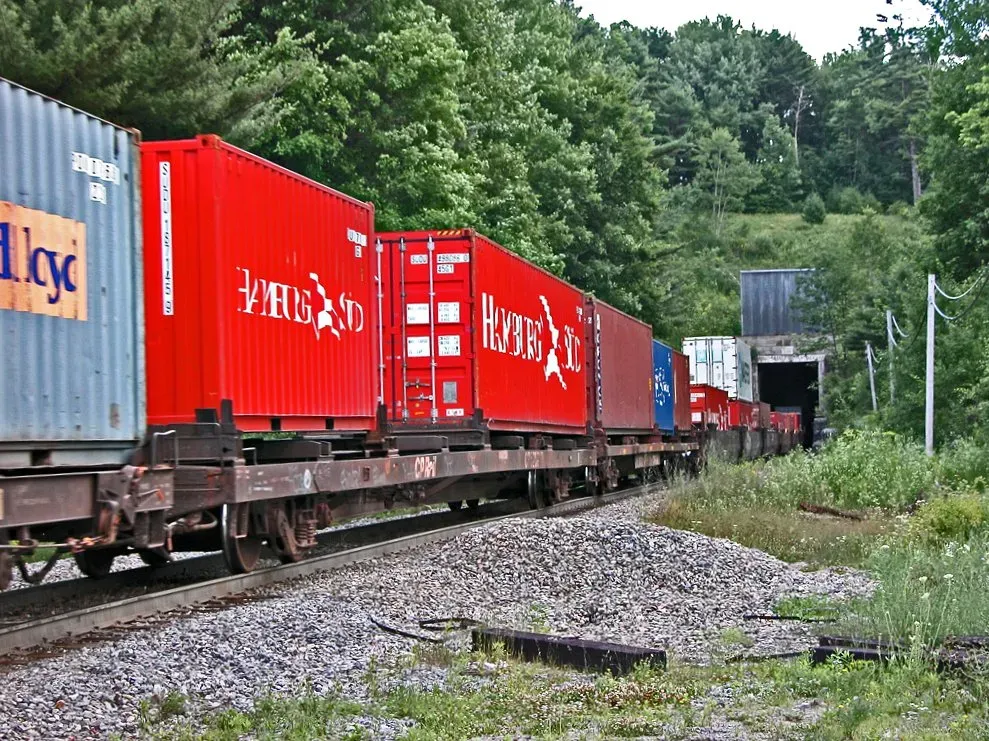
The Belden Hill Tunnel is still in service, now under Norfolk Southern, carrying freight that has nothing to do with 1869 coal. The hamlet at its west portal is still called Tunnel, after the workers who dug it. There is no plaque commemorating the moment when American capitalism decided to settle a shareholder dispute with axe handles. That, too, feels appropriate. The Gilded Age preferred not to be too specific about its methods.