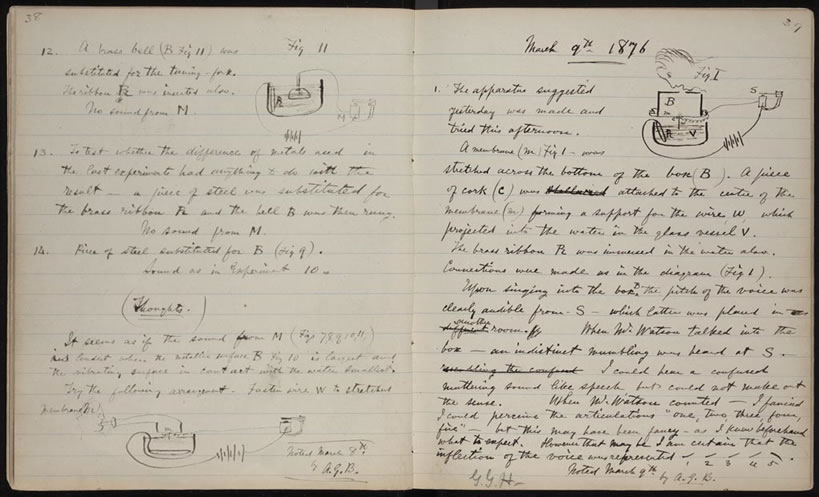
On 10 March 1876, in a room above the Palace Theatre at 109 Court Street in Boston, Alexander Graham Bell spoke into a device connected by wire to a second room where his assistant Thomas Watson was listening. The words were: “Mr. Watson — come here — I want to see you.” Watson came. Bell wrote in his laboratory notebook that Watson “declared that he had heard and understood what I said.” That was it. Not a speech, not a demonstration, not a public event — just two men in adjacent rooms and a sentence that happened to travel between them as electricity.
Bell was twenty-eight years old and had arrived at this moment by an unusual route. His father, Alexander Melville Bell, was a professor of elocution who had spent decades producing a system called Visible Speech — a notation for representing every sound the human vocal apparatus could make, which he intended as a tool for teaching the deaf to speak. Bell had grown up immersed in the mechanics of the voice, how the lips, tongue, and throat combined to produce particular frequencies. When he moved to Boston in 1871 to train teachers of the deaf, and then took up a professorship in vocal physiology at Boston University in 1873, the telephone came out of that — not from an interest in electrical engineering, but from a question about whether the undulating patterns of human speech could be converted into undulating electrical current and back again. The acoustic telephone had existed for centuries in the form of the tin-can-and-string toy. Bell’s goal was to do the same thing with electrons.
He was not alone in the ambition. On 14 February 1876 — three and a half weeks before the experiment on Court Street — both Bell’s lawyer and Elisha Gray’s lawyer appeared at the United States Patent Office in Washington with claims to a telephone. Gray arrived first; his caveat (a preliminary notice of intent) was placed in the in-basket early that morning. Bell’s application, filed by his lawyer closer to noon, was taken directly to the examiner and had its fee recorded first. Gray’s caveat sat at the bottom of the stack until the following afternoon. That sequence — Gray first through the door, Bell first on the ledger — produced one of the great patent disputes in American history. The problem was compounded by the application itself: seven sentences describing a variable resistance transmitter, the method depicted in Gray’s caveat, appear in Bell’s filing in a form that was not in Bell’s earlier drafts. Whether they were there when Bell sent his draft to his lawyers, or were inserted just before filing, has been argued in books and court cases ever since. Bell was granted US Patent No. 174,465 on 7 March 1876 — three days before the first successful test proved his invention actually worked.
What followed happened fast. The Bell Telephone Company was formed in 1877, with Bell holding a third of the shares. The first telephone exchange opened in New Haven, Connecticut, in 1878 with twenty-one subscribers. By 1880, there were roughly 150,000 telephones in use across the United States. Bell, who had been a schoolteacher, became extraordinarily wealthy. In 1880 the French government awarded him the Volta Prize — 50,000 francs for the telephone — and he used the money to set up the Volta Laboratory in Washington, where he continued research into communication and acoustic science, and eventually into techniques for teaching speech to blind-deaf children. He worked with Helen Keller later in his life, an echo of his original vocation. In 1885 he bought land in Nova Scotia and spent his summers there doing experiments, mostly in aviation — kites, tetrahedral structures, heavier-than-air flight. He died in 1922, on Cape Breton Island, having lived long enough to see his two-room experiment become a system carrying hundreds of millions of conversations a day.
The telegraph had already, by 1876, compressed the world considerably: a message could cross an ocean in minutes rather than weeks. But a message was text. It required a trained operator at each end, a code, a translation. The telephone removed all of that. The voice you sent was the voice that arrived — your pitch, your hesitation, the way you said a name. No encoding, no intermediary, no delay. Every communication technology since — radio, television, mobile telephone, video call — has drawn on the same basic proof that Bell and Watson established in those two rooms: that the specific character of a human voice can be captured, transmitted as a signal, and reconstructed intact somewhere else. It is worth occasionally stopping to find this remarkable, because it is. When Bell spoke those six words, the idea that a voice could leave a body and travel down a wire was not a known thing. By the time he wrote it in his notebook that evening, it was.