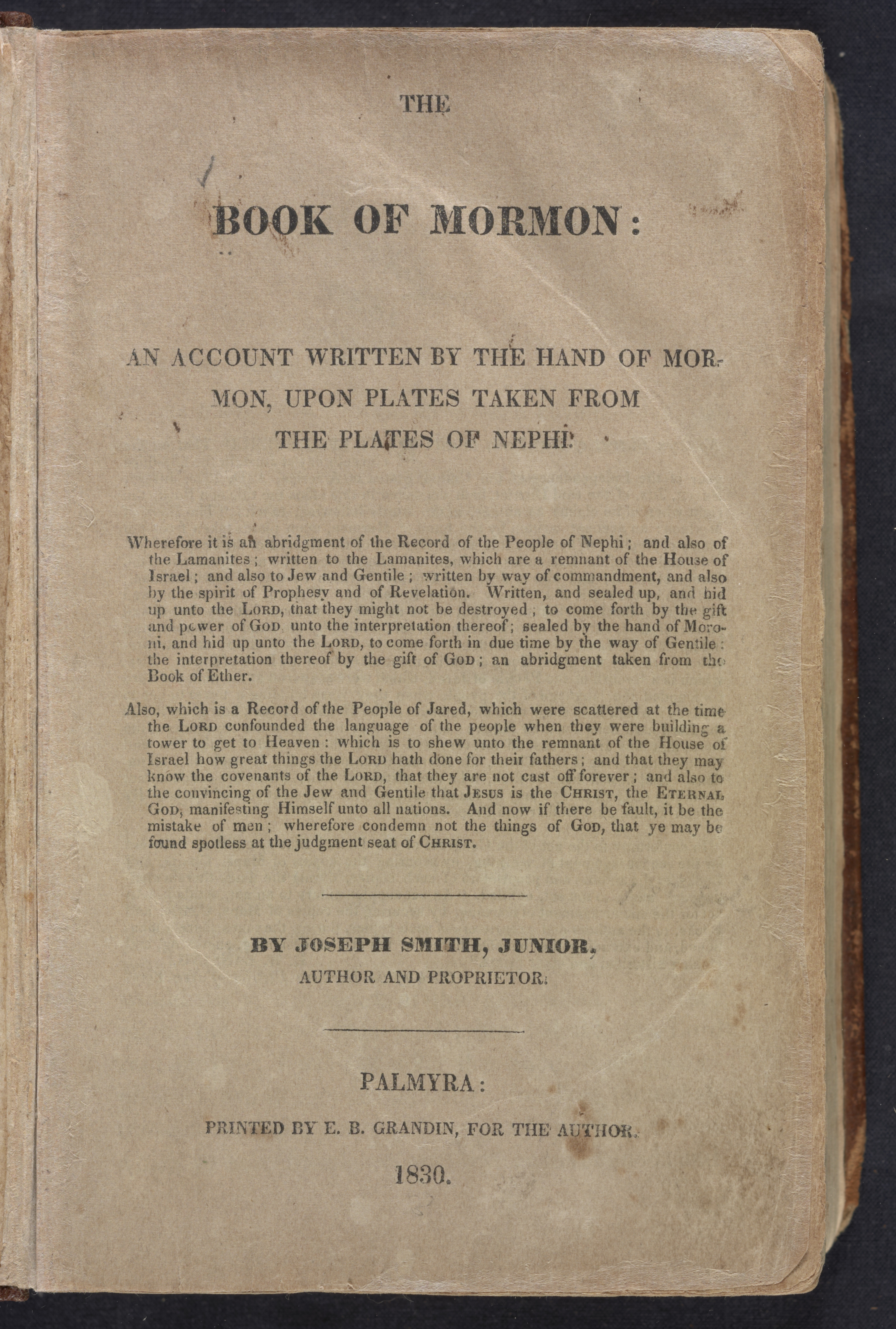
On 26 March 1830, a bookshop in Palmyra, New York, began selling a 588-page text claiming to be the translated record of an ancient civilisation - one that God had led out of Jerusalem around 600 BC and settled somewhere in the Americas. The Book of Mormon, printed by a local publisher named E.B. Grandin in a first run of 5,000 copies funded by a neighbouring farmer called Martin Harris, was by any measure an extraordinary object. The man who produced it, Joseph Smith Jr., said he had translated it from golden plates buried in a hillside in upstate New York, using a pair of clear seer stones set in a metal frame. In practice, for the bulk of the dictation, he dropped a single brown seer stone into a hat, pressed his face into the hat to block the light, and spoke strings of words to a scribe sitting on the other side of a curtain. The plates, he said, were removed by the angel Moroni upon the book’s completion.
Mark Twain, who read it decades later, called it “chloroform in print.” The verdict of the famous writer did not slow things down.
The world that produced the Book of Mormon was not a sceptical one. The 1820s and 1830s were the height of the Second Great Awakening - a wave of evangelical revivalism that swept across the young United States, filling camp meetings with thousands of converts, spawning dozens of new sects, and persuading large numbers of Americans that God was still actively intervening in history. Western New York, where Smith grew up, was so thick with competing revivals and prophetic claims that it earned the name “the Burned-over District.” Smith was not operating in a vacuum. He was working with materials his culture had provided and directing them toward conclusions that were genuinely new.
The text itself is strange. Written in an imitation of King James Bible English - complete with “it came to pass” appearing hundreds of times - it describes roughly a thousand years of civilisation in the Americas, centred on a family of Israelites who sailed from the Middle East around 600 BC and multiplied into two opposing nations: the righteous Nephites and the darker-skinned Lamanites. The climax of the narrative is a post-resurrection appearance by Jesus Christ in the Americas, in which he delivers teachings that closely parallel the New Testament. The whole thing is presented as a record compiled by a narrator named Mormon and completed by his son Moroni - the same angel who, Smith claimed, had directed him to the buried plates in 1823. The book presents itself as a complete circuit: divine instruction leads to the discovery of a record that explains why that instruction was necessary.
Historians and archaeologists have spent nearly two centuries looking for evidence of the civilisations it describes. No genetic link connects Native Americans to the ancient Near East. No archaeological site corresponds to Book of Mormon locations. The book refers to horses, steel, wheat, and chariots in pre-Columbian America - none of which the evidence supports. The language it claims to be translated from, “Reformed Egyptian,” does not exist in any known record. The mainstream position among scholars outside the Latter Day Saint movement is that the Book of Mormon is a nineteenth-century composition that reflects nineteenth-century American preoccupations: the mound-builder mythology that explained Native American earthworks, the theological disputes of the Second Great Awakening, the anxieties of Jacksonian-era class inequality. The text reads, in short, like a product of its time, because it almost certainly was.
What makes the story interesting is not the text itself but what happened next. Smith founded the Church of Christ eleven days after the book went on sale, on 6 April 1830, with a handful of followers in upstate New York. Within a decade it had thousands of members. Within two decades it was a significant American institution. It was also a source of constant controversy. Smith introduced polygamy - secret at first, then increasingly open, eventually with a written revelation that he said God had delivered in 1843 - re-establishing a practice that mainstream Christianity had not sanctioned since late antiquity. The resulting scandals drove the church from New York to Ohio, from Ohio to Missouri, from Missouri to Nauvoo, Illinois, where a mob shot Smith dead in June 1844.
After his death, Brigham Young led the largest faction of his followers west across the continent. They arrived in the Salt Lake Valley in 1847 and turned it into a functioning theocracy. The church officially abandoned polygamy in 1890, under sustained federal pressure and with the considerable incentive of Utah statehood on the table. The revelation authorising polygamy had arrived in 1843; the revelation rescinding it arrived, conveniently, in 1890. Utah became a state in 1896. Several splinter groups refused to accept the change and carried on practising plural marriage. The Fundamentalist Church of Jesus Christ of Latter-Day Saints, the most visible of these, eventually produced Warren Jeffs, convicted in 2011 on two counts of child sexual abuse.
The main church, today called the Church of Jesus Christ of Latter-day Saints, has approximately 17 million members worldwide. It runs nearly 70,000 missionaries in 407 missions. The Book of Mormon has been translated into 112 languages and over 192 million copies have been printed. The Tabernacle Choir at Temple Square fills arenas. Mitt Romney, a member of the church, ran for US president twice. Lin-Manuel Miranda co-wrote a Tony-winning Broadway musical mocking the enterprise, and the church responded by running adverts along the lines: “You’ve seen the play… now read the book.”
The Book of Mormon’s survival is, on its own terms, remarkable. It arrived in a country in the grip of a religious frenzy and outlasted the frenzy, the founding prophet, the doctrine of polygamy, decades of federal persecution, and the complete failure of its historical claims to withstand scrutiny. What it offered was apparently durable enough to survive all of that: a sense of divine participation in American history, a community of uncommon cohesion, and a theology built to keep updating itself without quite admitting that it is doing so. On 26 March 1830, a strange book went on sale in upstate New York. It is still going.