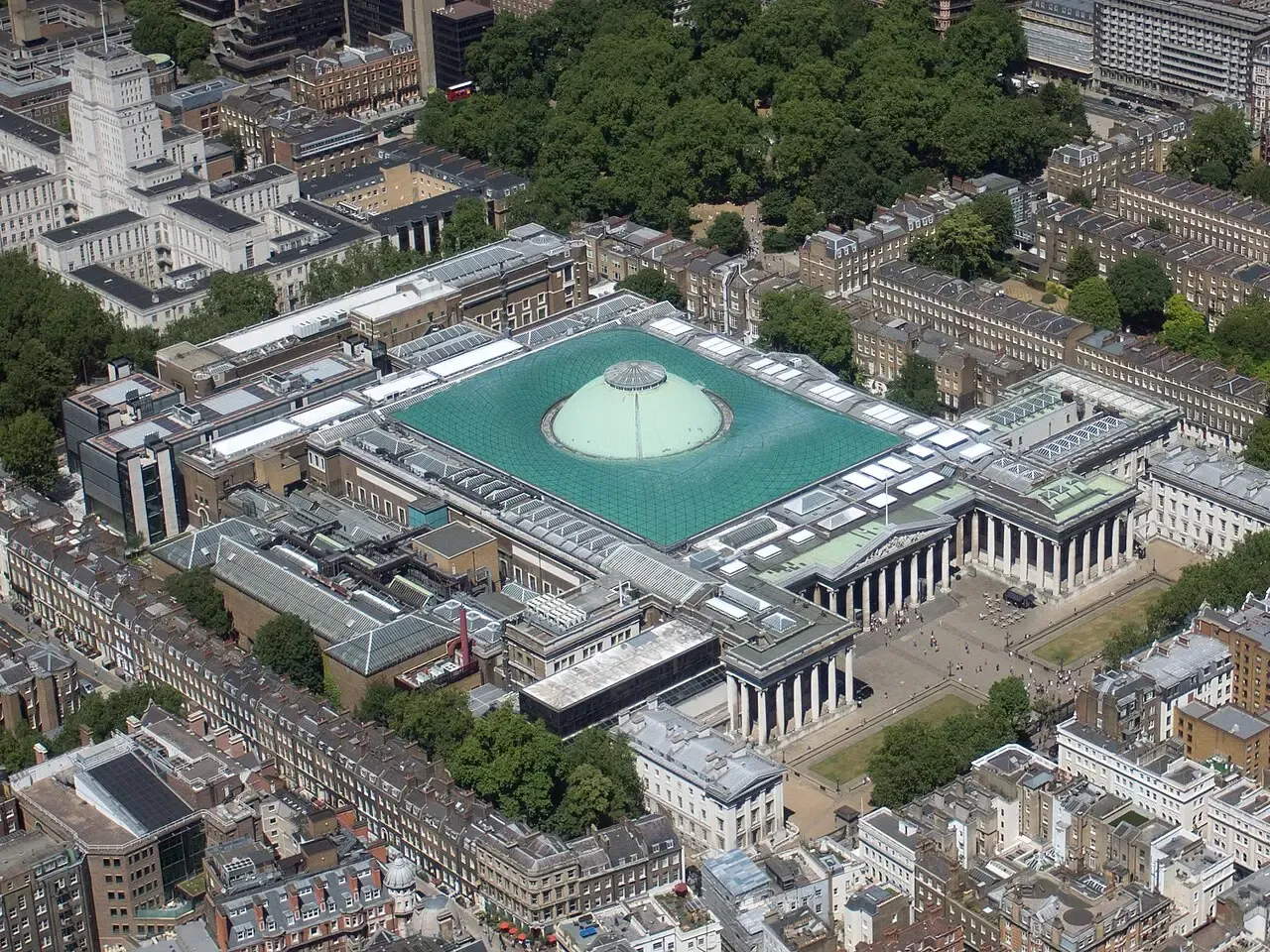
On 15 January 1759, Montagu House in Bloomsbury, London, opened its doors to the public for the first time. The institution it housed was called the British Museum, and the tickets required to enter - obtained by written application, processed over three days, issued in numbered batches - were not quite the egalitarian welcome the founding legislation had promised. “Studious and curious persons,” the British Museum Act of 1753 specified. In practice this meant educated men with the time and connections to navigate the application system, and the literacy to write the request in the first place. The working population of London did not queue. The museum was, from its first day, an institution with a gap between its ideals and its actual clientele.
That gap has never entirely closed, though it has narrowed. Today the British Museum admits over six million people a year, charges nothing to enter, and holds around eight million objects - roughly two million of which are accessible through a searchable online database. By any measurable standard it is one of the most successful public institutions in the world. The fact that a large share of those eight million objects were acquired under conditions its current staff would not endorse is the argument that has dogged it for decades and shows no sign of resolution.
The collection began with Hans Sloane. A physician who served as personal doctor to the Governor of Jamaica in the 1680s, Sloane returned from the Caribbean with 800 plant specimens and a taste for systematic collection that he pursued for the rest of his seventy-year medical career. By the time he died in 1753 at the respectable age of ninety-two, the collection had reached 71,000 items: manuscripts, coins, natural history specimens, antiquities, anatomical curiosities, ethnographic objects brought back from every corner of the world the British were then entering by force. He valued it at £80,000 and offered it to the crown for £20,000. Parliament bought it, funded the purchase through a public lottery, and passed the British Museum Act in the same year. The resulting institution was the world’s first national public museum - publicly funded, freely accessible in principle, and already, in its founding collection, entangled with empire.
The entanglement deepened as the collection grew. The Rosetta Stone arrived in 1802, seized from the French under the Capitulation of Alexandria after Napoleon’s Egyptian campaign failed. The Parthenon Marbles came between 1801 and 1812, removed from the Athenian Acropolis by Lord Elgin, then British ambassador to the Ottoman Empire, which technically controlled Athens but had no particular interest in its rubble. The Benin Bronzes were taken in 1897 during a punitive British military expedition that sacked the royal palace of the Kingdom of Benin in present-day Nigeria, left the palace burned, the king in exile, and the royal collection in British hands. These are not peripheral acquisitions. They are among the most visited objects in the museum.
The building that houses them - the Greek Revival structure Sir Robert Smirke designed from 1823 onwards, with its colonnade of forty-four Ionic columns - is itself a statement of some audacity. A building in the style of ancient Greece, housing sculptures taken from ancient Greece’s most famous monument, was either an act of remarkable cultural confidence or a failure to notice the obvious. Smirke was not a man given to irony. The circular Reading Room where Karl Marx researched Das Kapital while living in poverty in Soho was added in 1857. The Great Court, with its steel-and-glass roof enclosing what became Europe’s largest covered public square, opened in 2000. The museum keeps building. The arguments about what it contains do not simplify with the renovations.
The repatriation debate has reached a point where all sides have refined their positions into something approaching theology. Greece wants the Parthenon Marbles. The British Museum says it cannot legally deaccession them under the British Museum Act 1963, and that London provides a wider context. Greece says it can provide that context better, in Athens, five hundred metres from where the sculptures stood for two thousand years. Nigeria has requested the Benin Bronzes; the University of Aberdeen returned its single piece in 2021, and several German museums have followed, but the British Museum’s trustees have not. Egypt has been asking for the Rosetta Stone since 2003. The museum’s standard response - that objects must be viewed in the light of the values of the era in which they were acquired - is both technically accurate and the kind of argument that tends to convince only those who already agree.
What cuts through this, when you actually visit, is that the museum is extraordinary. The collection is genuinely staggering in its range: the Sutton Hoo helmet, the Lewis Chessmen, the Lindow Man, the clock collection - and those are just the things that mostly did not travel far to get there. To walk through the rooms is to understand that no single country’s history contains the whole story of human civilisation, and that an institution where you can move between continents and centuries within the space of an afternoon has a genuine claim on people’s time. The Enlightenment argument - that knowledge, gathered together and made available, serves everyone - is not wrong. It is simply incomplete as a description of how the knowledge got there.
The doors opened in January 1759 with a queue of studious and curious persons who had written ahead and waited three days for their tickets. Entrance is free now, which is something - a country that charges nothing to stand in front of the Elgin Marbles is not entirely without principle. The argument about where the marbles should be standing, however, has prorbably a rew more centuries left to run.