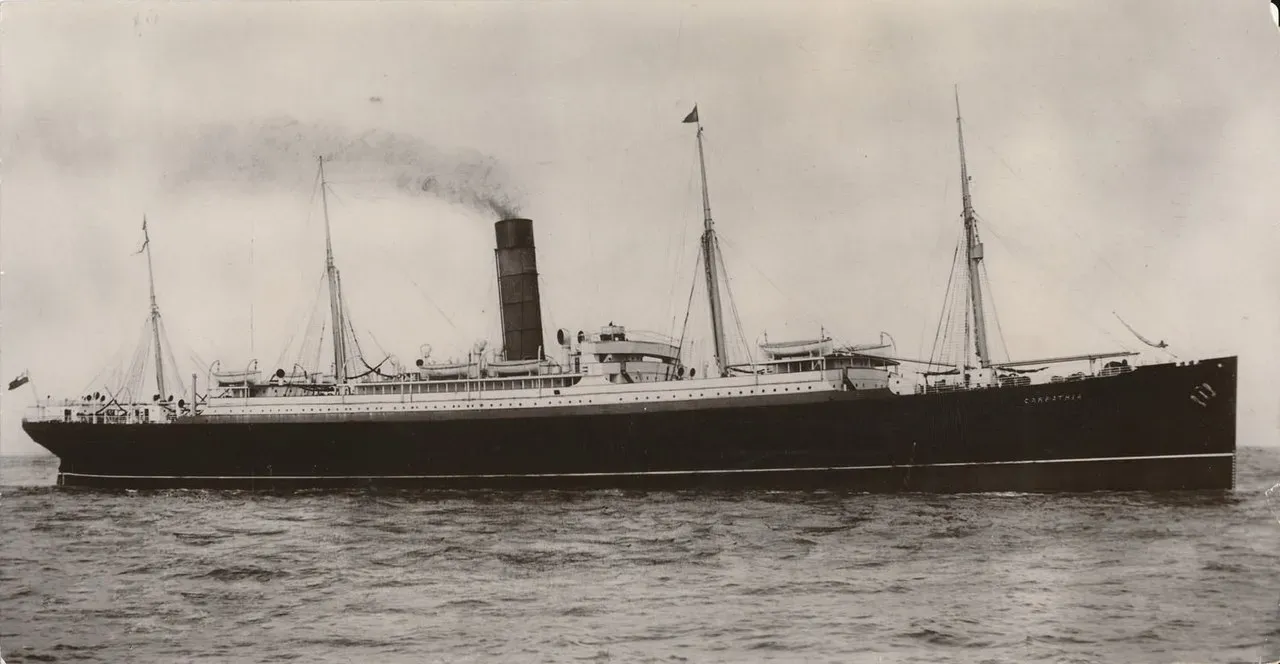
On the evening of 18 April 1912, the Cunard liner Carpathia arrived in New York Harbour under heavy rain with 712 people aboard who had no business being alive. Some newspapers had initially reported that all of Titanic’s passengers had been saved and that the ship was being towed to Halifax. The crowds waiting at Pier 54 - roughly 30,000 people, held back by police - knew that story had been wrong for days. The wireless lists coming from Carpathia on her way in had contained fewer than a third of the names of those who had sailed. The 712 stepping ashore in the rain were the survivors. The other 1,496 were on the floor of the Atlantic, 12,500 feet down.
The ship they had sailed on was, at the time it left Southampton on 10 April, the largest vessel afloat. RMS Titanic measured 882 feet, displaced 52,310 tonnes, and was the second of three Olympic-class liners built by Harland & Wolff in Belfast for the White Star Line. White Star’s chairman, J. Bruce Ismay, had decided to compete with Cunard’s new speed champions - Lusitania and Mauretania - not on pace but on scale and luxury, and Titanic was the embodiment of that strategy: a floating hotel with a gymnasium, a Turkish bath, a first-class dining saloon capable of seating 600, and a first-class Grand Staircase capped by a glass dome. She carried 2,208 people on her maiden voyage, and 20 lifeboats. The lifeboats had space for 1,178.
This was legal. The Board of Trade’s regulations required 16 lifeboats for any British vessel over 10,000 tonnes. Titanic was 46,000 tonnes. White Star fitted four more than required. That the rules had not been updated since 1894, when the largest liner under consideration was 13,000 tonnes, had been noted from time to time by the Board’s nautical adviser, Sir Alfred Chalmers, who concluded on each occasion that it was not necessary to revise them. The underlying assumption of the lifeboat system was that any sinking ship would be close enough to other vessels for the boats to ferry passengers across. The boats were not meant to carry everyone. They were meant to carry people to a rescue ship. The whole calculation depended on someone coming.
Titanic struck an iceberg at 11:40 pm on 14 April, four and a half days into her crossing. The damage opened a series of narrow gaps in the hull plating over roughly 300 feet of the starboard bow, flooding six of the sixteen watertight compartments. She could float with four flooded. Thomas Andrews, Harland & Wolff’s chief naval architect and the man who had designed her, assessed the situation within the first hour and told Captain Edward Smith they had perhaps two hours. He was accurate to the minute: Titanic went under at 2:20 am on 15 April, taking Andrews and Smith with her.
The 160 minutes between collision and sinking were enough time to get every lifeboat away. They were not used that way. In the first hour, officers loaded and launched boats at roughly half their stated capacity, partly because the discipline of mass evacuation takes time to establish, partly because in the early stages passengers were reluctant to leave a ship that did not yet appear to be sinking for an open boat on a black and freezing ocean. Lifeboat No. 1, which could carry 40 people, left with 12. No. 6 left with 28 of a possible 65. The average across all 20 boats, when the final count was taken, was 60 per cent of capacity. Had every lifeboat been filled to its rated limit, 1,178 people would have reached the water alive instead of 712. The iceberg did not prevent that. Decisions made on the boat deck prevented it.
The water that night was -2°C, well below normal for mid-April in the North Atlantic. Survival time in water that cold is measured in minutes. The people who went into the sea when Titanic went under did not drown. They died of cardiac arrest and cold shock, most of them within fifteen minutes. This is what the survivors aboard the lifeboats watched from a safe distance, and what the inquiry testimony later described at length. Fifth Officer Harold Lowe, who came back for survivors an hour after the ship sank, found around two dozen still alive in the water. The rest of the bodies were of people who had floated in their life jackets and frozen before he arrived.
There was a second ship nearby.
SS Californian, a Leyland Line cargo steamer, had stopped for the night at approximately 10:21 pm after running into ice. Her position is still disputed, but the British inquiry concluded she was no more than eight to ten miles from Titanic’s sinking point. Her wireless operator, Cyril Evans, had tried to warn Titanic of ice earlier that evening and been told to “keep out” by Titanic’s wireless operator, who was busy processing passenger messages. Evans went to bed at 11:30 pm, ten minutes before Titanic struck the iceberg. From the Californian’s bridge, Third Officer C.V. Groves and then Second Officer Herbert Stone watched a large passenger liner fire rockets into the sky. Between 1:10 am and 2:15 am, Stone reported to Captain Stanley Lord that the ship had fired rockets - first five, then three more, all white. Lord asked if they were company identification signals. Stone said he didn’t know. Lord went back to sleep. At 2:15 am, Stone reported that the ship could no longer be seen. Californian’s wireless operator was woken at 5:30 am, learned of the disaster, and the ship arrived at the scene well after the rescue was complete. The inquiry found that Californian could have reached Titanic in time to save additional lives and that Lord had acted improperly in failing to respond.
Arthur Rostron, captain of the Carpathia, was woken at 12:25 am by his wireless operator Harold Cottam, who had stayed up past his shift and been the one to receive Titanic’s distress call almost by accident. Cottam had been about to relay a message from Cape Cod and Titanic’s reply was its CQD. Rostron absorbed the information, set a course, called the chief engineer and told him to call an additional watch of stokers and make all possible speed. He then had the ship’s heating and hot water cut off to redirect every available unit of steam to the engines. He ordered doctors stationed at the entrances for each passenger class. He had extra lookouts posted to spot icebergs. He ordered blankets, ladders, and mail sacks brought to every gangway door so survivors could be hauled up from the lifeboats. By the time Carpathia reached the edge of the ice field at 2:45 am, she was doing 17 knots - three more than her rated service speed.
Carpathia arrived at Titanic’s last reported position at 4:00 am, roughly ninety minutes after Titanic had gone under. For the next four and a half hours, the crew brought survivors aboard from 13 surviving lifeboats. By 9:00 am, the last person had been pulled in. Rostron had Titanic’s 13 remaining lifeboats hoisted aboard, said a brief funeral service for the dead, and set course for New York.
The contrast between the two captains is not a morality tale about individual courage. It is an illustration of what institutional decision-making looks like when it fails and when it functions. Rostron ran his response with the clarity of a man who understood exactly what the situation required and had prepared for every contingency he could anticipate. Lord ran his with the passivity of a man who had been told enough to act and found successive reasons not to. Both had the same information: rockets in the sky from a ship that was not responding to signals. One got up and turned his ship around. The other went back to sleep.
The regulatory changes that followed Titanic were comprehensive in a way that the regulations before it had not been. The International Convention for the Safety of Life at Sea, agreed in 1914, required ships to carry enough lifeboats for everyone aboard - not enough for half, not enough under rules last revised for a 13,000-tonne ship. The Radio Act of 1912 mandated 24-hour wireless watches on passenger ships so that distress calls could not be missed because an operator had gone to bed. The International Ice Patrol was established in 1913 to monitor North Atlantic icebergs and has operated every season since except during the two World Wars, without a single reported loss of life to an iceberg collision in the patrol area.
None of this brought back the 1,496. What it did was acknowledge what the disaster actually was: not a confrontation with nature that humanity could only absorb with grief, but a sequence of specific, identifiable, correctable failures. The ship went too fast through waters where ice had been reported. The lifeboats were sized to the regulations, not to the ship. The regulations had not been updated in eighteen years. A nearby captain ignored distress rockets and the inquiry later said he should not have.
Against all of that, one captain turned his ship around, pushed his engines past their rated capacity through an ice field in the dark, and arrived ninety minutes too late to save anyone still in the water, and four and a half hours early enough to save everyone in the boats. On 18 April 1912, in heavy rain, Carpathia docked in New York and put 712 people ashore. They were alive because Arthur Rostron woke up and made a decision. The 1,496 were dead because, one way and another, other people did not.