The mathematical tables that guided ships across oceans in the early nineteenth century were wrong. Not occasionally wrong, not wrong in obscure edge cases - systematically, dangerously, repeatedly wrong, because they had been calculated and transcribed by human beings who made human mistakes and then printed those mistakes into authoritative volumes that other human beings trusted with their lives.
The standard navigation tables of the era ran to hundreds of pages of logarithms, trigonometric functions, and astronomical positions. Compiling them required teams of “computers” - the word described a person, not a device - who worked through the calculations by hand and passed the results to copyists who transcribed them for the printers. Every step in this chain was an opportunity for error. The errors accumulated. By 1822, Babbage had personally found mistakes in nine different sets of published tables. He estimated that transcription errors and miscalculations had cost the British government somewhere between £2 million and £3 million in navigation failures, insurance claims, and the wasted labour of recomputing tables from scratch.
On 14 June 1822, Babbage presented a paper to the Royal Astronomical Society with the unwieldy title “A Note respecting the Application of Machinery to the Calculation of Astronomical Tables.” The argument was simple: if all the operations required to calculate a mathematical table could be reduced to addition, and if a mechanical device could perform addition reliably, then errors of computation and transcription could be eliminated. The machine would not get tired. It would not sneeze at a critical moment and lose its place. It would carry its own results forward through a sequence of geared wheels, and print the output directly - bypassing the copyist altogether.
The mathematical basis for this was the method of finite differences. Many useful functions - trigonometric, logarithmic, astronomical - can be approximated by polynomials, and any polynomial can be reduced to a sequence of repeated additions. You begin with a set of differences between consecutive values, add those differences repeatedly, and generate the next values in the sequence without any multiplication or division. Addition is the simplest arithmetic operation to mechanise: a toothed wheel that advances one position for each unit added and carries over to the next column at ten behaves like a single-digit adder. Scale it up, link the columns together, and you have a machine that evaluates polynomials mechanically.
The Royal Astronomical Society found the proposal credible. So did the British government. In 1823, the Treasury provided an initial grant - the first in what became a sustained series of payments totalling around £17,000 over the following decade - to build what Babbage called his Difference Engine. This was, by most accounts, the first time a government funded a speculative technological research project on the basis of a theoretical argument rather than a working prototype. Whether that precedent was wise depends on whether the machine ever works.
Babbage’s Difference Engine No. 1 did not, in any complete sense, work. The engineering tolerances required to make the mechanism function with sufficient precision were beyond what early nineteenth-century manufacturing could consistently deliver. Machinists could produce individual parts that met specification; making thousands of them to the same specification, so that they would all mesh correctly inside a single assembly, was another matter. By 1833, a portion of the machine had been demonstrated - roughly 2,000 of the planned 25,000 parts, enough to prove the principle - but Babbage and the government’s appointed engineer were by then in a bitter dispute over costs, credit, and control that effectively ended the project. Babbage spent the rest of his life convinced the full machine could have been built. The rest of the world remained uncertain.
What he designed in parallel, and never stopped revising, was considerably more ambitious. Where the Difference Engine was a specialised calculator for one class of problem, the Analytical Engine was a general computing machine. It would read instructions from punched cards, the same mechanism used in Jacquard looms to control weaving patterns. It would separate the mechanism that stored numbers - Babbage called it the “store” - from the mechanism that operated on them, the “mill.” It would support conditional operations, so that the machine could take different actions depending on the results of its own calculations. Ada Lovelace, working through Babbage’s notes and an Italian engineer’s published account of his Turin lectures, wrote what is now recognised as the first algorithm for the machine - a method for computing Bernoulli numbers - and observed in her notes that the engine could manipulate any symbols that followed definite rules, not just numbers. The implications of that observation took another century to fully surface.
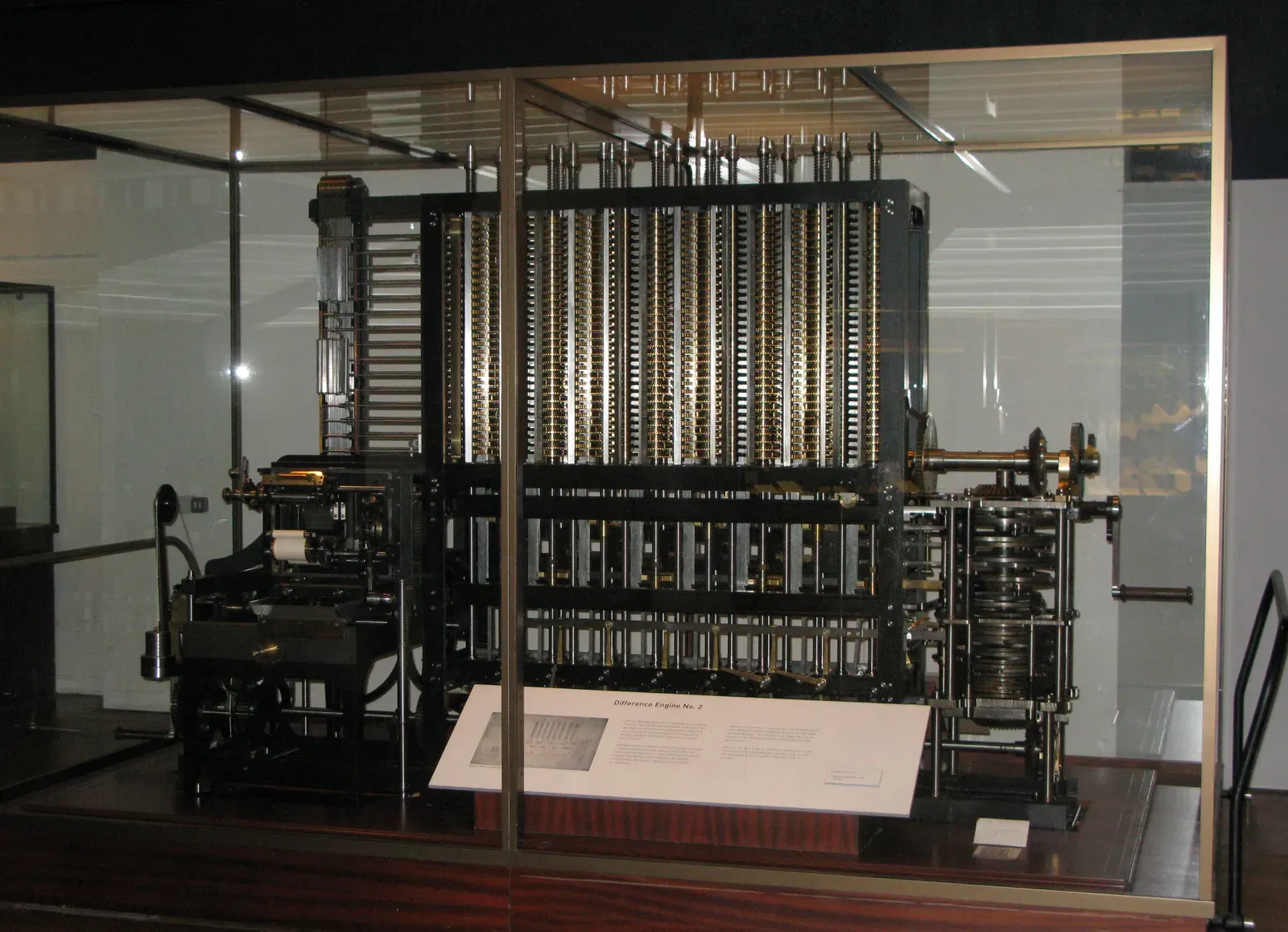
In 1991, the Science Museum in London began building Babbage’s Difference Engine No. 2 from his original drawings. The design dated from 1847 - he had kept refining it after the first project collapsed - and called for 8,000 parts. The museum completed it in 2002. It worked. Every mechanism Babbage had specified performed as he had specified it. The problem, in 1823, had not been the design.
Babbage presented his paper on 14 June 1822 and spent the next thirty years watching the machine that should have followed it fail to materialise. He died in 1871 with most of his designs unrealised and a reputation among contemporaries for obstinacy and eccentricity. What he had understood that the idea was sound: mechanical computation was possible, it could be more reliable than human computation, and the architecture of such a machine had specific and workable properties. The tables were always wrong. His machine was always right. He just could not get anyone to finish building it.