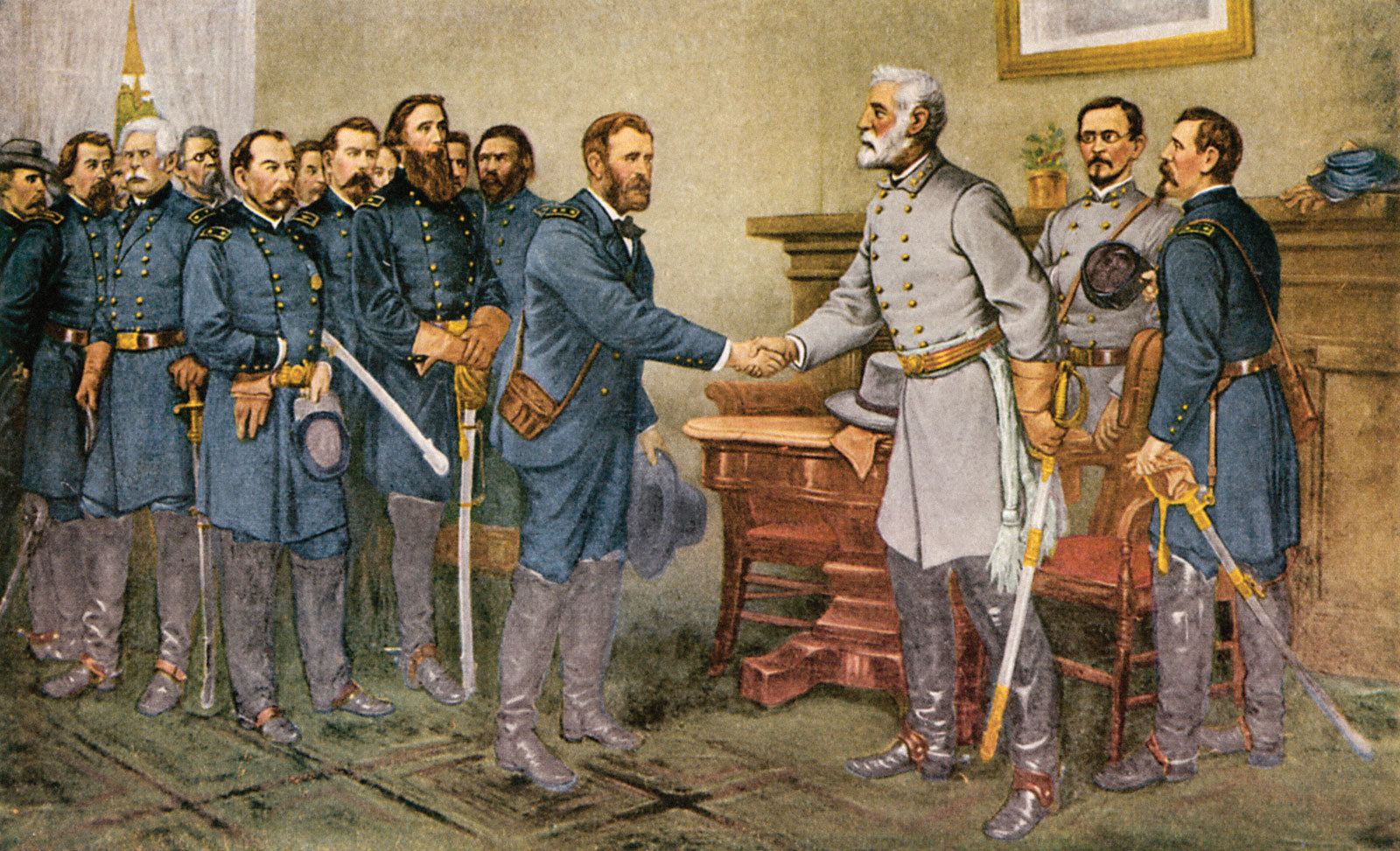
On 26 May 1865, the American Civil War did not end with a glorious, defiant charge of the Confederacy’s last major army. It ended with a quiet meeting in a New Orleans conference room, where Lieutenant-General Simon Bolivar Buckner - acting on behalf of General Edmund Kirby Smith - signed the surrender of the Trans-Mississippi Department. This was the bureaucratic dissolution of a rebellion that had torn a continent apart, slaughtered more than seven hundred thousand men, and shattered the institution of slavery. The grand martial dramas of Appomattox and Durham Station were over; what remained was the quiet, anti-climactic filing of paperwork in an occupied Southern city. It was a fittingly muted end to a conflict that had promised a heroic southern nationhood but delivered only ruin, desertion, and defeat.
To understand the absurdity of this final chapter, one must look west of the Mississippi River. The Trans-Mississippi Department was a vast, isolated territory comprising Texas, Arkansas, Missouri, western Louisiana, and the Indian Territory. After the Union captured Vicksburg in July 1863, the region was entirely cut off from the Confederate government in Richmond. Kirby Smith ruled this massive enclave like an independent potentate - a domain contemporaries mockingly dubbed "Kirby-Smithdom". He traded cotton across the Rio Grande with the French in Mexico, managed his own finances, and commanded some sixty thousand troops. I find the delusion of Kirby Smith’s continued resistance far more telling than his military strategy. Long after Robert E. Lee surrendered on 9 April and Joseph E. Johnston followed on 26 April, Kirby Smith issued furious proclamations decrying deserters and insisting that the South could still win. He believed that the Confederate armies in the east had merely been taken prisoner and that his department could hold out until a foreign power intervened.
But the war was already over in the minds of the men asked to die for it. While generals and politicians talked of making Texas an independent republic again (Make Texas Great Again, anyone?) or retreating into Mexico to serve Emperor Maximilian, the common Confederate soldiers voted with their feet. The rank and file had had enough of starvation, unpaid wages, and a hopeless cause. By May, desertion was no longer a trickle; it was an organised mutiny. Soldiers broke into government warehouses in Houston, Galveston, and Shreveport, seized provisions and weapons, and began walking home to their families. When Texas Governor Pendleton Murrah and other leaders called for volunteers to defend Galveston Harbour, they were met with a deafening silence. The Confederate experiment did not end because it was crushed by a final, overwhelming Union bayonet charge; it evaporated because the people who made up its armies simply walked away from the fiction.
It was this domestic collapse, rather than Union pressure, that forced Buckner to New Orleans. He knew that the Trans-Mississippi Department had no army left to command. On 26 May 1865, acting on behalf of a general who was still desperately riding through Texas trying to rally nonexistent troops, Buckner surrendered the entire department. When Kirby Smith finally caught up with reality on 2 June, he boarded the Union steamer USS Fort Jackson in Galveston Harbour and signed the articles. There is a delicious, dark irony in the fact that Buckner, who had surrendered the first major Confederate force at Fort Donelson in 1862, also signed the surrender of the last. The circle of rebellion had closed, completed by the same hand that had helped open it.
This four-year struggle was the first modern war, an industrialised slaughterhouse that foretold the conflicts of the twentieth century. It was a war of the telegraph, which allowed Abraham Lincoln to micromanage battles from the White House, and of the railroad, which moved entire army corps across states in days. It was a war of trenches and earthworks at Petersburg that anticipated the muddy horror of the Somme. Most decisively, it was the first conflict to see the clash of ironclads. When the USS Monitor and the CSS Virginia fought to a bloody draw at Hampton Roads in 1862, they rendered every wooden navy on earth obsolete, as if in passing, in a single afternoon. The wooden walls of Great Britain and France, once the ultimate guarantors of global power, were suddenly nothing more than floating kindling. The future belonged to steel, steam, and industrial output.
Yet the most profound legacy of 1865 was not technological, but social. The surrender of the Trans-Mississippi brought a formal end to the fighting, but it did not bring peace. When Federal troops finally landed in Galveston on 19 June 1865 - a date we now celebrate as Juneteenth - they brought the news of the Emancipation Proclamation to the last enslaved people in the Confederacy. But the destruction of slavery was only the beginning of a longer, uglier struggle. The "Lost Cause" myth, designed to salvage southern pride from the humiliation of absolute defeat, was born almost before the ink was dry on Buckner’s signature. The systemic disenfranchisement of Black Americans, the rise of Jim Crow, and the cultural battle lines of modern American politics were all forged in the immediate aftermath of this surrender. We are still arguing about the same questions of race, state sovereignty, and the definition of freedom that Kirby Smith tried to defend with cotton and bayonets.
I look at the silent surrender on the USS Fort Jackson and see a warning about the limits of military victory. You can defeat an army, you can dismantle a state, and you can paralyse a rebellion, but you cannot kill an idea with infantry. The American Civil War defined the United States, but it did not resolve the fundamental contradictions at its core. The guns fell silent in Galveston Harbour, but the deep cultural fractures remained unhealed. We still live in the shadow of that nineteenth-century conflict, listening to the long, low echoes of a war that ended on paper in a Texas bay, but remains unfinished in the American soul.