On 3 May 1791, the Sejm (the parliament) of the Polish-Lithuanian Commonwealth adopted Europe’s first modern constitution — second in the world only to the United States, which had managed it four years earlier. The document abolished the anarchic parliamentary mechanism that had kept Poland ungovernable for over a century, established a constitutional monarchy with genuine separation of powers, and declared in Article V that “all power in civil society should be derived from the will of the people.” Within four years, Poland had been partitioned off the map.
This is not the story of a failed reform. It is the story of a successful one that arrived too late to matter.
The Polish-Lithuanian Commonwealth, once one of the most powerful European states, had long run on a constitutional feature called the liberum veto: any single deputy to the Sejm could dissolve the entire parliament and invalidate all legislation passed during that session. Every deputy, in other words, held an effective veto over everything. Since it was first successfully invoked in 1652, the device had been used - or more precisely, weaponised - with increasing frequency. Between 1573 and 1763, the Sejm had sat in regular session forty-eight times; nineteen of those sessions were dissolved outright by a single deputy exercising the veto, and many more were paralysed by the threat of it. Poland’s neighbours, Russia and Prussia chief among them, had spent much of the eighteenth century bribing Polish noble deputies to invoke it whenever reform was on the agenda. Dysfunction was not an accident. It was policy, paid for from St Petersburg and Berlin.
The Constitution of May 3 abolished all of this. In its place: a hereditary constitutional monarchy - one that could actually govern - with a cabinet of ministers known as the Guardians of the Laws, collectively answerable to the Sejm. Deputies could no longer paralyse the legislature with a single word. The nobility’s monopoly on political life was broken, at least partially: burghers in the royal cities gained legal protection and political rights. Peasants - the majority of the Commonwealth’s population - were placed under the protection of the law for the first time, though serfdom itself survived. It was not a revolution. It was a reforming constitution written by people who understood what was needed but were working against a clock they could not see.
The background is essential. Poland had already been partitioned once. In 1772, Russia, Prussia, and Austria had helped themselves to roughly thirty per cent of the Commonwealth’s territory and forty per cent of its population, without a war, in what the three partitioning powers described, with straight faces, as a contribution to regional stability. The lesson should have been obvious: Poland’s neighbours preferred it weak, and were willing to act to keep it that way. The Four-Year Sejm that drafted the May 3 Constitution between 1788 and 1791 was attempting, at speed, the kind of modernisation that other states had taken generations to accomplish.
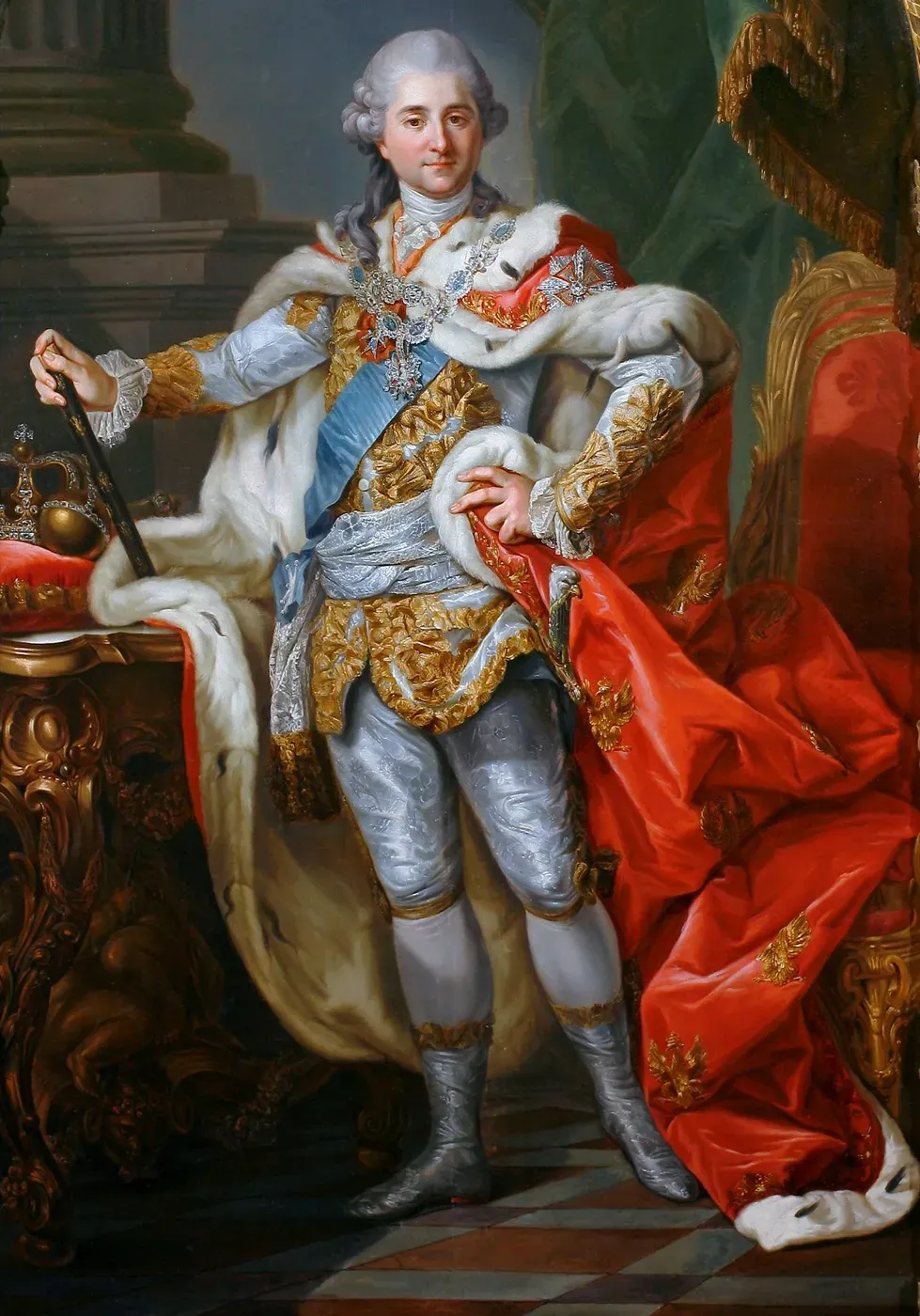
Catherine the Great of Russia watched this with open hostility. She had been occupied with a war against the Ottomans while the Sejm debated, but by early 1792 she had a free hand. In May of that year, a group of Polish magnates opposed to the constitution - men whose power depended on the old disorder - signed the Targowica Confederation and formally invited Russian military intervention to defend their ancient liberties. Russian troops crossed the border the same month. The Polish army fought, and fought well enough that a continued resistance might have held, but King Stanisław August Poniatowski capitulated to Catherine in July. By January 1793, a Second Partition had removed another third of Polish territory, primarily to Russia and Prussia. The constitution, in force for less than two years, was formally annulled.
The Kościuszko Uprising of 1794 - a national insurrection that mobilised soldiers, peasants armed with scythes, and the remnants of the army - was crushed by October. The Third Partition followed in 1795. Poland disappeared from the maps of Europe, divided among Russia, Prussia, and Austria, and did not reappear as an independent state for one hundred and twenty-three years.
The standard misreading is that the constitution weakened royal power and left Poland defenceless. It did the opposite: it replaced an elective monarchy dependent on noble consensus with a hereditary one backed by law, and stripped the individual noble of the veto that had made Poland ungovernable for so long. What the constitution could not do was conjure away the geopolitical reality surrounding it. Poland sat between three absolute monarchies, all of which had demonstrated in 1772 that they would carve up the Commonwealth when convenient. A reformed Poland was not less threatening to their interests - it was more threatening. Catherine was not alarmed by Polish weakness. She was alarmed by the prospect of Polish strength.
That is what makes May 3, 1791 genuinely tragic rather than merely unfortunate. The document’s principles - popular sovereignty, constitutional government, civic equality - were as solid as anything being written in Philadelphia or Paris in the same period. The problem was not the constitution’s quality. It was that consolidating Enlightenment reforms requires time and security, and the Polish-Lithuanian Commonwealth, surrounded and already partially eaten, had neither. The liberum veto had rotted the state from within for a century; by the time the Sejm found the courage to abolish it, the neighbours had decided that a functional Poland was an inconvenience they were not prepared to tolerate.
Poland still celebrates May 3 as a national holiday. It is a celebration without illusion - everyone knows how the story ends. The date is remembered not as a victory but as evidence of what was attempted and what was taken. The first modern constitution in Europe lasted four years. The idea has lasted considerably longer.