On 8 July 1853, four United States Navy ships anchored in Uraga Harbour at the mouth of Edo Bay. Two of them were steamships - coal-fired, black-hulled, trailing smoke columns visible for miles. Their commander, Commodore Matthew Perry, carried a letter from President Millard Fillmore demanding that Japan open its ports to American trade and provide safe harbour for shipwrecked sailors. He left a deadline. He said he would return in a year for an answer.
The Japanese called them kurofune - the black ships. When Perry reappeared the following February with ten vessels instead of four, the Tokugawa Shogunate understood that the question was not whether to negotiate.
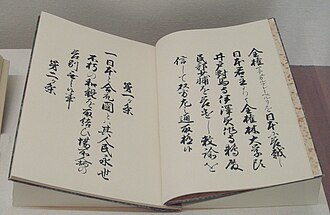
The Convention of Kanagawa was signed on 31 March 1854. By its terms, Japan opened the ports of Shimoda and Hakodate to American vessels, agreed to supply coal and provisions to any American ship in distress, and accepted a resident American consul at Shimoda. The treaty made no provision for comprehensive trade - that came four years later, with the Harris Treaty of 1858 - but it ended what had been the most sustained experiment in national self-isolation in recorded history. Since 1635, the Tokugawa Shogunate had closed Japan to almost all foreign contact. No Japanese subject could leave the country on pain of death. No foreign ship could enter most Japanese ports. The Dutch East India Company was permitted a single trading post on the artificial island of Dejima in Nagasaki harbour, and even its merchants were forbidden from entering the city. For 219 years, this had held.
The reasons for sakoku were primarily domestic. The Tokugawa feared Christian missionaries and the social disruption they brought, feared European weaponry reaching rival lords, and had watched what happened to neighbouring states when outside contact went wrong. The policy worked, in the sense that the shogunate preserved its own authority for over two centuries. But it also froze Japanese military technology somewhere around the mid-seventeenth century. When Perry’s steamships anchored off Uraga, no Japanese vessel in existence could have contested them. The gap was not a few decades behind. It was a different era.
The humiliation was visible to everyone who witnessed it. The shogunate had no real choice - Perry’s guns made the calculation plain - but the act of capitulating to foreign pressure exposed what 220 years of enforced tranquillity had actually cost. The sonnō jōi movement - “revere the Emperor, expel the barbarians” - drew its energy from exactly this moment. Its adherents were largely young samurai from domains like Satsuma and Chōshū that had never been fully reconciled to Tokugawa supremacy. They wanted to expel the foreigners, yes - but the sharper minds among them understood, increasingly, that expulsion required the same weapons the foreigners carried.
That contradiction produced the Meiji Restoration. By 1868, a coalition of southern domains had overthrown the shogunate and restored nominal imperial rule under Emperor Meiji. Within a decade, Japan had abolished its feudal domains, conscripted a national army on Prussian lines, established a Western-style legal code, built railways, introduced compulsory education, and dispatched hundreds of students and officials to Europe and the United States to bring back whatever was useful. The Iwakura Mission of 1871 - 107 government officials and students travelling for 22 months across America and Europe - was essentially a systematic audit of everything Japan did not yet know how to do. The slogan was Fukoku Kyōhei: “enrich the country, strengthen the armed forces.” They meant it literally.
The speed of what followed is difficult to fully absorb. In 1853, Japan had no modern navy. By 1905, the Japanese fleet destroyed the Russian Baltic Squadron at Tsushima - the most decisive naval engagement since Trafalgar, and the first time an Asian power had defeated a European one in a major war. Two Russian battleships were sunk and several more captured. Approximately 5,000 Russian sailors were killed in a single afternoon. Japan had gone, in fifty-two years, from being unable to contest four American ships in its own harbour to annihilating a fleet that had sailed halfway around the world to challenge it.
The Convention of Kanagawa did what it was designed to do. It opened Japanese ports to American ships, secured coal for the Pacific trade routes, and established an American consular foothold. It was the first in a series of unequal treaties that other Western powers quickly followed with similar demands - Britain, Russia, and France extracted comparable concessions within two years - and for a generation Japan was legally constrained in the ways China remained constrained indefinitely: foreign residents tried under foreign law on Japanese soil, tariff rates set by treaty rather than domestic policy, sovereignty compromised by the terms of agreements it had signed under duress.
Japan removed those constraints systematically. The unequal treaty framework was renegotiated between 1894 and 1911, largely because Japan had built the military and economic leverage to make renegotiation unavoidable. The Anglo-Japanese Alliance of 1902 - Britain’s first formal peacetime military alliance since the eighteenth century - was signed with a country that had been forced to open its ports under naval threat forty-eight years earlier.
Perry’s black ships arrived to extract concessions from a weak and isolated state. What they actually set in motion, through the chain running from national humiliation through the Meiji Restoration to the industrial and military transformation that followed, was the fastest and most thorough modernisation any country had ever managed. Japan was not the only nation subjected to Western gunboat diplomacy in the nineteenth century. It was the only one to respond by becoming a Great Power. The kurofune left the harbour. Japan built its own.