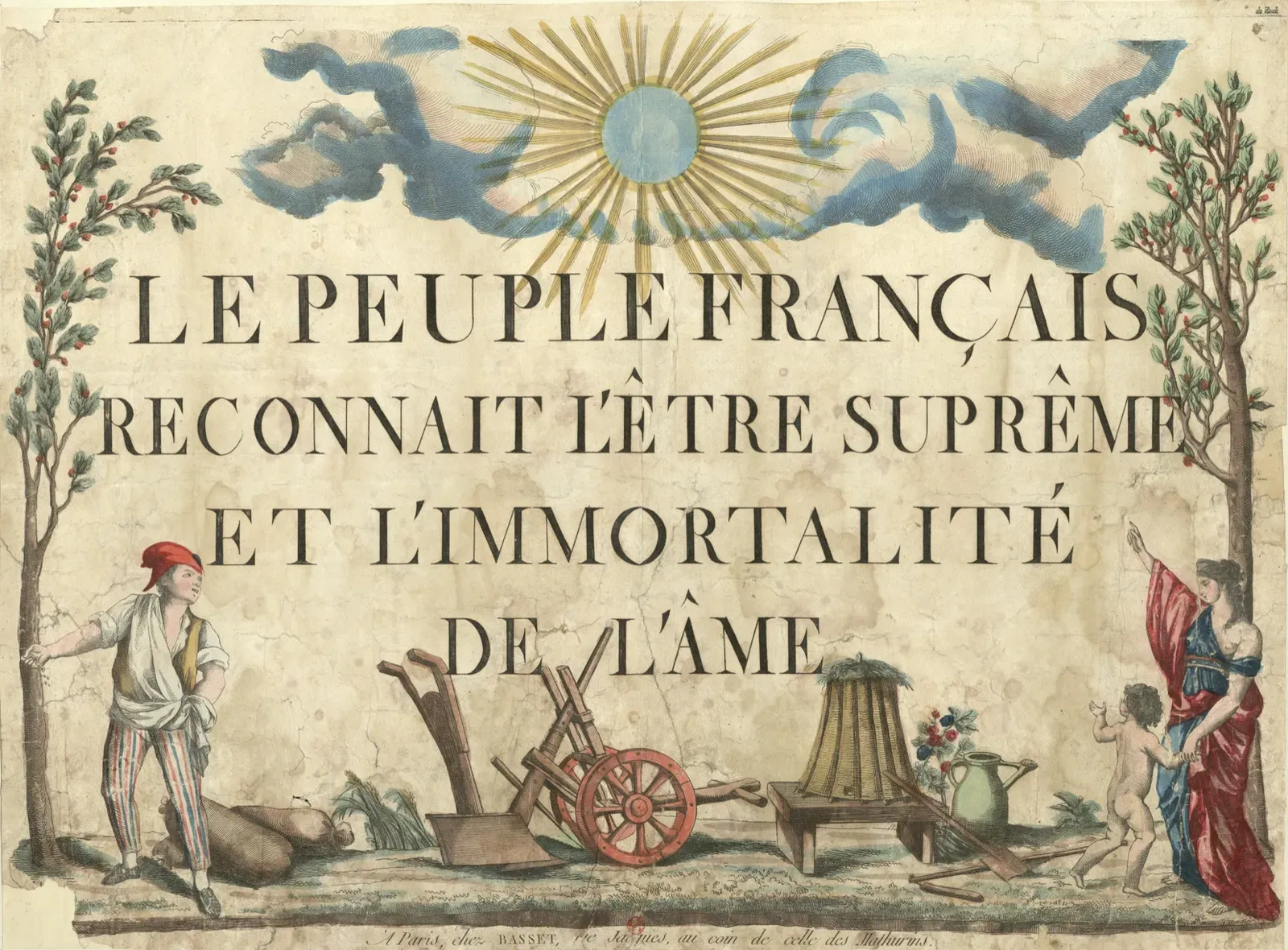
By the spring of 1794, France had killed its king, abolished the monarchy, renamed the months, redesigned the calendar, beheaded around 2,700 people in Paris alone, and was in the middle of a war with most of Europe. What it had not yet done, apparently, was sort out its religion. On 7 May 1794, Maximilien Robespierre stood before the National Convention and introduced the Cult of the Supreme Being as the official civic religion of the French Republic. He had written it himself. The Convention voted for it that afternoon. France now had a new god.
The problem Robespierre was solving was real, even if the solution was peculiar. The Revolution had from its earliest stages been in conflict with the Catholic Church - understandably, given that the Church owned roughly ten per cent of all land in France, was exempt from most taxation, and had been the ideological backbone of the monarchy. By 1793, the dechristianisation campaign was in full swing: priests were being pressured to abdicate, churches were stripped of their silver and statues, and the new Republican Calendar had replaced the Christian week with a ten-day décade, removing Sunday from the schedule entirely. The radical factions in Paris had gone further. The Cult of Reason - championed by Jacques Hébert and Antoine-François Momoro - had taken atheism as its organising principle. There would be no god at all, only Reason: abstract, impersonal, and sufficient. A woman was installed as the Goddess of Reason at Notre-Dame, which had been renamed the Temple of Reason. Hébert’s newspaper described the ceremony with evident satisfaction.
Robespierre was disgusted. This surprises people who know him only through the Terror, but he was a genuine Voltairean deist who had believed since his student days that God was necessary for moral order - not the Catholic God, but a god nonetheless. He liked to quote Voltaire directly: “If God did not exist, it would be necessary to invent him.” He found the Cult of Reason’s “wild masquerades” dangerous as well as offensive. Atheism, in his view, was aristocratic philosophy - the luxury of men who did not need to be kept honest by fear of divine judgment. The common people needed a god, and Hébert’s atheist theatre was undermining the Republic’s moral foundations at exactly the moment it needed them most.
Robespierre used the religious conflict to destroy Hébert in March 1794 - a political killing dressed as doctrinal correction. Hébert went to the guillotine on 24 March. Momoro followed two days later. Having removed the competition, Robespierre was free to present his alternative.
The decree the Convention passed on 7 May was spare and deliberate. “The French People recognise the existence of the Supreme Being and the Immortality of the Soul.” There would be no priests, no sacraments, no miracles, and no Christ. The Supreme Being was accessible through virtue, which Robespierre defined in terms borrowed from Rousseau and the Roman Republic: civic-mindedness, public duty, devotion to liberty. The soul was immortal, which meant actions had consequences beyond death, which meant the machinery of morality would keep running even without confession and absolution. It was less a theology than a behavioural framework given a divine guarantor.
The first - and, as it turned out, last - major celebration was the Festival of the Supreme Being, held on 8 June 1794. The artist Jacques-Louis David organised the event; the scale was considerable. A man-made mountain was constructed on the Champ de Mars. Every commune in France was required to hold a parallel ceremony. Robespierre, who was that month presiding over the Convention, led the procession in Paris dressed in a sky-blue coat and nankeen trousers, beaming - according to witnesses - with the specific joy of a man finally able to say publicly what he had believed all along. He gave two speeches at the summit. He was heard declaring that there would be no Christ, no Mohammed - the Supreme Being required no prophets, only virtuous citizens.
While Robespierre was speaking, a colleague - identified in some accounts as Thuriot, an old associate of Danton, himself guillotined three months earlier - was heard muttering: “Look at the blackguard. It’s not enough for him to be master, he has to be God.” The line spread. It stuck. Whatever Robespierre had intended the festival to be - a demonstration of the Republic’s spiritual seriousness, a counter to the atheist left - what many of his colleagues took away from it was a man in a blue coat on an artificial mountain, positioning himself as the high priest of a religion he had personally designed. The Committee of General Security’s president, Vadier, subsequently presented a parliamentary report on a woman named Catherine Théot who had been prophesying a coming messiah and whose followers had links to Robespierre. The Convention laughed. Robespierre was furious, and demanded the investigation be suppressed.
The Cult of the Supreme Being is sometimes treated as an eccentric footnote to the Revolution, but I think it is more revealing than that. It captures something essential about Robespierre’s theory of politics: that the Republic could be willed into existence through correct moral architecture, that virtue was a civic engineering problem, that human nature could be reliably redirected if you designed the institutions properly. The Supreme Being was not a mystery to be worshipped but a logical requirement to be acknowledged - the guarantor of the moral order without which the Republic could not function. The religion was Enlightenment rationalism all the way down, which is why it felt so airless and why it generated so little actual devotion. You cannot manufacture the sacred by committee vote, even in Floréal Year II.
The Thermidorian Reaction - the coup that ended the Terror - came on 9 Thermidor Year II, which is to say 27 July 1794. Robespierre was arrested, and executed the following day at the same Place de la Révolution where Louis XVI had died eighteen months earlier. He had introduced the Cult of the Supreme Being 82 days before he was guillotined. The cult, deprived of its founder, quietly dissolved. Napoleon banned it formally in 1802, though there was not much left to ban.
The speed of its collapse is instructive. A religion that lasts 82 days and requires legislation for its founding is not really a religion - it is a political argument dressed in vestments. What Robespierre understood, correctly, was that the Revolution had left a vacuum where Christianity had been, and that vacuums in public moral life are dangerous. What he did not understand, or could not accept, was that you cannot fill that vacuum by decree. The civic virtue he wanted was either already there, emerging organically from the conditions he had helped create, or it was not - and a festival on the Champ de Mars and a man-made mountain would not produce it. On 7 May 1794, Robespierre tried to invent God. He succeeded only in giving his enemies evidence that he thought he already was one.