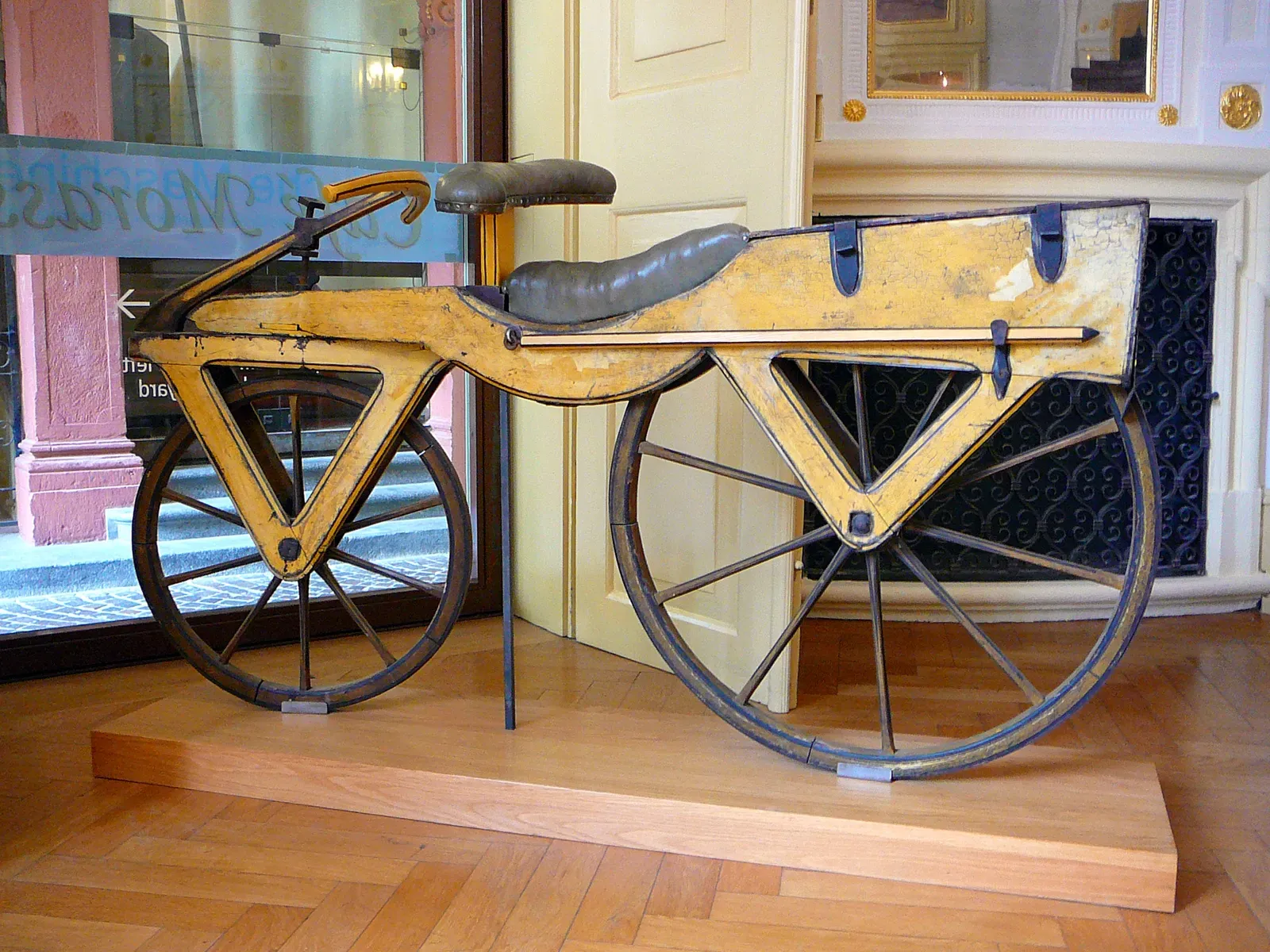
In the summer of 1816, horses were dying. The eruption of Mount Tambora the previous April had thrown enough sulphate aerosols into the stratosphere to cut northern hemisphere temperatures by roughly half a degree - sufficient to kill harvests across Europe and North America and, in turn, to ruin the fodder that kept livestock alive. Grain prices in Germany doubled. Karl von Drais, a forty-year-old baron and forestry official in the Baden civil service, watched the shortages and began thinking about what might replace the horse for short journeys. The answer he arrived at was a wooden frame, two wheels, and the rider’s own legs.
What he built was about the length of a modern bicycle: a padded crossbar for a saddle, a pivoting front wheel controlled by a crude handlebar, and no mechanism between the rider and the ground except balance. There were no pedals, no chain, and no engine. The rider straddled the frame and pushed both feet alternately against the road, building into a running stride, then lifted them to coast. At full pace on level ground, the machine reached around 15 kilometres per hour. Drais called it a Laufmaschine - a running machine.
On 12 June 1817, he rode it from Mannheim to the relay station at Schwetzingen and back: roughly 14 kilometres, completed in under an hour. On foot, the same journey would have taken four times as long. He had a documented route, a witness, and a result. He filed for a patent in Baden that year and took his machine on a further demonstration tour, covering 60 kilometres in four hours on one occasion - a pace that made the postal and military applications he had in mind look genuinely plausible.
The machine crossed the Channel quickly. In 1818, a London coachmaker named Denis Johnson built his own version, which he called the pedestrian curricle, and marketed it at six to eight guineas to the fashionable young men who rode it through Hyde Park as a matter of style. The English name for it - “dandy horse” - came directly from them: the dandies, the conspicuously dressed idlers of the Regency period, for whom gliding silently past pedestrians on a wooden frame was an appealing form of display. Within a year, several cities including London and Milan had banned the machine from pavements after collisions with pedestrians multiplied. The dandy horse was exhilarating on smooth gravel and functionally useless on the rutted earth roads that connected most places to most other places. The postal applications Drais had envisioned never arrived.
The craze lasted perhaps three years before fading. Drais had further ideas - a four-wheeled velocipede, a rail-based human-powered carriage, something resembling an early typewriter - none of which attracted the same attention. His aristocratic title was stripped in 1849 after he backed the losing faction in the Baden Revolution, his property was confiscated, and he died in Karlsruhe in 1851, largely forgotten. He was sixty-six.
What he had built outlasted him by a long way. French mechanics added pedals to the front wheel in the 1860s, producing the velocipede - nicknamed the “boneshaker” for what iron tyres on cobblestones did to the rider’s spine. An enlarged front wheel, the penny-farthing, arrived next and covered ground quickly at the cost of pitching riders onto their heads from a height of nearly two metres when the front wheel caught a stone. The solution came in 1885: James Starley’s Rover Safety Bicycle, with equal wheels, a chain drive to the rear axle, and a diamond frame of steel tubing. John Boyd Dunlop added pneumatic tyres in 1888. Sixty-eight years from Drais’s wooden frame to something a sensible person could ride to work.
None of those improvements discarded the core principle from June 1817: that a rider can balance on two aligned wheels and steer by moving the front one. The wood became steel, the leather softened, the feet left the ground permanently once the pedals arrived - but the relationship between rider, frame, and wheel is the same. There are roughly a billion bicycles in use today, making them the most numerous personal transport vehicle on earth. All of them descend from what a Baden forestry official built during a horse shortage, and demonstrated on a good road between two small German towns, in a summer that the rest of the world was still trying to recover from.