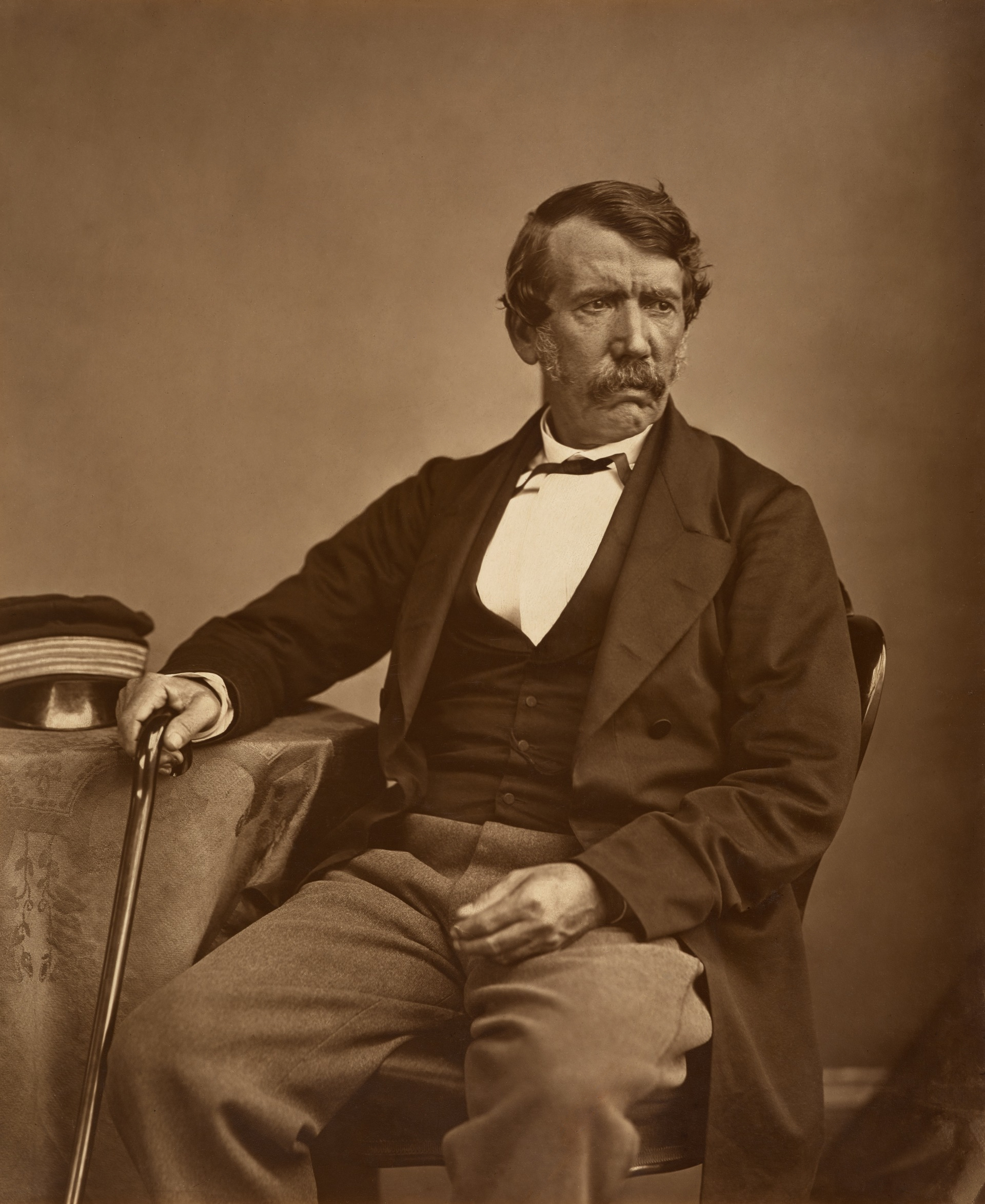
David Livingstone is buried in two places. His body lies in the nave of Westminster Abbey, where it was interred in April 1874 with a ceremony attended by thousands. His heart is under a tree in a village in Zambia. His servants cut it out, wrapped it, and buried it where he died, because they decided — on their own, without instruction — that his heart belonged to Africa and the rest of him could go home. That arrangement tells you more about Livingstone than anything else.
He was born on 19 March 1813 in Blantyre, Scotland, in a single-room tenement above a cotton mill. At ten years old he was working fourteen-hour days on the factory floor, tying broken threads on spinning machines. His shift ran from six in the morning to eight at night. He propped a book on the spinning frame and read while he worked, moving along the machine to keep it tended while getting through Latin grammar and natural history. He kept this up until he was twenty-six. His medical degree, earned in Glasgow while still working mill shifts to pay for it, cost him fifteen years of simultaneous labour and study.
His original plan was China. Karl Gützlaff, a German missionary, had published a pamphlet calling for medical missionaries to the Chinese coast. Livingstone signed up, studied the language, and prepared to go east. The First Opium War intervened, and the London Missionary Society redirected him. He arrived in Cape Town in March 1841 and might have spent his career there, in an established station among English-speaking colleagues, if he had not met Robert Moffat — the great Scottish missionary who ran the Kuruman station in what is now Botswana. Moffat had been back in Britain on a speaking tour and described what lay to the north: “the smoke of a thousand villages where no missionary had ever been.” Livingstone never got over it.
He moved to Mabotsa in 1843. A lion caught him from behind there the following year, crushed his left arm at the shoulder, and shook him — in his own words — “as a terrier-dog does a rat.” A deacon named Mebalwe saved his life by distracting the animal, which turned and bit him too. Livingstone set his own arm badly; it never healed correctly, and for the remaining twenty-nine years of his life he could not raise it above his shoulder. He went to recuperate at the Kuruman station, where Robert Moffat’s daughter Mary nursed him. They were married in January 1845. He spent most of the next seventeen years leaving her.
The explorer years produced the things he is famous for. In 1849 he crossed the Kalahari Desert and reached Lake Ngami, 3,000 kilometres inland and uncharted. In 1851 he pushed further north and reached the Zambezi. In 1854 he set out westward from the middle of the continent with 27 Kololo guides and reached the Portuguese city of Luanda on the Atlantic, having nearly died of fever several times on the way. He then turned round, retraced the entire journey back to Linyanti, and headed east. In November 1855 he became the first European to see the waterfall the local Kololo called Mosi-oa-Tunya — “the smoke that thunders” — and named it Victoria Falls after the Queen. He reached the Indian Ocean at Quelimane in May 1856, having crossed south-central Africa from coast to coast at a latitude no European had covered before.
He was celebrated on returning to Britain in late 1856 as Africa’s greatest missionary. He had been in Africa for fifteen years. He had converted one person: Chief Sechele of the Kwena people, who had learned to read in two days and who spent the months after his baptism, by his own admission, having children with an ex-wife. Livingstone withdrew fellowship from him and headed north. Sechele, who did not require a foreign evangelist to confirm his faith, went on to convert nearly his entire tribe by himself. The man called Africa’s greatest missionary was, in practice, Europe’s most famous African explorer.
He knew this, and was candid about it. The goal was never primarily souls. “The Nile sources are valuable only as a means of opening my mouth with power among men,” he told a friend. “It is this power with which I hope to remedy an immense evil.” The immense evil was the East African slave trade — the Arab-Swahili network that moved hundreds of thousands of captives to the coast each year, of whom perhaps one in five survived to reach their destination. His theory was that if he could open the interior to “Christianity, commerce and civilisation,” legitimate trade would displace slavery and the economic logic behind it would collapse. He needed famous geographical discoveries to get people to listen. He was using exploration as a campaigning tool.
The Zambezi Expedition was supposed to prove the river’s potential as a trade highway into the interior. He set out in 1858 with six specialist officers, a prefabricated iron steamboat, and the confidence of a man who had walked across a continent. The river was impassable past the Cahora Bassa rapids — cataracts Livingstone had somehow failed to notice on his earlier journey. The steamboat ran aground on sandbanks. A missionary family he had promoted to the region arrived to find marshy, malarial land he had described as fertile, and lost their wives and children to fever. His own wife Mary came out to join him in 1862 and died of malaria in April of that year, buried in a riverside grave at Shupanga. The expedition was recalled in 1864 and condemned in the British press as a failure. By the late 1860s his reputation in Europe had collapsed.
He went back anyway. In January 1866 he returned to Africa for the last time, landing at Zanzibar and setting out to find the source of the Nile. His porters deserted him in stages. His medicines were stolen. He became dependent on Arab slave-trading caravans for transport, food, and protection — the precise people he was trying to put out of business. He noted the dependency in his journals with honesty, then recorded the departure time of the next slaver’s caravan and followed it.
On 15 July 1871, at a market on the banks of the Lualaba River in Nyangwe, he watched Arab slavers kill roughly 400 people. He was standing beside the leading trader, Dugumbe, who had been feeding and sheltering him, while the shooting went on. “To overdraw its evil,” he wrote, “is a simple impossibility.” He could not leave. He had no supplies, no men, no route out without them. The man who had come to end the slave trade watched a massacre from the position of a guest.
He had already been out of contact with the outside world for years when Henry Morton Stanley — a Welsh-American journalist sent by the New York Herald — found him at Ujiji on the shores of Lake Tanganyika on 10 November 1871. The encounter produced the most famous greeting in exploration history: “Dr. Livingstone, I presume?” Stanley later tore out the pages of his diary covering the meeting. Livingstone’s own account does not include those words. The phrase first appears in a New York Herald editorial published eight months later. It may be the most quoted sentence ever spoken at a moment that probably did not happen quite that way.
Stanley urged him to come home. Livingstone refused. His mission was not complete. He continued south to the swamps around Lake Bangweulu, convinced he was closing in on the Nile’s source. He was wrong about that too — the Lualaba flows into the Congo. He spent his final months in deteriorating health, bleeding internally, barely able to walk. On 1 May 1873, his servants found him kneeling beside his bed at Chief Chitambo’s village, in present-day Zambia. He had died in the night. He was sixty years old.
What followed is the part of the story that matters. Chuma and Susi — two African men who had been with him for years — convened the expedition and made a decision. They removed Livingstone’s heart and buried it under a tree near where he died. Then they dried the rest of his body in the sun for two weeks, wrapped it, and began walking. The journey to the coastal town of Bagamoyo took 63 days and covered more than 1,000 miles. Seventy-nine of his followers completed it. They arrived with his body, his last journal, and his instruments intact. He was shipped home and buried in Westminster Abbey.
The journals and the death did what the expeditions had not. His published Last Journals, the image of African servants carrying him out of the continent, the accounts of the Nyangwe massacre — these shifted British public opinion on the East African slave trade decisively. The Sultan of Zanzibar, under British pressure sharpened by Livingstone’s writings, closed the main slave market in 1873, the same year Livingstone died. Within a decade, the missionary rush into central Africa he had called for was underway. Within two decades, the Scramble for Africa had carved the continent into European territories. Livingstone did not want that. He had imagined Christian settlement among the people, not colonial rule over them. The myth assembled from his death was more powerful than his intentions and pointed in a direction he had not foreseen.
The cities of Livingstone in Zambia and Livingstonia in Malawi keep his name. Rhodesia, named for Cecil Rhodes who came after him, does not. His heart is still under a tree in Zambia — or was, before the ground reclaimed the marker. His body has been in Westminster Abbey for 150 years. He meant to open Africa to trade and Christianity and end the slave trade. He opened it to everything that came after. His heart stayed where it belonged. The rest of him could go home.