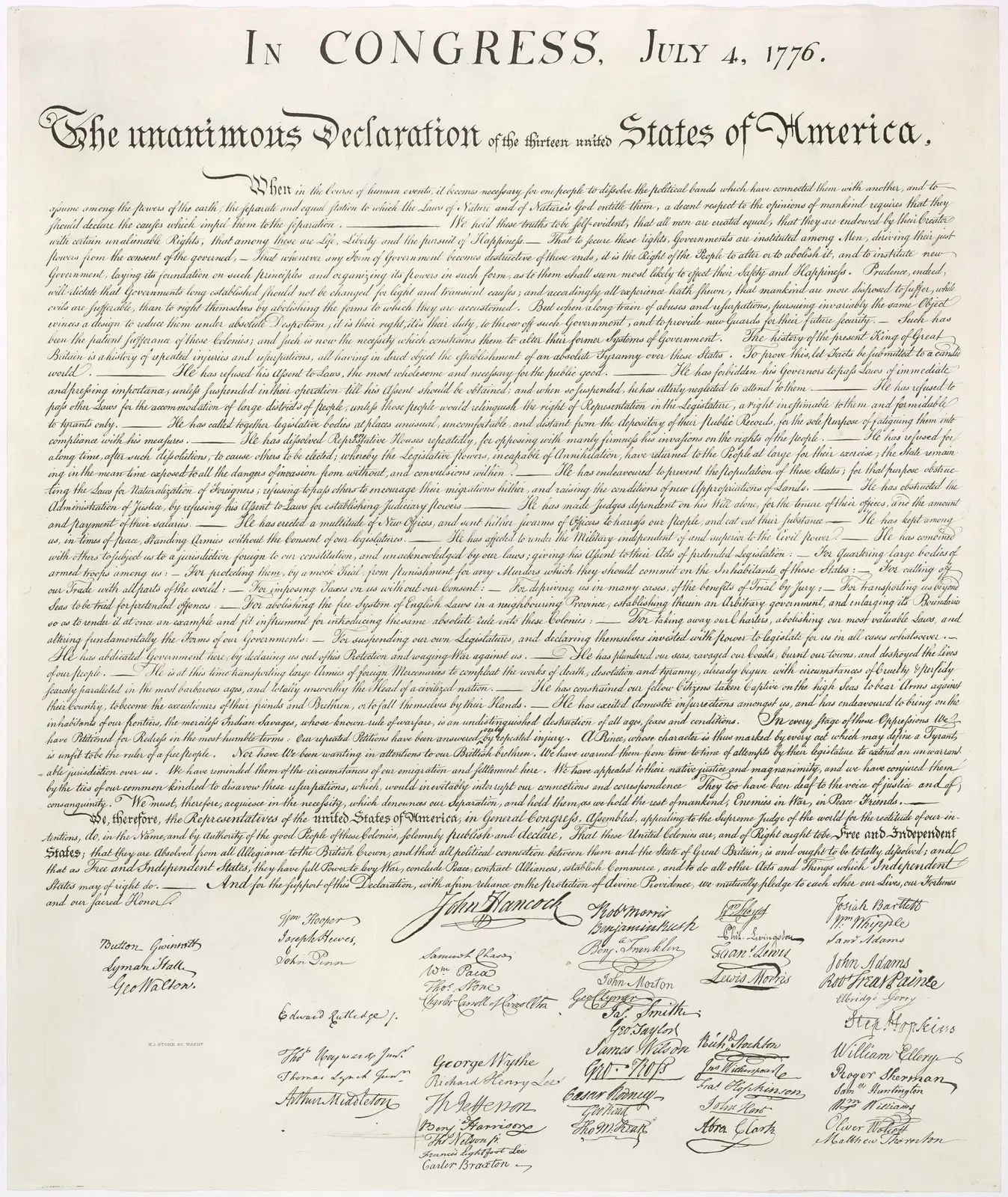
Two hundred and fifty years ago today, fifty-six men signed a document that amounted to a confession of treason, an offence English law still punished with hanging and worse. The Second Continental Congress had already voted for independence two days earlier, on 2 July, when it approved the Lee Resolution. John Adams was so sure that date would be the one Americans celebrated that he wrote to his wife predicting “pomp and parade, with shews, games, sports, guns, bells, bonfires and illuminations from one end of this continent to the other, from this time forward forever more” - and missed the actual anniversary by 48 hours. What Congress adopted on 4 July was the explanation: the Declaration, drafted mostly by Thomas Jefferson in seventeen days at a rented room on Market Street, then cut by a quarter and edited line by line by delegates who removed his clause blaming George III for the slave trade rather than risk losing Georgia and South Carolina. The compromise embedded in the founding document that day would outlast most of the men who signed it.
What they founded was not obviously destined for anything. Thirteen colonies strung along the Atlantic coast, no navy worth the name, no treasury, no functioning federal government, and a king who could still call on the most capable military machine on the planet. For its first century the new republic did what struggling, ambitious countries do: it expanded. It bought Louisiana from Napoleon in 1803, took the Southwest from Mexico in 1848, and pushed rail lines across a continent that wagon trains had once taken the better part of a year to cross. It filled the emptied land with immigrants who came for work and stayed to build it. None of this was clean - it was violent toward Native nations and, until 1865, built in part on slavery - but it was, decade after decade, a story of scale that none of the colonial powers watching from Europe had fully priced in.
By the turn of the twentieth century that scale had hardened into infrastructure: a rail network larger than the rest of the world’s combined, a manufacturing base that had overtaken Britain’s, and a financial system centred on Wall Street that could mobilise capital as fast as anywhere on earth. That machinery is what let the United States decide, twice, who won a world war. American loans and the American Expeditionary Force tipped a war of exhaustion in 1918. Two decades later, Lend-Lease turned American factories into what Roosevelt called the arsenal of democracy, keeping Britain and the Soviet Union supplied before American soldiers landed in North Africa, Italy, Normandy and the Pacific to finish the job. The country that emerged from both wars richer than it entered them - the only major combatant to fight the whole war without a single bomb falling on its industrial heartland - was left in a position no empire before it had occupied: it could rebuild its enemies, bankroll its allies, and set the terms every other currency would be measured against at Bretton Woods for the rest of the century.
I do not think the world is America’s oyster any more, and it would be dishonest to pretend otherwise. China has a larger manufacturing base and, on some measures, a larger economy. The Middle East and post-Soviet Eurasia tell Washington no on a regular basis. The unipolar decade after 1991 is over, and nobody serious argues that it isn’t.
But run through the list of what actually decides the next fifty years, and the United States is still setting the pace on most of it. The frontier AI labs - OpenAI and Anthropic among them - are American, built on top of Nvidia’s near-monopoly on the chips that train the models, a position no country has managed to replicate despite spending billions trying. American drug companies and universities still produce most of the world’s genuinely novel medicine, from Moderna and Pfizer’s mRNA vaccines to Eli Lilly’s GLP-1 drugs, which are reshaping obesity treatment faster than any public health campaign in decades. The US Navy operates more aircraft carriers than the rest of the world combined, and American defence spending still roughly matches that of the next nine countries put together. None of that guarantees anything. It is simply where the puck currently sits.
People have been confidently predicting American decline for as long as I have been reading the news. After Vietnam. After the 1970s oil shocks and stagflation. After Japan’s manufacturing boom in the 1980s, when serious economists wrote bestsellers about Tokyo overtaking Washington. After 2008, when the financial system that was supposed to be the country’s great strength nearly burned itself to the ground. Each obituary got written a little too early. The colony that gambled everything on a piece of paper in 1776, betting that a rebellion against the most powerful empire on earth could actually work, has made a two-hundred-and-fifty-year habit of proving its doubters wrong on a schedule. I would not bet against it doing so again.