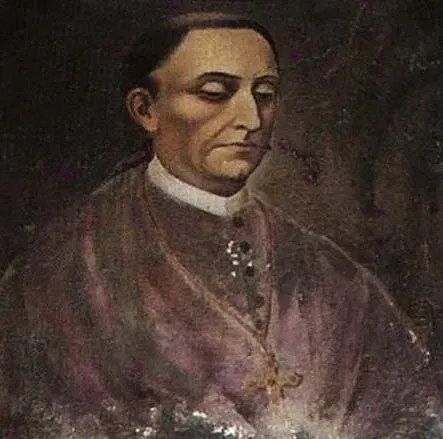
On 12 July 1562, in the plaza of the mission town of Maní in the Yucatán, Franciscan friars piled up carved wooden idols and painted deerskin books and set them alight. The Maya who had gathered to watch did not stand there passively. Fray Diego de Landa, the man who gave the order, recorded their reaction himself, years later: “We burned them all, which they took most grievously, and which gave them great pain.” He wrote that sentence as a simple statement of fact, not as a confession. I think it is one of the most quietly damning lines in the historical record of the Americas, precisely because the man writing it never seemed to grasp what he was admitting to.
Landa was not yet a bishop. He was the Franciscan provincial of Yucatán, twelve years into a mission he had joined as a young friar in 1549, and by 1562 he had convinced himself of something specific: that the mass baptisms his order had performed across the peninsula were theatre. He believed the Maya were still worshipping their old gods behind closed doors, and when his friars started turning up idols hidden in caves, buried under house floors, and tucked behind altars that looked Christian from the front, he treated it as proof of a betrayal aimed at him personally. His response was not a sermon. It was an inquisition, run without the Inquisition’s actual authority, in which Maya nobles were interrogated and, by multiple later accounts, tortured to extract confessions of continued idol worship.
The bonfire at Maní was the result. Landa’s own tally, recorded in his writings, put the destruction at roughly 5,000 idols and statues. Twenty-seven bark-paper codices went into the same fire, books that held generations of Maya astronomical tables, ritual calendars, genealogies, and history, written in a script no European could read and few Europeans thought worth preserving. Landa clearly could have chosen to preserve at least a sample for study. He chose incineration instead, and he did it with the confidence of a man who believed he was saving souls rather than erasing a civilisation’s written memory.
He did not get away with it cleanly. The newly arrived Bishop of Yucatán, Francisco de Toral, was appalled when he learned how the interrogations at Maní had been conducted, and he complained loudly enough that Landa was recalled to Spain in 1563 to answer to the Council of the Indies for exceeding his authority. It took years, but Landa was eventually cleared and returned to Yucatán in 1572, this time as bishop himself, the same office his own superior had used to have him hauled across the Atlantic in disgrace. Rome and Madrid, it turned out, cared rather more about jurisdiction than about a burned library.
What that fire actually cost is difficult to overstate, and I don’t think it gets stated often enough in those terms. Only four Maya codices are known to survive anywhere in the world today: the Dresden, the Madrid, the Paris, and the disputed Grolier, named for the European cities and collectors that ended up holding them rather than for anywhere in the Maya world itself. Four books, out of a literate civilisation that had been writing for well over a thousand years. This is not a footnote to Spanish colonial history. It is one of the most complete destructions of a written tradition on record, on a par with the worst losses classical antiquity ever suffered, and it happened in an afternoon, on the say of one convinced man.
Here is the part that still unsettles me every time I read it. Landa, defending himself back in Spain against the charges Toral had brought, wrote a manuscript called Relación de las cosas de Yucatán to prove he understood the culture he had disciplined well enough to have acted in good faith. In building that defence, he documented an enormous amount of the Maya world he had just spent a decade attacking: their calendar, their gods, their customs, and a transcription system pairing Spanish letters with Maya glyph sounds that became known as the “Landa alphabet.” He assumed, wrongly, that Maya writing worked the way Spanish did, sound by sound. It doesn’t. But the manuscript sat in Spanish archives for three centuries, largely ignored, a strange kind of insurance policy nobody had asked him to write.
It paid out in 1952, in Moscow, in the hands of a Soviet epigrapher named Yuri Knorozov, who had never set foot in Mexico and, given the Cold War, had no realistic prospect of doing so. Working from Landa’s alphabet and photographs of the surviving codices, Knorozov demonstrated that Maya script was not the crude picture-writing generations of Western scholars had assumed. It was a mixed logosyllabic system, phonetic at its core, closer in structure to Egyptian or Japanese than to any purely pictographic code. His work became the foundation for the decipherment that has, over the following seven decades, made large parts of Maya writing legible again.
I don’t think that redeems Landa, and I don’t think it was supposed to. He set out to erase a people’s written memory and, four hundred years later, an accident of his own self-justification became the key that let us start reading what little of it survived. The books themselves are still gone, twenty-seven of them, along with whatever history, astronomy, and belief they held that never made it into any friar’s account. The fire took those permanently. What it left behind, almost despite itself, was the alphabet that let their descendants’ language speak again.