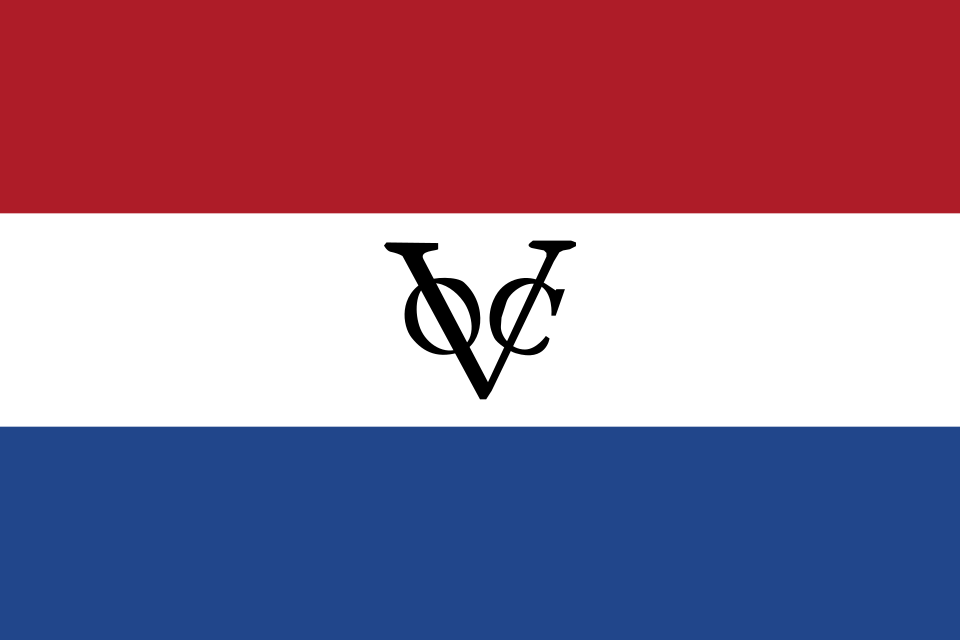
The Dutch East India Company was given permission, in writing, to declare war. The date was 20 March 1602. The States General of the Dutch Republic had chartered a trading company with the authority to build forts, maintain armies, negotiate treaties, execute convicts, and mint its own coins. A corporate charter containing these provisions had never been issued before. Nothing quite like it would be issued again.
The VOC — Vereenigde Oostindische Compagnie, the United East India Company — was not the product of entrepreneurial ambition. It was the product of a competitive emergency. Dutch merchants had been running separate expeditions to the Spice Islands since 1595, when Cornelis de Houtman led four ships to Java and made it back with enough pepper and nutmeg to turn a profit, having lost half his crew to disease and a running fight at Sidayu. A second expedition in 1598, under Jacob van Neck, reached the Maluku Islands directly and returned a 400 per cent profit. Word got around. By 1598, fleets were departing from Amsterdam, Rotterdam, Zeeland, and Enkhuizen — sometimes in the same season, sometimes racing each other to the same anchorages, bidding against each other for the same cargoes, and in the process driving up purchase prices at source while flooding the market at home.
The voorcompagniën, as the pre-companies were known, were destroying the profit margin they all competed to capture. In 1600, the English solved this problem by bundling their resources into a single monopoly venture — the English East India Company. The Dutch had to respond or be outcompeted before they had properly begun.
Johan van Oldenbarnevelt, the republic’s leading statesman, engineered the merger. Six chambers — Amsterdam, Middelburg, Rotterdam, Enkhuizen, Delft, and Hoorn — pooled their resources. Start-up capital came to 6,424,588 guilders, raised from 1,143 shareholders. The minimum investment was 3,000 guilders, which placed it within reach of merchants and prosperous tradespeople, not just the very wealthy. Among the early subscribers were 39 Germans and 301 from the Southern Netherlands — refugees from Habsburg-controlled territory who had brought their capital and their commercial networks north. The largest single subscriber, Isaac le Maire, put in 85,000 guilders. He would later become history’s first recorded short seller and, after a dispute with management, file the first recorded expression of shareholder activism against the very company he had helped found. The financial instrument had barely been invented before someone found a way to bet against it.
What made the VOC structurally different from anything before it was the permanence of the capital. Previous expeditions were funded voyage by voyage and liquidated on return. The VOC’s capital was locked in for the company’s lifetime. Investors who wanted out could not demand liquidation — they had to sell their stake to someone else. This necessity created a secondary market for shares, which grew into the Amsterdam Stock Exchange. The joint-stock corporation, the publicly traded share, the stock exchange: the modern financial system did not invent these instruments separately. A Dutch spice monopoly invented all three at once, as a byproduct of wanting to reach the Moluccas before the English did.
The governing body was the Heeren XVII — the Lords Seventeen — drawn from the six chambers, with eight seats held by Amsterdam alone. Amsterdam’s chamber had nearly half the voting power and never let anyone forget it. The Zeelanders resented this from the beginning. The arrangement was, in practice, Amsterdam stipulating what happened and the other chambers adjusting accordingly.
By 1669, the VOC was the richest private company in the world. It operated 150 merchant ships and 40 warships, employed 50,000 people, maintained a private army of 10,000 soldiers, and paid a 40 per cent dividend on the original investment. Between its founding and 1796, it sent nearly a million Europeans to Asia on 4,785 ships and moved 2.5 million tonnes of goods. The English East India Company, its nearest competitor, carried one-fifth the tonnage.
The violence required to sustain these numbers was considerable and, in one instance, systematic. The charter had authorised it: the right to wage war was not decorative. Jan Pieterszoon Coen — governor-general from 1619, the man who stormed Jayakarta and built Batavia on its ashes — set about securing a monopoly on nutmeg. The Banda Islands, the only place in the world where nutmeg grew, had a population of around 15,000 people. Coen’s solution was to remove the population. Through warfare, starvation, forced expulsion, and killing, nearly the entire native population of the Banda Islands was destroyed within a few years. Dutch settlers and enslaved workers were brought in to run the nutmeg plantations. The VOC then sold nutmeg across European kingdoms at 14 to 17 times the price it paid in Indonesia. This was not a side effect of the spice trade. It was the policy — and the charter had always made it possible.
The company’s early shareholders had already protested management self-enrichment in 1622, complaining that the account books had been “smeared with bacon” so they might be “eaten by dogs.” They demanded a proper audit. They did not get one. Corruption deepened rather than retreated, becoming so thoroughly embedded in the company’s operations that by the late 18th century the Dutch had quietly reinterpreted the acronym: vergaan onder corruptie — perished under corruption. Salaries were low, private trading was officially forbidden but universally practised, and the accounts grew progressively more fictional.
The end came in stages. The Fourth Anglo-Dutch War, which broke out in 1780, halved the company’s fleet and inflicted roughly 43 million guilders in damages. Loans to keep it operational wiped out its net assets. The VOC charter was renewed through the 1790s more out of inertia than confidence, and it was finally allowed to expire on 31 December 1799. The Batavian Republic, the Dutch successor state installed under French influence, absorbed the company’s possessions and its debts.
What the VOC left behind was not nutmeg. The spice trade it had dominated for a century was already diminishing before the collapse; the world’s appetite had shifted to coffee, tea, and cotton, commodities where the VOC had always struggled to maintain its edge. What it actually bequeathed was structural: the joint-stock corporation, the limited liability framework, the publicly traded share, the shareholder revolt — the entire apparatus of modern corporate capitalism, assembled in 1602 to help Dutch merchants reach the Spice Islands before the English did. Every multinational company operating today runs, at least in part, on the legal and financial architecture that Johan van Oldenbarnevelt and the States General wrote into a single charter on 20 March 1602.
They also wrote the template for what happens when corporate interests are backed by sovereign force. The Banda Islands were not the last example of that combination. They were the first.