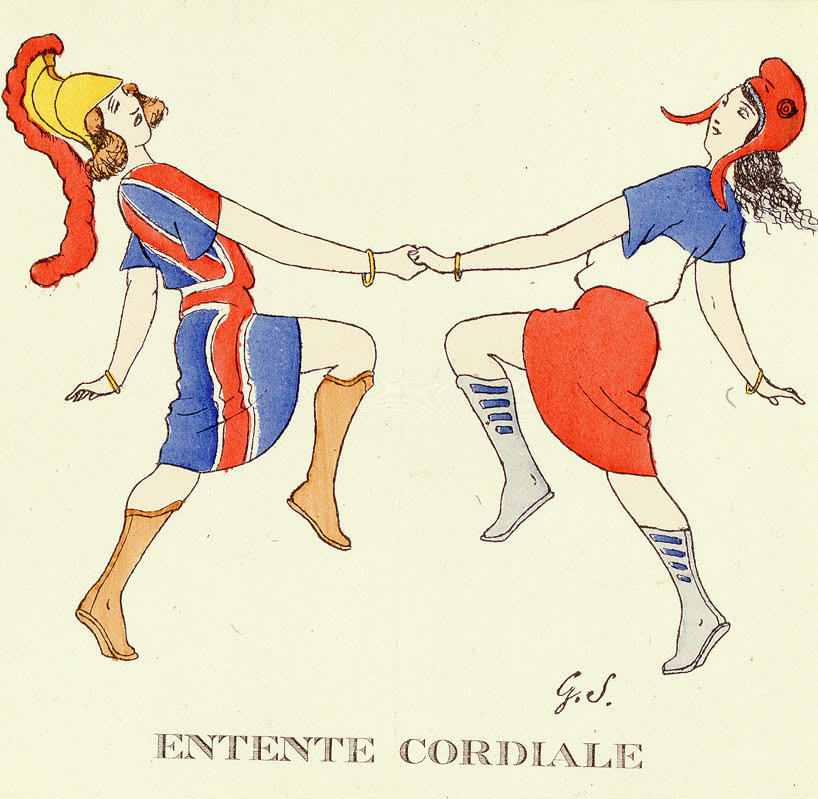
England and France had been fighting, off and on, for roughly nine centuries before 8 April 1904. William the Conqueror was Norman. The Hundred Years’ War ran from 1337 to 1453. Napoleon spent a decade and a half trying to starve Britain into submission via continental blockade. In 1898, French and British troops had faced each other down at Fashoda, in what is now Sudan, in a confrontation that briefly looked as if it might tip into outright war over a meaningless patch of African riverbank. The pattern was so old it had its own gravity. And then, in a single afternoon of paperwork in London, it stopped.
The Entente Cordiale was not a military alliance. That is the first thing to understand. It was a series of colonial agreements — three main conventions covering Morocco, Egypt, Newfoundland fishing rights, West Africa, Madagascar, and a handful of smaller territories. France recognised Britain’s dominant position in Egypt; Britain recognised France’s in Morocco. Longstanding disputes over fishing grounds off Newfoundland were resolved. The arrangement was mundane in its specifics, carefully avoiding any formal security commitments between the two powers. What it signalled, however, was anything but mundane: the two countries that had spent most of the previous thousand years as each other’s primary enemy had decided they had bigger problems.
The bigger problem had a name: Germany. The German Empire, unified only in 1871, had by 1900 the largest industrial economy in Europe. Kaiser Wilhelm II was building a navy explicitly designed to challenge British sea power — the Naval Laws of 1898 and 1900 had made that ambition formal and public. From London’s perspective, the traditional policy of playing European powers against each other — “splendid isolation,” in the phrase — was becoming less splendid by the year. From Paris, the calculus was similar: France had lost Alsace-Lorraine to Germany in 1871 and had spent thirty years living with the knowledge that the largest army on the continent was quartered across its eastern border. Neither country needed the other as an enemy when there was a more pressing one in view.
The diplomatic work fell largely to two men. On the British side, Foreign Secretary Lord Lansdowne drove the negotiations; on the French, Foreign Minister Théophile Delcassé had been manoeuvring toward accommodation with Britain since the Fashoda humiliation had demonstrated that France could not afford to antagonise both Germany and Britain simultaneously. King Edward VII’s state visit to Paris in May 1903 — a charm offensive that went better than anyone expected, given that Paris crowds had greeted his arrival with shouts of “Vive les Boers!” — provided the political atmosphere. The actual content was lawyers and cartographers.
The consequences of the Entente were not immediately obvious, and that is precisely what makes it worth examining. No guns fired on 8 April 1904. No troops moved. The document signed was, on its face, a tidying exercise in colonial administration. But alliances, once formed, generate their own logic. The Entente Cordiale deepened. In 1906, secret Anglo-French military conversations began — staff officers talking about what cooperation might look like if war came with Germany. Britain and France had not committed to fight together, but they were now planning to. The conversations were kept from the Cabinet for years. In 1907, Britain concluded a similar entente with Russia, completing what became known as the Triple Entente — Britain, France, and Russia on one side; Germany, Austria-Hungary, and Italy nominally on the other.
Europe was now divided into two armed camps, each bound by commitments that interlocked like gears. When Archduke Franz Ferdinand was shot in Sarajevo on 28 June 1914, the machinery engaged. Austria-Hungary issued its ultimatum to Serbia. Russia mobilised to protect Serbia. Germany declared war on Russia. France, bound to Russia, was next. Germany’s Schlieffen Plan called for a rapid attack through Belgium to knock France out before Russia could fully mobilise — and Britain, which had guaranteed Belgian neutrality since 1839, had its casus belli. What had begun in the Balkans became a continental war because the web of alliances and ententes left almost no room for localisation. The Entente Cordiale was one of the threads in that web.
None of this was intended. Lansdowne and Delcassé wanted to reduce friction, not manufacture catastrophe. Their agreement was a rational response to the pressures of their moment: two declining empires managing their relationship with each other while a rising power altered the balance of the continent. The logic was sound. The outcome, filtered through a decade of military planning, secret commitments, and escalating arms races, was the death of roughly seventeen million people in four years of industrialised warfare. History has a way of delivering the bill for reasonable decisions long after the people who took them are out of office.
There is a kind of symmetry in the date. The nine centuries of English and French fighting each other produced no single peace treaty, no solemn moment of formal reconciliation. They simply stopped, in 1904, because both countries had too much else to worry about. The blood feud ended not in magnanimity but in pragmatism — colonial bargains, fishing rights, and the unspoken acknowledgement that Germany had changed everyone’s calculations. A thousand years of bad blood, cleared away in an afternoon. The war that resulted four years later killed more people than all of those previous centuries of Anglo-French conflict combined.