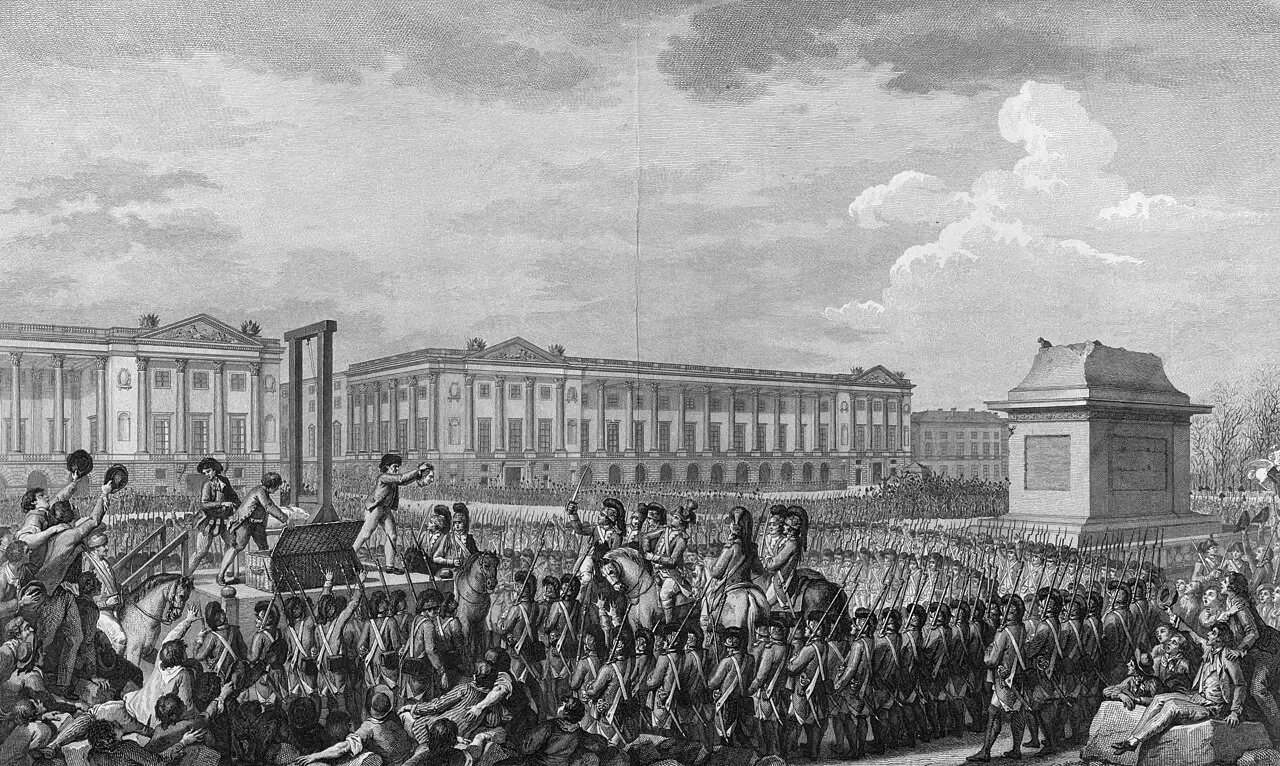
On the morning of 21 January 1793, a carriage made its way through the streets of Paris carrying Louis XVI to the Place de la Révolution. The journey took two hours. Sanson, the executioner, rode with him - the same Charles-Henri Sanson who had spent his career as the royal executioner under the man he was now escorting to the scaffold. When Louis arrived and mounted the steps, he attempted to address the crowd. He declared his innocence. He said he pardoned those who had brought him to this. The drums rolled over his words by the order of the officer in command. At around 10:22 in the morning, the blade fell.
The vote that sent him there had passed by forty-two deputies. Out of 721 members of the National Convention, 361 voted unconditionally for death; 319 voted for imprisonment or banishment. A motion to reprieve him was defeated 380 to 310. Unanimity on guilt - 693 to zero - had been easy. What to do about it was not. The Girondins, the more moderate faction, had wanted an appel au peuple, a referendum that would have let the country decide. The Montagnards - Robespierre, Saint-Just, Danton - argued that the Republic could not be born while the king lived. The Montagnards won, by a margin considerably thinner than the history books tend to imply.
The Revolution had started in 1789 as something more limited than what it became. The storming of the Bastille, the Declaration of the Rights of Man, the Constitutional Monarchy of 1791 - these were not blueprints for regicide. A significant portion of the men who had built the Revolution up to this point had imagined a France with a constitutional king, not a France without a king entirely. The execution of Louis on 21 January 1793 was the moment that bridge burned behind them. You cannot un-execute a king. What had been a political dispute about power and sovereignty became something irreversible. France had not merely removed its monarch; it had killed him, publicly, on a machine built for commoners, while a crowd watched.
The immediate consequences were predictable and predicted. The execution shocked the courts of Europe. Britain and the Dutch Republic, previously neutral, entered the war within ten days. Austria and Prussia were already fighting. Spain, which had tried to save Louis through negotiation, joined the coalition. France was now at war with most of its neighbours, and the Revolutionary government needed to win that war or cease to exist. That pressure - existential, constant - is part of what drove what followed.
What followed was the Terror. The Girondins, who had argued for restraint, were purged from the Convention in June 1793 and sent to the same guillotine they had tried to withhold from the king. By the summer of 1794, the Committee of Public Safety, with Robespierre and Saint-Just at its centre, had built a machine for producing enemies: 16,000 people executed by guillotine across France between September 1793 and July 1794, with perhaps another 25,000 dying in prison or summary executions. The Revolution, having consumed the king, began consuming its own. Danton, who had helped drive the Revolution to radicalism, was executed in April 1794 on Robespierre’s orders. Three months later, the Convention turned on Robespierre himself. He was arrested on 9 Thermidor (27 July 1794) and guillotined the following day - at the same Place de la Révolution, on the same machine. Saint-Just, who had argued most eloquently that the king must die because kings could never be judged, died with him.
The Terror ended. The Directory that replaced it was corrupt and incompetent. In November 1799, a general who had turned Revolutionary wars into personal conquest staged a coup - the 18 Brumaire - and within five years had made himself Emperor Napoleon I. The country that had killed its king to abolish monarchy had, in a decade, found itself an emperor with a court, a nobility, a dynasty, and ambitions of continental domination.
The French Revolution is one of those events that seems to confirm every possible lesson depending on which part you look at. The conservatives saw the execution as proof that radical change devours itself. The radicals saw Napoleon as proof that the bourgeoisie betrayed the Revolution before it could be completed. The liberals saw the Terror as what happens when popular sovereignty has no institutional check. All of them are describing something real about what happened between 1789 and 1815.
What is harder to dispute is the reach. The ideas that the Revolution generated - popular sovereignty, equality before the law, the rights of citizens against the state, the nation as a political unit rather than a royal possession - escaped the borders and did not come back. The Haitian Revolution, which produced the first Black republic in history, took its language and logic directly from the Declaration of the Rights of Man. Latin American independence movements drew on the same source. The constitutions written across Europe in the nineteenth century were arguing with, or borrowing from, 1789. The reactionary order that tried to reassemble itself at the Congress of Vienna in 1815 was already fighting against something it could not put back in the box.
The Place de la Révolution was eventually renamed. It is the Place de la Concorde now - a name chosen for reconciliation, in one of history’s more optimistic acts of municipal rebranding. The square still stands, in the same spot, with the same proportions. The guillotine is gone. The ideas, the fractious arguing ones about who governs and on what terms and at whose expense, are considerably harder to be rid of. On 21 January 1793, France dropped a king’s head into a basket and made that argument impossible to ignore. It has not stopped since.