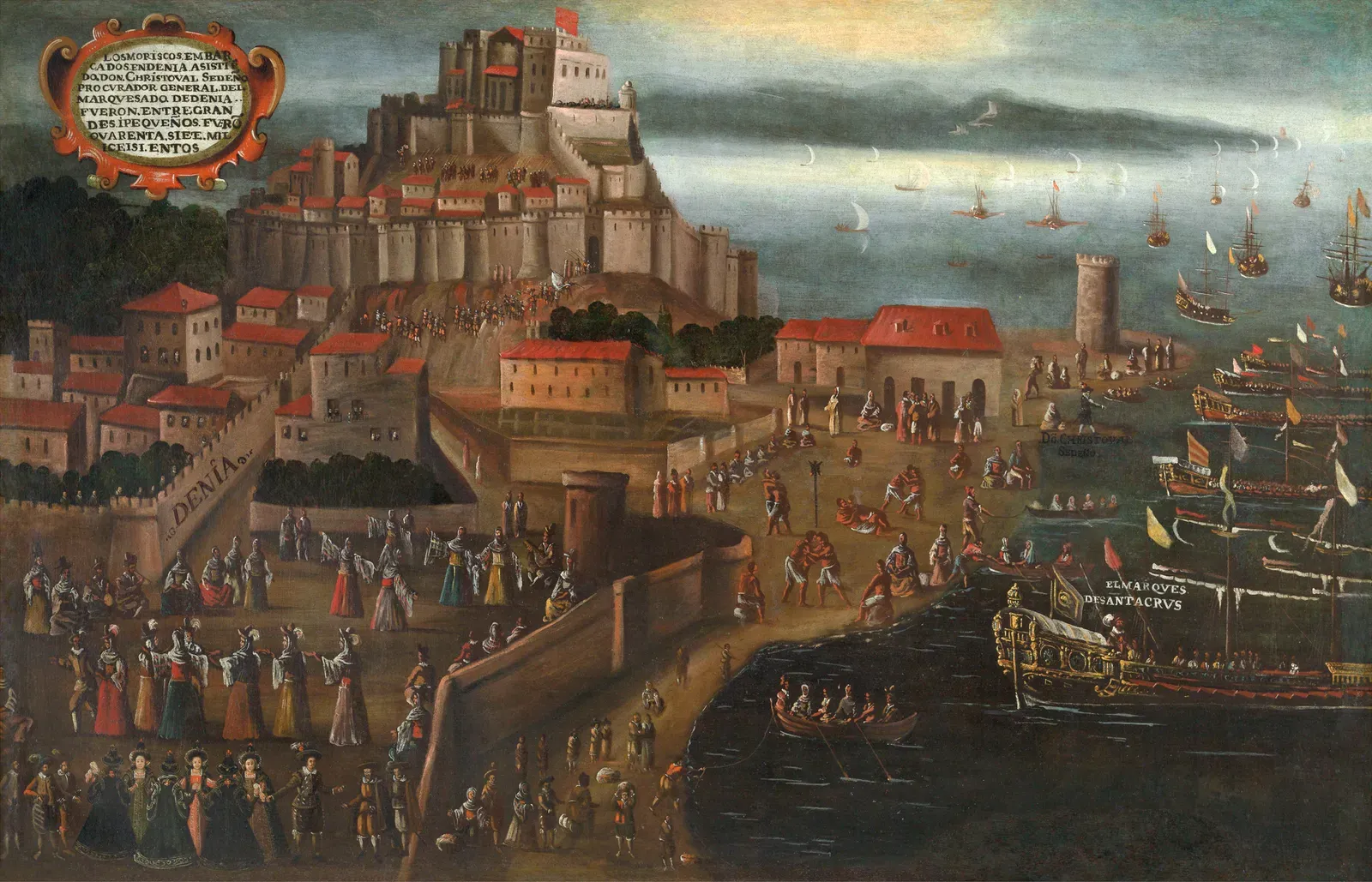
The Treaty of Granada, signed on 25 November 1491, was unusually generous for a document of surrender. The Muslims who remained in the city after Boabdil rode out were guaranteed their property, their customs, their laws, and - crucially - the free practice of their faith. Ferdinand and Isabella had spent ten years and considerable blood taking the city. They could afford to be magnanimous. The treaty lasted nine years.
By 1500, Cardinal Cisneros - Isabella’s confessor, not known for subtlety - had arrived in Granada and begun mass forced baptisms. When the population of the Albaicín quarter rose in protest that December, the Crown used the uprising as justification for voiding the treaty’s religious protections. In 1502, Muslims in Castile were given the same choice that had been extended to Jews a decade earlier: convert or leave. Most converted. The converted Muslims - the Moriscos - had kept their end of the bargain. The Crown had not kept its.
Those conversions produced a question that would obsess the Spanish state for the next century: were the Moriscos actually Christian? Many practiced Islam in private while observing the outer forms of Catholicism. The Inquisition called this crypto-Islam and prosecuted it. The problem was that the Moriscos were too economically useful to simply remove. In Valencia, they made up roughly a third of the population and provided most of the agricultural labour. In Aragon, they were weavers, traders, and craftsmen whose work the noble landlords depended on. Persecution was one thing; economic self-harm was another.
Philip II had to deal with this contradiction directly. In 1567, he issued a decree banning Arabic language, dress, and customs in Granada - a policy designed to complete, by force, the cultural assimilation that had not happened voluntarily over sixty years. The Granadine Moriscos rose in rebellion in January 1568. The revolt in the Alpujarras mountains lasted nearly three years and required an army under Philip’s half-brother, Don John of Austria, to suppress. When it was over, Philip forcibly dispersed the Granadine Morisco community across Castile, breaking up the most concentrated Morisco population in the hope of diluting the threat. It did not dissolve the threat. It spread it.
The anxiety about Morisco loyalty - particularly the fear of an alliance with the Ottoman Empire or the Barbary corsairs raiding Spain’s southern coast - grew through Philip III’s reign rather than diminishing. In 1609, Spain had just signed the Twelve Years’ Truce with the Dutch, ending the most expensive phase of the long war in the Low Countries and freeing up military capacity. The timing of what followed was not coincidental.
On 9 April 1609, Philip III signed the decree ordering the expulsion of the Moriscos. The decision came from a council convened in January, and it moved with unusual speed. The King’s chief minister, the Duke of Lerma, was among its most vocal advocates - which should tell you something about the underlying logic, since Lerma owned extensive Valencian estates. Under the expulsion’s terms, Morisco debts to their landlords would be cancelled, while the landlords would retain the land. This arrangement enriched the Valencian nobility directly. That the same measure was simultaneously presented as a religious and national-security imperative illustrates how cleanly those two justifications can be made to overlap when there is money to be made.
The expulsion began in Valencia in September 1609, where the Morisco population was both the largest and the most economically visible. By 1614 it had been extended to Castile, Extremadura, and Murcia. The total expelled runs between 275,000 and 300,000 people - whose families had been on the Iberian peninsula since 711, nearly nine centuries of continuous presence. Most went to North Africa: Morocco, Algeria, Tunisia. Some reached Turkey. In France, Philip pressed the authorities to deny them safe passage overland, and many of those crossing the Pyrenees were robbed or killed. In North Africa, several Morisco communities were attacked by Berber tribes who viewed them as unwanted arrivals. The promise of a safe expulsion did not make the expulsion safe.
The economic consequences were immediate and, in Valencia, severe. Agricultural output fell sharply. The noble landlords who had championed the decree found that the people they had just expelled were considerably harder to replace than anticipated. The irrigation networks, the silk weaving techniques, the specific knowledge of a particular landscape - all of it walked out the door with the people and did not come back. The landlords had cleared their debts and kept the land. What they lost was everyone who knew how to work it.
This was Spain’s second major expulsion in 117 years. The Jews had been driven out in 1492, the year Boabdil handed the keys of the Alhambra to Ferdinand and Isabella and Columbus set sail. The logic of both expulsions was identical: religious uniformity mattered more than the economic and intellectual contribution of communities that had been in Iberia for centuries. The Ottoman Sultan Bayezid II had observed, on receiving the expelled Jews in his empire, that Ferdinand had impoverished his own kingdoms to enrich his enemy’s. By 1609, Philip III was demonstrating that the lesson had not been absorbed.
The guarantees written into the Treaty of Granada in 1491 - the religious freedoms, the legal protections, the property rights - were, in hindsight, never intended to be permanent. They were terms of surrender, bought with the credibility of the Catholic Monarchs and void whenever the Crown found them inconvenient. What the Moriscos received was not protection but a slow-motion version of the same dispossession: conversion mandated, culture banned, identity stripped year by year, until the final step felt almost administrative. On 9 April 1609, the paperwork caught up with the policy.