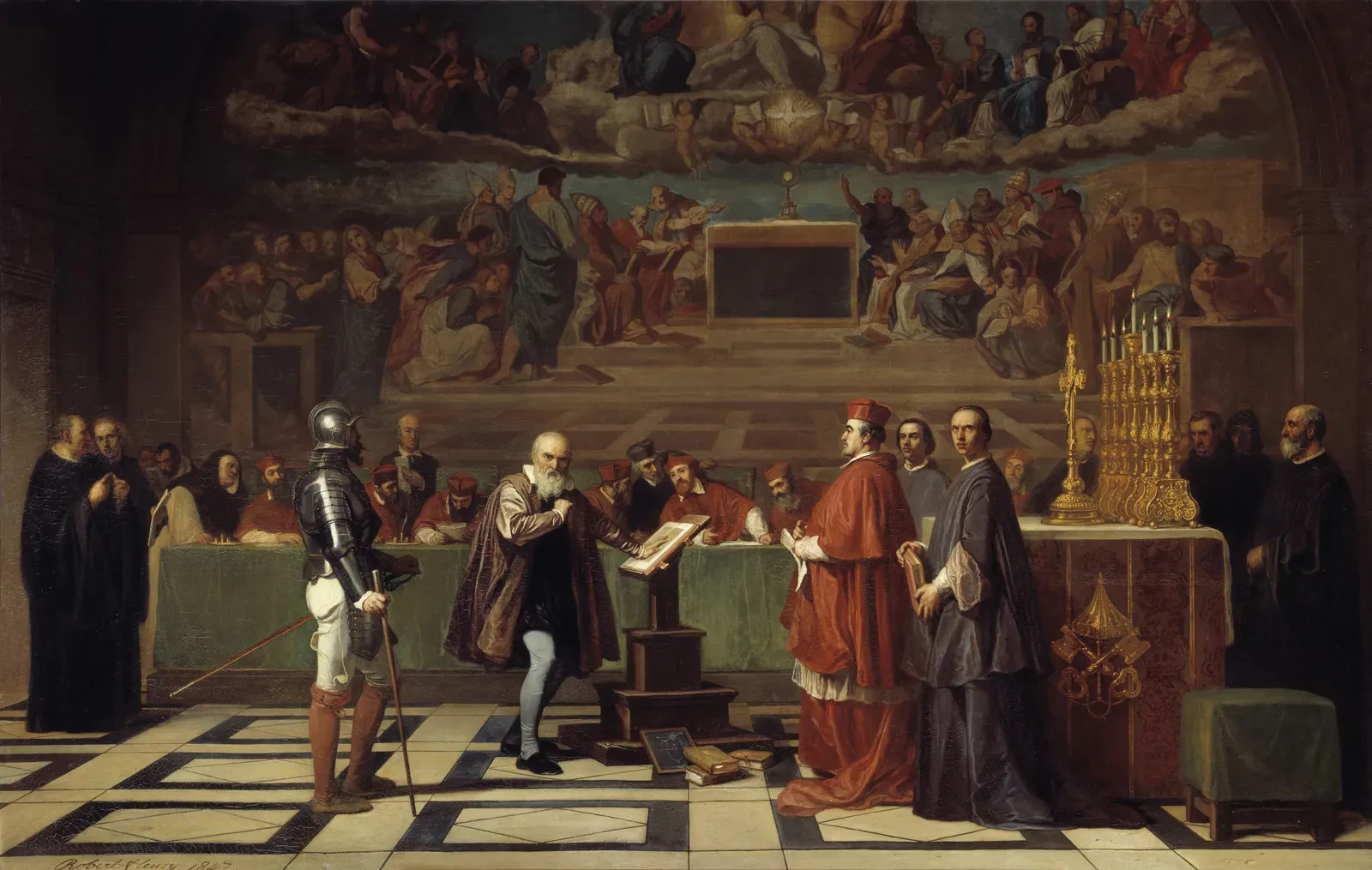
The painting everyone knows - Galileo before the Inquisition, the old man kneeling before black-robed judges - was made in 1857, more than two centuries after the event. By then the story had hardened into a perfect myth: reason on its knees before superstition, truth silenced by authority. The Romantics needed a martyr for the war between science and the Church, and Galileo fitted the role so well that they polished the facts until they gleamed. The reality of 22 June 1633 was messier, smaller, and in some ways more interesting.
Galileo had been warned seventeen years earlier. In 1616, Cardinal Robert Bellarmine - the most formidable theologian in Rome and not, by the standards of his time, an unreasonable man - summoned him and ordered him to abandon, not to hold, teach, or defend in any way whatever, the opinion that the sun stands still at the centre of the universe and the earth moves. This was not a death sentence. It was an injunction. Galileo accepted it, met the Pope, received assurances he was safe, and went home. Then in 1623 his old friend Maffeo Barberini was elected Pope Urban VIII. The climate changed overnight. Galileo visited Rome, had six audiences with Urban, and came away with permission to write about the Copernican system - provided he treated it as a hypothesis, not a physical fact. The terms were explicit.
What he published in 1632 was, by any honest reading, a violation of those terms. The Dialogue Concerning the Two Chief World Systems staged a debate between three characters: Salviati, a brilliant Copernican; Sagredo, a witty and open-minded moderator; and Simplicio - the Aristotelian geocentrist, whose arguments were demolished, ridiculed, and occasionally reduced to baffled silence by the other two. The name Simplicio, in Italian, carries the connotation of “simpleton.” This alone would have caused trouble, but Galileo had done something worse. Urban had personally asked him to include the papal argument about God’s omnipotence - the claim that God could make the universe appear heliocentric even if it were not, so absolute certainty was impossible. Galileo included this argument. He gave it to Simplicio. By the time the book had circulated through Rome, Urban’s enemies were whispering that the man he had personally patronised had caricatured him in print as a fool.
Urban VIII is not normally cast as a sympathetic figure in this story, and in most other respects he does not deserve to be. He was vain, politically reckless, and spent the duration of the Thirty Years’ War pursuing Italian dynastic quarrels while Protestant armies tore through Germany. But his fury at Galileo was not simple wounded vanity. He had extended extraordinary personal protection to a man who had been under suspicion since 1611, had lobbied for Galileo to be allowed to publish, had trusted that the agreed terms would be honoured - and then found himself mocked as a simpleton in a book that had sold out across Europe. The Inquisition moved not because the Church had just discovered heliocentrism, but because the pope’s patience had run out.
The trial was a grim piece of legal theatre. Galileo was sixty-eight, seriously ill, and had to be carried to Rome on a stretcher. He was interrogated under the threat of torture - the trial minutes use the precise legal formula - and required to “abjure, curse, and detest” the opinions he had spent thirty years developing. The sentence issued on 22 June 1633 was threefold: found “vehemently suspect of heresy,” sentenced to house arrest for the remainder of his life, and his Dialogue banned. In a separate action not announced at the trial, publication of any of his works was forbidden, including anything he might write in the future. He was seventy years old. The prohibition on his future works was, by any measure, institutional pettiness at its most thorough.
After the sentence, Galileo allegedly muttered “Eppur si muove” - and yet it moves. He almost certainly never said this. The first written account of the phrase appears more than a century after his death. It is exactly the kind of line that history invents retrospectively for the people it has decided were heroes, because the actual record is rarely as satisfying as the legend demands. What Galileo actually did after the trial was more instructive than defiance: he returned to his villa at Arcetri, in the hills above Florence, continued working, and in 1638 published his Dialogues Concerning Two New Sciences - a foundational text for classical mechanics, and arguably his most important scientific contribution - through a Dutch publisher in Leiden, where the Inquisition’s writ did not run. He wrote the work that mattered most while blind, under house arrest, with the Church’s agents monitoring his visitors. The system suppressed his voice and could not stop his mind.
I find the Church’s subsequent handling of the affair almost more telling than the trial itself. The general prohibition on heliocentric books was quietly dropped from the Index in 1758 - not in any spirit of scientific reckoning, but because the question had become embarrassingly settled. Copernicus’s De Revolutionibus was finally removed from the Index in 1835, two centuries after Galileo’s trial. John Paul II convened a commission to re-examine the case in 1981; when the commission failed to produce a definitive result, his 1992 speech closing the inquiry was widely reported as a rehabilitation but was, on close reading, notably vague about where exactly the Church had gone wrong. Three hundred and fifty-nine years to offer a partial apology for silencing a man who was correct. The Earth was not waiting for ecclesiastical permission to move.
The painting of Galileo before the Inquisition is still the image people reach for, and the myth it represents - reason against superstition - is not entirely wrong. The Church really did force a man to publicly deny what he knew to be true, and it really did suppress his books until the embarrassment became too great. But what the myth erases is the smaller, human story inside the grand confrontation: a scientist who could not resist turning his patron into a punchline, and a pope who could not forgive the insult. Galileo did not fall simply because he told the truth. He fell because he told the truth in a way that made his most powerful ally look like an idiot. The Earth was always moving. It was the Dialogue that pushed Galileo off his feet.