Most revolutions burn something down. The Glorious Revolution preferred paperwork.
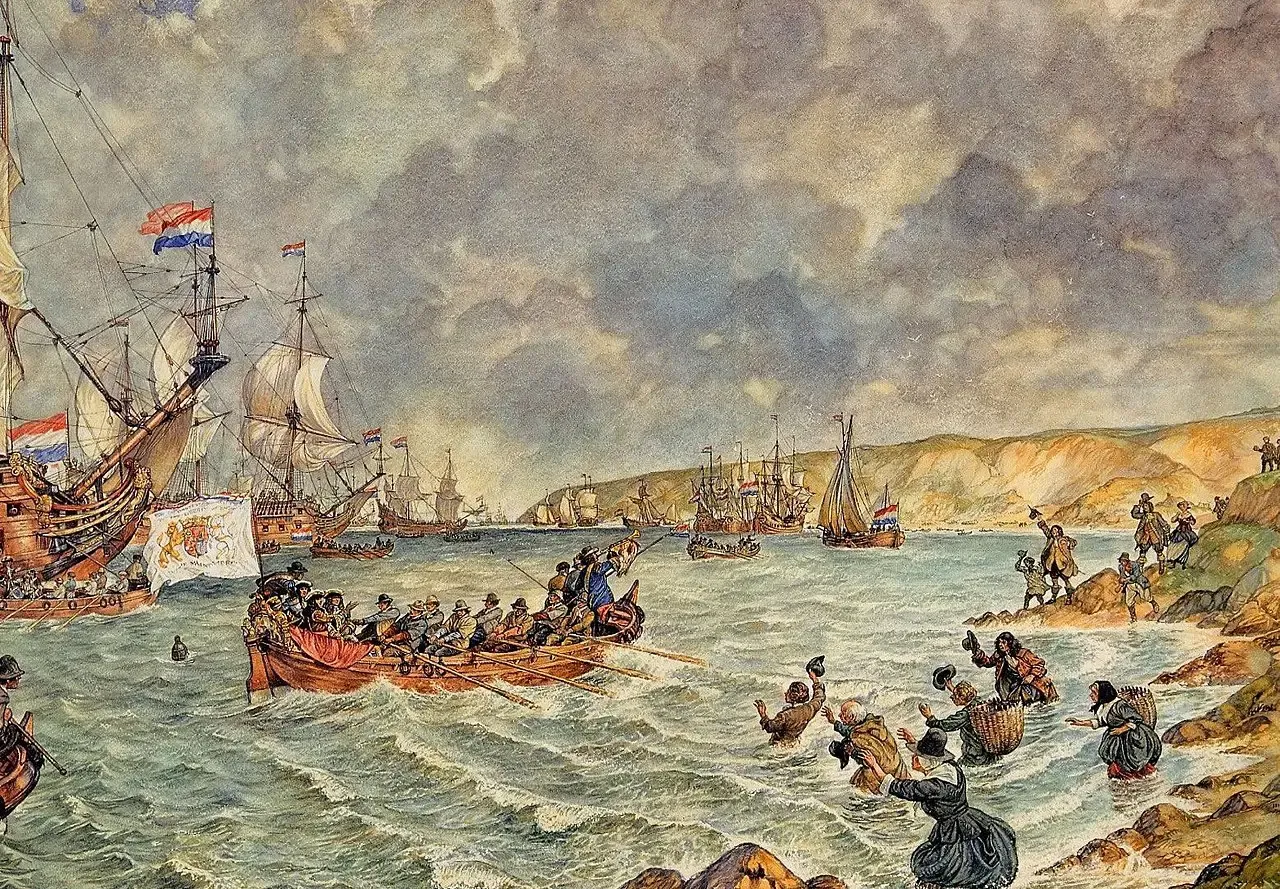
William of Orange did not seize the English throne in November 1688 - he was invited. Seven prominent Englishmen, including two bishops and a former admiral, sent him a letter in June 1688 listing James II’s offences and requesting that William come to England with an army. He obliged, landing at Torbay with 15,000 men on 5 November. James’s support collapsed with startling speed: his generals defected, his Protestant daughter Anne abandoned him, and by December he had fled to France, reportedly dropping the Great Seal of England into the Thames on his way out. He later retrieved neither the kingdom nor the seal.
On 11 April 1689, William and Mary were crowned as joint sovereigns - the only time in British history that a king and a queen regnant have shared the throne. What followed was the Bill of Rights, passed in December 1689, which settled in law what the revolution had achieved in fact. The monarch could no longer suspend Acts of Parliament, levy taxes without parliamentary consent, or maintain a standing army in peacetime without the same. Parliament would meet regularly and elections would be free. Catholics were barred from the throne in perpetuity. The theoretical architecture of the previous century - the Divine Right of Kings, the idea that a monarch answered to God and not to law - was not formally denounced or ceremonially burned. It was simply no longer operative.
France reached roughly the same constitutional destination - a state where law constrains executive power - through the Revolution of 1789, the Terror, Napoleon, the Bourbon Restoration, two more revolutions, the Second Empire, and another century and a half of instability. England got there in 1689 by sending a letter and reorganising its paperwork. The contrast is not evidence of some innate English reasonableness. It is evidence of timing: England had already had its violent phase. The Civil War of the 1640s and the execution of Charles I in 1649 had taught the political class what happened when constitutional disputes escalated to their logical conclusion. By 1688, even those who most wanted change were wary of the wreckage that came with it. When the opportunity arrived to constrain the monarchy without destroying the institution, they took it.
To call the revolution bloodless is not quite right. William fought a major campaign in Ireland, where James had fled with French support and found a Catholic population willing to fight for him. The Battle of the Boyne in July 1690 settled matters in William’s favour, but at considerable cost. Scotland had its own violent convulsions. The English constitutional settlement was achieved cleanly; the rest of the British Isles was a different story, and the wounds did not close quickly.
What endured from 1689, beyond the Bill of Rights itself, was structural. Parliament was now genuinely supreme, and a government that Parliament controlled could be trusted to borrow against its own revenue. The Bank of England was founded in 1694, five years after the coronation, and the logic was directly connected: parliamentary oversight of state finances made public credit possible for the first time. That credit funded the Royal Navy, the wars of the eighteenth century, and eventually the infrastructure of empire. The constitutional settlement and the financial revolution that followed were not separate events. One made the other possible.
The longer shadow falls across the Atlantic. The American colonists who drafted their constitutional documents in the 1770s and 1780s had read the English Bill of Rights and regarded it as their inheritance. The principle that a government requires the consent of the governed - and that this consent must carry legal force rather than merely theoretical acknowledgement - passed directly from Westminster into Philadelphia. Jefferson and Madison built on a foundation that 1689 had laid nearly a century before.
On 11 April 1689, two people were crowned who had not won a battle to be there. They had been invited in, produced a settlement, and signed it. The revolution earned its name from the outcome: glorious because it worked, because what came out of it lasted, and because the guillotine was conspicuously absent. History offers very few examples of a political order reforming itself without first destroying itself. England managed it once. That the process required a Dutch army to get started is, in a characteristically English way, left largely unmentioned.