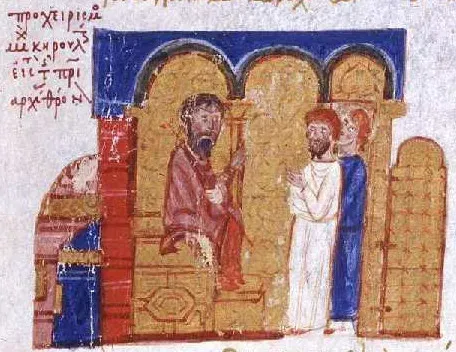
Saturday afternoon, 16 July 1054. The Divine Liturgy is underway in Hagia Sophia, the greatest church in Christendom, when three Latin churchmen walk up the nave to the altar, lay down a folded parchment, and walk back out. No sermon, no announcement, no fight. Just a document left on the altar of a building whose priests are, at that exact moment, mid-service. The parchment is a bull of excommunication against Patriarch Michael I Cerularius, Archbishop Leo of Ohrid, and everyone who follows them. Historians call this the formal start of the East-West Schism, the fracture that still separates the Catholic and Orthodox churches. What they mention rather less often is that the pope who supposedly authorised the document had been dead for three months, and Rome would not have a new one for another nine. The men delivering an ultimatum on the Holy See’s behalf were, at that precise moment, representing an empty chair.
The quarrel behind it had been building for longer than anyone involved was honest about. In 1053, Cerularius closed every Latin church in Constantinople, a retaliatory move against Norman pressure on Greek-rite churches in southern Italy. Archbishop Leo of Ohrid then wrote to a bishop in Apulia denouncing the Western practice of using unleavened bread in the Eucharist, arguing that azyma was not properly bread at all and that the Latin Mass was therefore no sacrament. Underneath the bread argument sat the real ones: the Filioque clause added to the Latin creed without Eastern consent, the pope’s claim to universal jurisdiction over bishops who considered themselves his equals, and Cerularius’s own habit of styling himself “ecumenical patriarch” and addressing Pope Leo IX as “brother” rather than “father” - a small linguistic slight that mattered enormously to men whose entire authority rested on titles. None of this, on its own, demanded a rupture. Leo IX needed Byzantine military help against the Normans overrunning southern Italy nearly as much as the emperor needed his. The mission he sent to Constantinople in 1054 was meant to negotiate, not to condemn.
Leo picked Cardinal Humbert of Silva Candida to lead it, alongside his secretary Frederick of Lorraine and Archbishop Peter of Amalfi. Humbert’s own contemporaries did not describe him as a natural diplomat, and the choice showed. Emperor Constantine IX Monomachos received the legates warmly - he wanted the alliance and had every incentive to smooth things over. Cerularius did not share the enthusiasm. He refused to grant the delegation a formal audience and left them waiting for months while, with nothing better to occupy them, Humbert and his colleagues threw themselves into informal theological arguments with Byzantine clergy over the exact issues Leo of Ohrid had raised.
Then, on 19 April 1054, Leo IX died in Rome. A papal legate’s authority is a personal grant from the pope who issues it; it does not survive him. The moment word of Leo’s death reached Constantinople, the three men carrying his letters were, strictly speaking, private citizens with an expired commission and no employer. The correct move was to go home and wait for a new pope. Rome would not get one until Victor II’s election the following April - a nine-month vacancy. Humbert and his colleagues instead stayed put through the spring and into summer, still arguing, still waiting for an audience that never fully materialised, acting with less and less claim to represent anyone but themselves.
What they produced on 16 July was, by the Church’s own later reckoning, an act with no one behind it: no living pope to have authorised it, and a target confined to three named men and their immediate followers rather than the entire Byzantine church. Cerularius did not let the gesture pass unanswered. On 20 July, he convened a synod of twenty-one bishops and metropolitans in Constantinople and had it excommunicate Humbert, Frederick, and Peter by name - a mirror-image gesture, personal rather than sweeping, proclaimed back in Hagia Sophia on 24 July. Two sets of clergymen had now excommunicated each other in their personal capacities, and technically nobody had excommunicated a church.
Nobody at the time treated it that way either. Byzantine chroniclers of the period barely mention the episode. Ordinary worshippers in Constantinople and Rome went on attending each other’s rites, and institutional ties that had nothing to do with theology carried on as if July 1054 had never happened: decades later, Pope Gregory VII was still confirming the Patriarch of Jerusalem’s ownership of a church property in the Pyrenees. The schism, in other words, was not experienced by anyone alive at the time as a hinge on which history turned. That reading was assembled afterwards, by people who needed a clean date for something that had actually been drifting apart for centuries and would keep drifting for centuries more.
What did the real damage came later and had nothing to do with parchment on an altar. The Massacre of the Latins in Constantinople in 1182, in which mobs killed thousands of resident Western merchants and clergy, poisoned relations far more thoroughly than Humbert ever managed. The Fourth Crusade’s sack of Constantinople in 1204, followed by the installation of a Latin patriarch on the Orthodox throne, did the rest. Those were events with bodies and stolen relics attached to them, not a dispute over bread recipes settled by three men nobody had authorised to settle anything.
In 1965, Pope Paul VI and Patriarch Athenagoras I met in Jerusalem and jointly lifted the mutual anathemas of 1054 - a genuine, considered gesture that both churches still describe carefully as not restoring full communion. By then, Catholic historians had long since conceded what should have been obvious from the start: Humbert’s bull was invalid the day he wrote it. A legate without a living principal cannot bind anyone in the principal’s name, and even taken at face value, the document excommunicated three named individuals, not a hemisphere of Christians. The parchment that landed on the Hagia Sophia altar that Saturday afternoon was worthless from the moment it touched the marble. The schism it is blamed for starting has outlasted the Byzantine Empire, the Papal States as anyone in 1054 would have recognised them, and every government that has existed on either side since. A document with no legal force behind it turned out to have all the staying power the two churches’ real, decades-in-the-making disagreements never quite managed to lose.