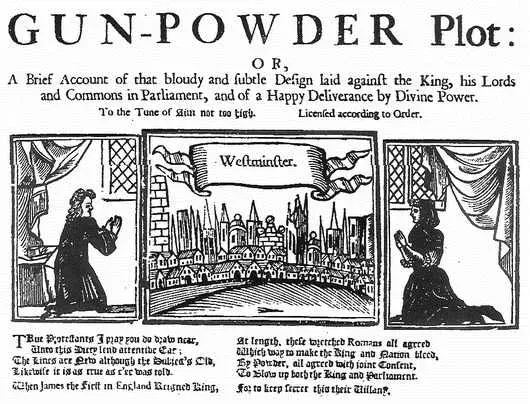
The school rhyme tells you to remember the 5th of November, and the rhyme is wrong about which date matters. On 5 November 1605, the Gunpowder Plot failed. On 31 January 1606, it ended. Four men were tied to wooden hurdles at the Tower of London, dragged through the winter mud across the city to Old Palace Yard at Westminster - a few yards from the cellar in which Guy Fawkes had crouched with thirty-six barrels of gunpowder eighty-eight days earlier - and hanged in front of the building they had tried to destroy. The bonfires every November mark the night nothing happened. The day something happened was a Tuesday in January, and it happened to the men who had tried to make it happen, by the slow and prescribed method that Tudor and Stuart law reserved for traitors to the king’s person.
The plan had been simple in concept and demented in scale. On 5 November 1605, James VI of Scotland and I of England would open his second parliament in the House of Lords. Beneath the chamber sat a vaulted undercroft that the conspirators had rented through a frontman, Thomas Percy. They had filled it with thirty-six barrels of gunpowder and covered them with iron bars and faggots of firewood. The intention was to detonate the lot under the king, his queen, his eldest son Henry, the entire House of Lords, and as many of the senior judges, bishops, and Privy Counsellors as the State Opening could collect into one room. The political establishment of England would be vaporised in a single morning. In the chaos, Catesby’s smaller force would seize Princess Elizabeth, the king’s nine-year-old daughter staying at Coombe Abbey in Warwickshire, and proclaim her queen as a Catholic figurehead under a Catholic regent. That was the entire plan. There was no second stage that survived contact with reality, and there did not need to be: the first stage was meant to remove every adult who could plausibly object.
The leader was Robert Catesby - a Warwickshire gentleman of exhausted patience and considerable charisma, whose cousins and friends made up most of the original cell. Guy Fawkes was the technician. He had spent ten years fighting in Flanders for Spain, where he had picked up the practical knowledge of mining, sapping, and gunpowder that the conspiracy required. He had also, in the course of that service, anglicised his name to Guido and acquired a habit of soldierly competence that the others lacked. He was the man left in the cellar with a slow match and a watch on the night of 4 November because he was the only man in the cell who understood how to set off thirty-six barrels of black powder without blowing himself up first.
What undid the plot was an anonymous letter sent on 26 October to Lord Monteagle, warning him to avoid the State Opening because “they shall receive a terrible blow this Parliament.” Monteagle handed it to Robert Cecil, the king’s chief minister, who almost certainly knew more than the letter contained and certainly knew how to use it. The cellar was searched twice, very theatrically, on 4 November. The second search, after midnight, found Fawkes, the powder, the matches, and a man who gave his name as John Johnson and explained that he intended to blow Scotsmen back to Scotland. He was taken to the Tower at three in the morning. The king, on reading the report, authorised torture - specifically, gentler tortures first, and “the gentler tortures are first to be used unto him, et sic per gradus ad ima tenditur” - and so by degrees to the worst. By 8 November Fawkes had given up the names. The signature on his confession is a broken scrawl across half the page; he could barely hold the pen.
The other conspirators ran for the Midlands and made one of history’s worse decisions: they tried to dry damp gunpowder in front of an open fire at Holbeche House in Staffordshire. The resulting accident burned several of them, including Catesby. The sheriff of Worcestershire arrived on 8 November with two hundred men. Catesby and Percy were killed in the ensuing shootout, reportedly by the same musket ball. The survivors were taken to London in irons.
The trial took place on 27 January 1606 in Westminster Hall. The verdict was a formality: under the statute of treasons, no defence was permitted to a charge of compassing the king’s death, and the evidence required no contesting. Sir Edward Coke, the attorney general, gave the prescribed sentence in its full and ceremonial form. The traitor was to be drawn backwards by a horse to the place of execution, hanged by the neck and cut down while still living, his bowels and genitals cut out and burnt before his eyes, his head struck off, and his body quartered. The four quarters and the head were to be placed where the king should appoint, “to the terror of all that should hereafter behold them.”
The sentence was carried out on two consecutive days. On 30 January, Sir Everard Digby, Robert Wintour, John Grant, and Thomas Bates were executed at the western end of St Paul’s Churchyard. On 31 January, Thomas Wintour, Ambrose Rookwood, Robert Keyes, and Guy Fawkes were taken from the Tower to Old Palace Yard, in front of the Houses of Parliament. The first three suffered the full sentence. Fawkes was last. He was already broken from torture - he could barely walk, and required help to climb the ladder to the gallows. At the top, before the noose tightened, he either jumped or his weight took him; in either case the fall snapped his neck and killed him at once. The disembowelling knife was used on a corpse. It was the small private mercy his own injuries had prepared, and the closest thing to a victory he was ever going to get.
The political consequences were the opposite of what the conspirators had intended. The Popish Recusants Act of 1606 imposed a new oath of allegiance on Catholics, requiring them to renounce the pope’s authority to depose the king - which most could not in conscience do - and barred Catholics from the legal profession, from medicine, from acting as guardians, and from voting in parliamentary elections. The disabilities took until the Catholic Emancipation Act of 1829 to lift, two hundred and twenty-three years later. The Observance of 5th November Act, also passed in 1606, made attendance at a thanksgiving service compulsory on the anniversary of the failed plot. Bonfires followed; effigies of the pope and, eventually, of Fawkes himself were burned. The act remained in force until 1859. The bonfires never went away.
There is a peculiar national talent on display in all of this - the way the English took a near-disaster involving the murder of their king and turned it into a centuries-long folk celebration with gunpowder and a guy on the fire. The plotters wanted to detonate the political establishment. They got themselves disembowelled and converted into a public holiday. The 5th of November is in the rhyme because it is the night the cellar was searched and the danger averted. The 31st of January is the day the men who had built that danger paid for it in the prescribed way under English treason law, in front of the building they had tried to blow up. One of those dates is the country’s shorthand. The other is the country’s actual answer.