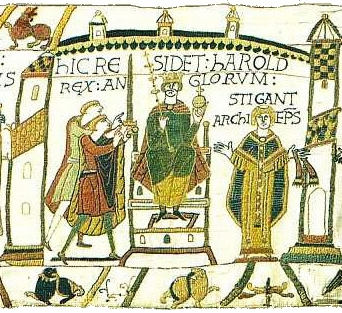
The coronation happened with indecent haste. Edward the Confessor died on 5 January 1066, and by the following morning - the feast of Epiphany - Harold Godwinson was being crowned in Westminster Abbey, probably the first English monarch to be crowned there. The reason for the speed was practical: the nobility of England was already assembled at Westminster for the holiday. The Witenagemot, the council of the most important nobles in the country, had chosen Harold, and Harold moved fast because England had no time for ceremony. Two armies were already being readied to dispute his crown.
Harald Hardrada of Norway had the thinnest of legal justifications: a succession pact struck between Harthacnut, who ruled England until 1042, and Magnus of Norway, whereby whichever died first would leave his kingdom to the survivor. Harthacnut died, Magnus gained Denmark, and the English throne - which was arguably also covered by that pact - went instead to Edward the Confessor. Hardrada, as Magnus’s heir, decided to press the claim his predecessor had neglected for twenty-four years. He had two things working in his favour: a fearsome military reputation earned across three decades of warfare from the Byzantine Empire to the North Sea, and an unexpected ally in Harold Godwinson’s own brother, Tostig.
William of Normandy’s claim was, in some respects, less absurd. Edward had spent more than twenty-five years in exile in Normandy, and Norman sources maintain he had promised William the succession. Whether that promise was ever genuinely made remains contested, but William believed it - or found it useful to believe it - and in 1064, Harold had apparently sworn on sacred relics at Bayeux to support William’s claim. Why Harold made that oath is disputed. Norman chroniclers say he was there as Edward’s messenger to confirm the succession; others say he had been blown across the Channel by a storm and took what deal he could to get home. Either way, when Harold accepted the crown in January 1066, William went immediately to Pope Alexander II - who declared Harold an oath-breaker and proclaimed the invasion a crusade - and began building approximately 700 warships on the Normandy coast.
The Godwinsons had been England’s dominant noble family for a generation. Harold’s father Godwin was a Sussex thegn’s son who had hitched his prospects to Cnut the Great, the Danish conqueror of England, and been rewarded with the earldom of Wessex in 1018. He survived the succession chaos after Cnut’s death in 1035, navigated three subsequent reigns, and became the kingmaker who helped Edward the Confessor onto the throne in 1042. When Edward married Godwin’s daughter Edith in 1045, the family’s position was unassailable. Harold had been Earl of East Anglia since roughly the same time, and on Godwin’s death in 1053 he stepped into the most powerful earldom in England. By 1066 he had led successful campaigns into Wales and crushed the Welsh king Gruffydd ap Llywelyn so thoroughly that Gruffydd was killed by his own men in 1063. He was, by every measure, the obvious successor.
He had also, the previous year, made an enemy of his brother. In 1065, the north of England rose against Tostig’s harsh governance and demanded his removal. Harold backed the rebels. Tostig was exiled. He did not forget and would dedicate the rest of his life to get even with this brother.
From January 1066, Harold prepared for war on two fronts simultaneously. He assembled his forces on the Isle of Wight, watching for the Norman fleet. The fleet didn’t come. For months the army held position, provisions running out, waiting for the wind that would carry William across the Channel. On 8 September, with food exhausted and his men near mutiny, Harold disbanded the force and returned to London. That same day, a Norwegian fleet of around three hundred ships sailed into the Humber estuary. Tostig was aboard, and so was Hardrada.
The northern earls Edwin and Morcar met the Norwegians at Fulford on 20 September and were beaten badly. Harold was in York four days later with a force that had just covered nearly 190 miles in under a week. The Norwegians, certain that no English army could have moved so fast, were resting at Stamford Bridge without their armour when Harold arrived. A story, probably embellished and possibly true, has Harold himself riding alone to the Norwegian lines before the battle and offering Tostig his earldom back. Tostig asked what Harold would give Hardrada for his trouble. “Seven feet of English ground,” Harold reportedly replied, “as he is taller than other men.” Then he rode back. The battle was a rout. Both Hardrada and Tostig were killed. The Norwegians had come in three hundred ships; the survivors left in twenty-four.
Three days after the victory, the messenger arrived. William had landed at Pevensey on 28 September with around 7,000 men. Harold had two options: wait in the north, rest his exhausted army, gather reinforcements from across the country, and let William burn Sussex in the meantime. Or march immediately. Harold marched. His army covered 240 miles in roughly nine days and established its position on the ridge at Senlac Hill, near Hastings, by the morning of 14 October.
The battle lasted nine hours. The English fought from the ridge in tight formation - the shield wall that was the foundation of Anglo-Saxon infantry tactics - while William’s cavalry and archers probed for gaps. Twice during the day the rumour spread through the Norman ranks that William was dead, and twice he had to remove his helmet and ride forward to prove he was alive. Harold’s wall held through the morning and into the afternoon. Then, either through a deliberate Norman feint that drew the English downhill in pursuit or through the sheer attrition of nine hours of killing, the line began to fragment. Harold’s brothers Gyrth and Leofwine were killed. Harold himself died - shot through the eye, or cut down by knights, or both, depending on which source you trust. William later refused Harold’s mother’s offer to ransom the body for its weight in gold. He thought it “unseemly to receive money for such merchandise.”
It was close. Harold had destroyed one of the most formidable armies in northern Europe eighteen days earlier, marched 240 miles, and fought all day before losing. An extra fortnight of rest, a different choice of ground, a few thousand fresher men, a lucky arrow hitting the Norman duke and the result might have been otherwise. We will never know.
What we do know is what followed. William was crowned in Westminster Abbey on Christmas Day 1066 - in the same church as Harold, eleven months and nineteen days later. Norman French became the language of the court, the law, and the ruling class; Old English survived as the tongue of the peasantry. Over the following centuries the two merged into what became Middle English and eventually the language in which this sentence is written. Every time an English speaker uses a word of French origin - justice, government, royal, parliament, noble - they are speaking in the shadow of Senlac Hill. English has two words for most farm animals: the Saxon farmer’s pig and the Norman lord’s pork, the Saxon cow and the Norman beef. The language carries that conquest in its bones.
Harold’s coronation and his death are the hinge on which English history turns. Everything before is Anglo-Saxon; everything after is something else.