The United States invented International Workers’ Day and then quietly refused to celebrate it. Every year on the 1st of May, workers march in London, Paris, Berlin, Mexico City, São Paulo, and a hundred other cities in memory of events that happened in Chicago in 1886. The country where those events happened holds its Labour Day on the first Monday in September — a date chosen specifically because it had no radical associations. That is, by any measure, a peculiar outcome.
On 1 May 1886, between 300,000 and half a million American workers went on strike. They had a simple demand: eight hours as a legal working day, from and after that date. The Federation of Organised Trades and Labor Unions had set the deadline two years earlier, and as the day approached, employers responded with lockouts, blacklists, Pinkerton agents, and hired strikebreakers. Workers responded with the largest co-ordinated labour action the country had yet seen. In Chicago alone, 30,000 to 40,000 workers walked out; perhaps 80,000 people were on the streets in various marches. They sang a movement anthem whose chorus was unusually direct about what was being claimed: “Eight hours for work. Eight hours for rest. Eight hours for what we will.” That last phrase was the one that frightened people. Not the economics — the leisure.
American workers in 1886 averaged slightly over sixty hours across a six-day week. In Chicago, German and Bohemian immigrants — the majority of the industrial workforce — earned around $1.50 a day for this. The argument for the eight-hour day was not merely that exhausted workers should get more sleep. It was that a person who works twelve or fourteen hours, travels to and from a factory, eats and sleeps, has no time left to be a citizen, a parent, a reader, a human being with preferences. The demand for eight hours for “what we will” was a demand for the category of life that did not belong to an employer. That is what the employers, and the newspapers that served them, found so intolerable.
On 3 May, August Spies — editor of the German-language anarchist paper Arbeiter-Zeitung and one of the main organisers of the strike — was speaking at a rally outside the McCormick Harvesting Machine Company on Chicago’s West Side when the end-of-shift bell sounded and striking workers surged toward the gates to confront strikebreakers. The police fired into the crowd. Two workers were killed; some accounts put the number higher. Spies, by his own later testimony, was “very indignant” and said the shooting had been done “for the express purpose of defeating the eight-hour movement.” He and fellow organisers printed flyers calling a protest meeting the next evening at Haymarket Square. The first draft included the words “Workingmen Arm Yourselves and Appear in Full Force.” Spies said he would not speak unless the line was removed. All but a few hundred copies were destroyed and reprinted without it.
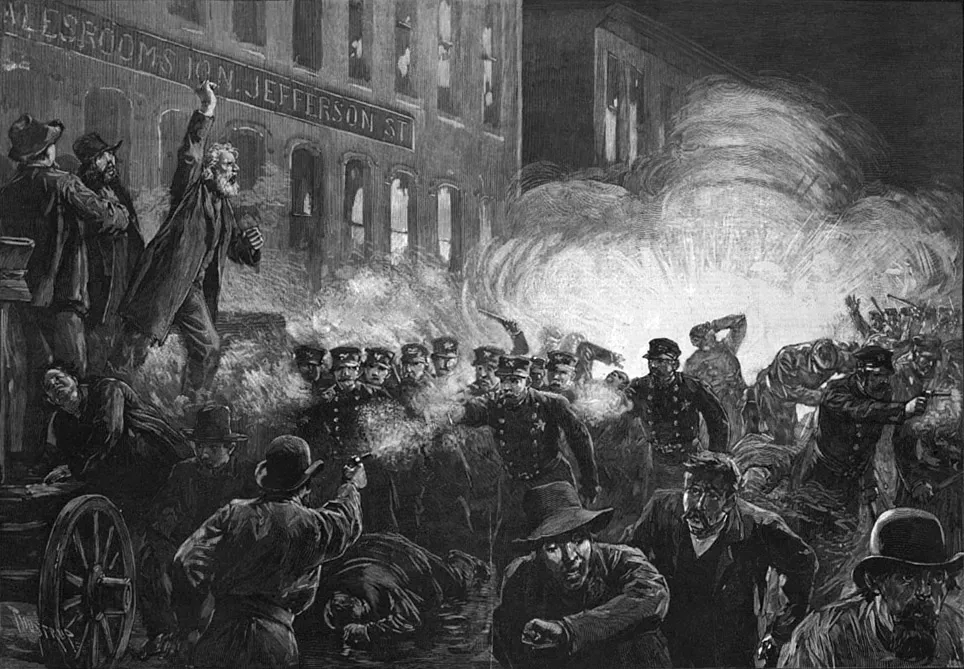
The Haymarket rally on the evening of 4 May began peacefully under a light rain. Spies, then Albert Parsons, then the Methodist pastor Samuel Fielden spoke from a wagon to a crowd variously estimated at between 600 and 3,000. Mayor Carter Harrison III had come to watch; satisfied the meeting was orderly, he walked home early. As Fielden was finishing his address, Police Inspector John Bonfield marched 176 officers in formation toward the wagon and ordered the crowd to disperse. Then someone — no one knows who, and no one has ever been brought to trial for it — threw a homemade fragmentation bomb into the advancing police column. Officer Mathias Degan was killed by the blast. The police opened fire. In less than five minutes the square was empty except for the dead and wounded: seven officers killed, at least four civilians. An anonymous police official later told the Chicago Tribune that “a very large number of the police were wounded by each other’s revolvers.”
What followed bore almost no relationship to justice. The city’s newspapers immediately declared anarchist agitators responsible. Police ransacked the offices of the Arbeiter-Zeitung and raided homes across the immigrant communities of the North Side without search warrants. Eight men were eventually indicted for conspiracy: of these, only two had been at Haymarket when the bomb went off, and neither of them had thrown it. One defendant had been at home playing cards. Another had been speaking at a different rally entirely. The man police most strongly suspected of throwing the bomb, Rudolph Schnaubelt, was arrested twice and released; by the time investigators realised his significance, he had left the country and was never charged.
The trial was a spectacle of prejudice presented as procedure. Judge Joseph Gary displayed open hostility to the defendants from the bench. The jury selection took three weeks and nearly a thousand prospective jurors; anyone who expressed sympathy for labour or socialism was disqualified, while men who admitted prejudice against the defendants were seated after saying they could try to be fair. The prosecution’s argument was novel: since the defendants had publicly advocated ideas that could have inspired the bomber, they were equally guilty as if they had thrown the bomb themselves. No direct connection to the bombing was required. The jury convicted all eight. Seven were sentenced to death.
Governor Richard Oglesby, a former Radical Republican who acknowledged that under the conspiracy logic applied at trial “all of us abolitionists would have been hanged a long time ago,” commuted two sentences to life in prison — but only for those who petitioned him for mercy. The four who refused to ask — Spies, Parsons, Fischer, and Engel — were hanged on 11 November 1887, dressed in white robes, singing the Marseillaise on the scaffold. Louis Lingg, who had built bombs but was not at Haymarket, died the night before by holding a smuggled blasting cap in his mouth like a cigar. It blew off half his face and he survived in agony for six hours.
August Spies’s last words from the gallows were: “The time will come when our silence will be more powerful than the voices you strangle today.” Albert Parsons had requested permission to speak his last words; the signal to open the trap door was given while he was still asking.
The executions were reported internationally. In 1889, when Samuel Gompers of the American Federation of Labor wrote to the founding congress of the Second International in Paris to report that American workers planned another mass strike on 1 May 1890, the International adopted a resolution calling for a global demonstration on that day — partly in solidarity with the eight-hour campaign, partly to honour what it called “the martyrs of Chicago.” The first International Workers’ Day on 1 May 1890 was enormous: the front page of the New York World that week covered demonstrations in two dozen European cities, plus Cuba, Peru, and Chile. The date became an annual event.
In 1893, Governor John Peter Altgeld — himself a German immigrant — pardoned the three surviving defendants. His statement did not hedge: the trial had been conducted with a “packed jury,” a “biased judge,” and a prosecution built on hysteria rather than evidence. “The state has never discovered who it was that threw the bomb,” he wrote, “and the evidence does not show any connection whatsoever between the defendants and the man who threw it.” Altgeld’s political career was effectively ended by the pardon. He lost his re-election campaign the following year.
The question of who actually threw the bomb was never resolved. The most likely suspect, Schnaubelt, died in 1901. Others have been named over the decades — a shoemaker, a Bavarian farmer, an unnamed outsider — without conclusive evidence attaching to any of them. The American justice system hanged four men for a conspiracy to commit a murder that no one in the courtroom was shown to have committed, and never came close to the person who actually did it.
May Day is today observed as a public holiday in more than sixty countries. The United States Congress, in 1958, designated 1 May as “Law Day.” In 1955, President Eisenhower proclaimed it “Loyalty Day.” Neither designation produced any parades worth noting. The eight-hour day, when it finally arrived in America — partly through the Fair Labour Standards Act of 1938 — arrived without ceremony or acknowledged connection to the men who first demanded it at Haymarket Square. You cannot hang a demand into silence. You can only make it take longer.