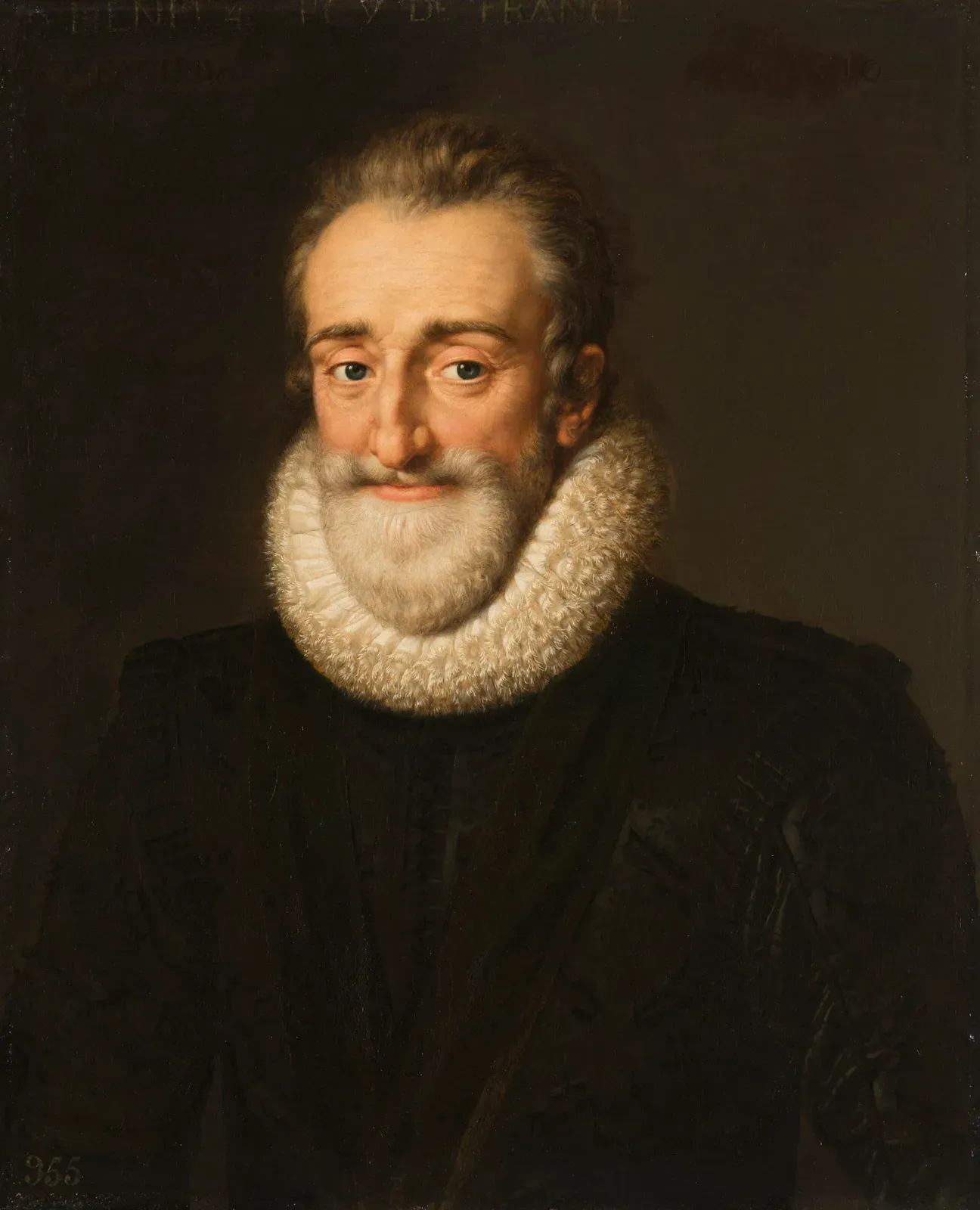
Henry IV of France had been shot at, nearly blown up, survived four decades of the most vicious religious civil war Europe had seen, converted from Protestantism to Catholicism to take his throne (“Paris is worth a mass,” he reportedly remarked, though he probably did not), and built a reign so popular that the French called him “Good King Henry” long after he was dead. He was killed in a traffic jam.
On the afternoon of 14 May 1610, his carriage became stuck on the narrow Rue de la Ferronnerie in Paris, wedged between a cart loaded with wine and a wagon loaded with hay, while his guards fell behind in the crowd - he had waved off the escort of the Horse Guard that morning as unnecessary for a short trip to visit his ailing finance minister. A man named François Ravaillac climbed onto the wheel and drove a knife between Henry’s ribs twice before anyone could stop him; a third thrust went wide and only tore the coat of the Duke of Montbazon, who was riding beside the king and survived his wound. The king was dead before they got him back to the Louvre. He was fifty-six years old.
It was, by most counts, the last of at least a dozen attempts on Henry’s life, and the ones before it had been the professional kind. Pierre Barrière was arrested in 1593 on his way to stab the king with a would-be accomplice’s blessing. Jean Châtel got further in December 1594, lunging at Henry with a knife as the king bent to greet two kneeling courtiers; the blade caught only his upper lip and knocked out a tooth, and the court jester wrestled Châtel to the floor before he could try again. Both men were executed for it, elaborately. Henry had spent the better part of two decades as a target for the fanatical edges of a country he had only ever partly reconciled, and he outlived every calculated plot against him. What finally killed him was a wine cart.
Ravaillac was not a foreign agent, not a conspirator backed by the Habsburgs or the Jesuits or the Spanish court, though contemporaries suspected all of them. He came, oddly enough, from a respectable family - his grandfather had been a prosecutor in Angoulême, two of his uncles were canons at the cathedral there - and worked first as a servant, then as a village schoolteacher, while an obsession with religion hardened into something his superiors found alarming rather than devout. He applied to join the ascetic Feuillants order and was dismissed after a short probation for being, in the examiners’ own phrase, “prey to visions.” In 1606 he tried the Jesuits instead and was turned down again.
By 1609 the visions had settled on a mission: Ravaillac believed he had been instructed to make Henry IV force the conversion of France’s Huguenots to Catholicism. Between Pentecost that year and the following May he travelled to Paris three separate times to deliver this message to the king in person and never once got near him. Frustrated and increasingly certain he had been personally deputised by God, he reinterpreted Henry’s actual plans - a military build-up tied to the Jülich-Cleves succession dispute in the Holy Roman Empire, backing a Protestant claimant against the Habsburgs - as the opening move of a war against the Pope himself. To Ravaillac, who barely distinguished between Protestant foreign policy and direct assault on Christendom, this was the confirmation he needed. He decided the king had to die, and set about arranging it alone.
Under torture, which was thorough, he insisted he had worked alone and received no instructions from anyone. The magistrates did not believe him. Most historians today do.
That consensus has never fully silenced the doubters, and the doubts are not baseless. On each of his three trips to Paris, Ravaillac lodged with Charlotte du Tillet, the mistress of the Duke of Épernon - the same Épernon who was sitting beside Henry in the carriage when the knife went in. Épernon made no visible effort to shield the king after the first blow, took custody of Ravaillac himself for most of a day before handing him to the courts, and later threatened one of the investigating magistrates to keep questions about his own conduct closed. In January 1611 a woman named Jacqueline d’Escoman, who had known Ravaillac, told the authorities that Épernon had arranged the whole thing; she was imprisoned for the rest of her life for saying so, which is either evidence of a cover-up or evidence that seventeenth-century France had no patience for regicide theories it hadn’t authorised. Historians have argued both sides since, Philippe Erlanger for a plot involving Épernon’s circle, Roland Mousnier for a lone fanatic answerable only to his own visions. Neither camp has ever produced anything sturdier than circumstance.
The man he killed was one of the more unlikely kings in French history. Henry of Navarre had been raised Protestant in the south of France by a mother, Jeanne d’Albret, who made Calvinism a point of family honour. He fought in the Wars of Religion from his teens, survived the St. Bartholomew’s Day Massacre in 1572 only because he was under royal protection as the recent bridegroom of Margaret of Valois, and spent the following years as effectively a prisoner of the Catholic court before escaping in 1576 and returning to lead the Protestant cause. When Henry III - the last Valois - was assassinated in 1589 with no heir, Henry of Navarre was the legal successor. The Catholic League, which controlled most of the country, refused to recognise a Protestant king. He fought them for four years.
In 1593 he converted to Catholicism. “Paris is worth a mass” captures the political calculation neatly whether he said it or not. Five years later, in 1598, he issued the Edict of Nantes: a settlement that ended the Wars of Religion by granting French Protestants the right to worship in designated places, maintain their own courts, and garrison specific towns. It was not equality - the edict treated Protestants as a recognised minority under carefully controlled conditions, not as full citizens - but it was the most comprehensive religious settlement France had produced, and it held. The thirty years of war that had killed hundreds of thousands and stripped entire regions were over. That was his achievement and his political justification. The Catholic extremists never forgave him for either.
The Jülich affair that triggered Ravaillac was, in French strategic terms, entirely conventional: a Protestant-backed intervention in an Imperial succession dispute that also happened to weaken the Habsburgs, with whom France had been at odds for the better part of a century. The army Henry was assembling in May 1610 was not a crusade against Rome. Ravaillac’s logic - convert-king, Protestant army, anti-Habsburg campaign - collapsed these separate facts into a single unified threat, the way conspiracy thinking always does. The king who had ended France’s religious wars by protecting Protestants appeared, through that particular lens, to be the greatest danger French Catholicism had ever faced.
His death produced exactly the instability that forty years of civil war had threatened to make permanent. Henry left a nine-year-old heir, Louis XIII, and a widow, Marie de’ Medici, who assumed the Regency. Marie promptly reversed the foreign policy her husband had been preparing, made peace with Spain, and arranged Spanish marriages for her children - undoing, in months, the anti-Habsburg position Henry had spent years constructing. The factions he had defeated and reintegrated regained influence. The Huguenot governors who had relied on his patronage lost their guarantor. For a decade, France came close to sliding back into confessional conflict.
It did not slide, ultimately, because of one man. Cardinal Richelieu entered the royal council in 1616 and became chief minister in 1624. He subordinated everything - religious sympathy, personal morality, the outrage of Catholic Spain - to the project of building French state power. He crushed Huguenot political and military independence at the Siege of La Rochelle in 1628, then proceeded to ally France with Protestant powers against the Habsburgs in the Thirty Years’ War. The logic was Henry IV’s foreign policy, pursued with considerably more ruthlessness. The absolute monarchy that Louis XIV would complete after 1661 - the one built at Versailles, the one that made France the dominant power in Europe for two generations - was constructed on foundations Henry had laid and Richelieu had reinforced.
The man Ravaillac stabbed on the Rue de la Ferronnerie was not, as Ravaillac had imagined, the destroyer of French Catholicism. He was one of its more effective rulers: a king who had made France, long ungovernable through religious war, governable again, by the simple method of refusing to let either side win permanently. Ravaillac wanted to save the Church from Henry IV. What he actually produced was a Regency sympathetic to Habsburg Spain, followed by a prime minister who made Catholicism politically irrelevant to the question of who France’s enemies were. He wanted to protect the faith. He accelerated the conditions that produced the modern secular state.
Henry was buried at Saint-Denis, in the crypt of French kings. Ravaillac was executed on 27 May 1610 in the Place de Grève by the method reserved for regicides. The hand that had held the knife was scalded first with burning sulphur; then his flesh was torn with red-hot pincers and the wounds packed with molten lead, boiling oil, and resin, an ordeal drawn out deliberately over more than an hour before the horses were even brought up. Four of them were tied to his arms and legs and driven apart, and when the animals struggled to finish the job, the crowd hauled on the ropes alongside them until the work was done. The crowd that watched had loved the king, and made sure the debt was collected in full. The man who had wanted to save France from its best ruler in a century died slower than the king he killed, and achieved considerably less.