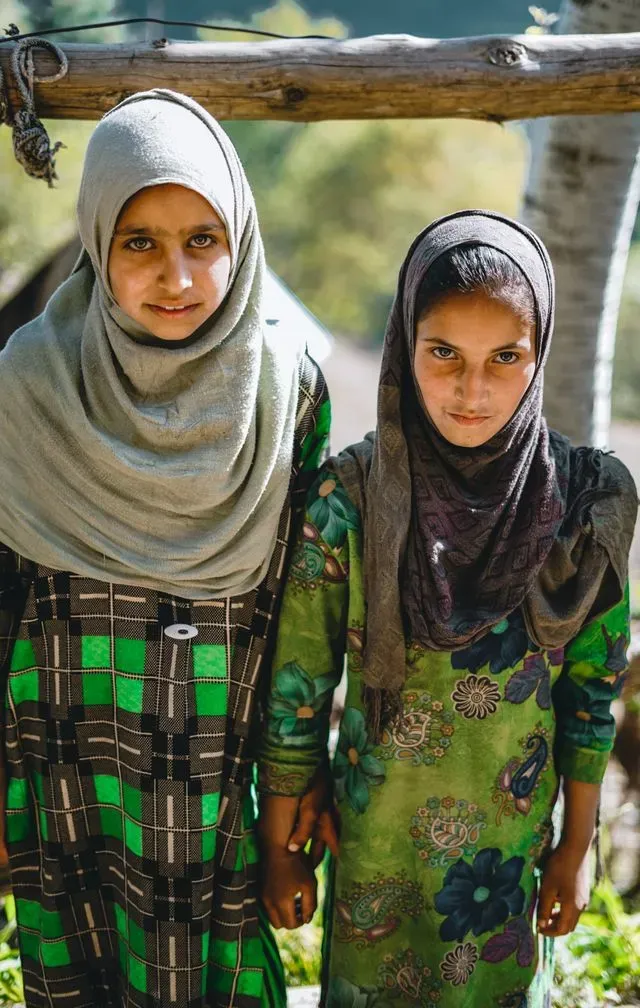
There is something peculiar about the global response to the Taliban’s education ban. Conferences are convened. Statements are issued. UN resolutions are passed. World leaders express grave concern. And Afghan girls, forbidden from entering a classroom since 2022 - the point at which the prohibitions reached their current scope, after arriving in waves following the 2021 takeover - wait. What they are mostly waiting for, it seems, is for someone else to solve the problem.
I understand the impulse to look towards external pressure. The Taliban government runs the country; only the Taliban can reopen the schools. But the history of negotiating with people who view female education as a theological threat does not offer much encouragement on timelines. It could be years before anything changes at policy level. It could be decades. A generation of Afghan girls is accumulating a gap in their education that grows wider with each passing month, while everyone waits for the mullah who will have a change of heart. Waiting, as a strategy, has an obvious flaw: it does nothing during the wait.
There is an alternative, and it has nothing to do with convincing those clerics with Kalashnikovs. It requires a phone, or a laptop, and periodic access to the internet.
Homeschooling is not some radical fringe experiment. Parents across the United States, Britain, Australia, and Germany have been educating their children at home for years - in some cases decades - not because they lacked a school to send them to, but because they concluded they could do better themselves, or at least differently. The reasons vary: religious conviction, dissatisfaction with state curricula, children with learning needs that standard classrooms handle badly, or simply parents with the time and the confidence to take it on. Whatever the motive, the infrastructure exists, and it is not expensive. There are textbooks covering every subject at every age. There are structured curricula that can take a child from first principles to university entrance standard. There are exercise books, practice exams, and, increasingly, video lectures and interactive platforms that do a better job of explaining long division or the periodic table than most classroom teachers manage. Khan Academy, to name only the most visible example, provides a complete mathematics and science education up to secondary school level, for free, supported by video tutorials that a student can pause, rewind, and replay as many times as she needs. A lot of this material requires nothing more than a working internet connection.
Afghanistan still has one. The Taliban attempted to restrict internet access after taking power. That effort was rolled back relatively quickly - too much of the economy and government administration depended on connectivity for a complete blackout to survive even brief contact with reality. Afghans can, at least in principle, get online. The materials are out there.
The practical obstacles are real, and I do not want to dismiss them. The overwhelming majority of high-quality homeschooling resources are in English. Khan Academy is mostly English-language. MIT OpenCourseWare is in English. The best freely available textbook libraries are in English, Spanish, French, German - the languages of countries with strong educational publishing markets and the money to fund digital learning. Dari and Pashto are not on that list. A girl in Kabul who speaks neither English nor any other European language faces an immediate wall before she has opened a single lesson.
This is exactly where two groups that claim to care deeply about Afghan women could stop debating and start building something. The Afghan diaspora - hundreds of thousands of people distributed across Germany, Australia, the United States, the United Kingdom, and elsewhere - contains teachers, academics, software developers, translators, graphic designers, and people with money to donate. NGOs already working in the space of Afghan women’s rights spend considerable sums on advocacy reports, media campaigns, annual conferences, and communications staff. Some fraction of that money, directed at producing a coherent library of homeschooling materials in Dari and Pashto, would accomplish something concrete rather than provide that warm and fuzzy feeling of completing a useless PR activity. A practical starting point would not even require original content: collect the most important existing materials in one place, translate a basic orientation guide into Dari and Pashto so that parents know what exists and how to use it, and begin working through the most important subjects. Mathematics first. Reading and writing. Science. History, the unsanitised version.
The translation problem is also less formidable than it was even five years ago. AI translation tools now produce competent first-draft outputs across most language pairs, including Dari and Pashto. The output is not perfect - a human editor still needs to review it, catch errors, and ensure the material reads naturally rather than like something squeezed through a machine. But the heavy lifting, the first pass through a 300-page secondary school physics textbook, can be done in hours rather than months. The marginal cost of building a translated curriculum has dropped dramatically. A medium-sized NGO with a focused mandate and, realistic budget and, most importantly, the staff that really cares, could plausibly produce a comprehensive K-12 resource library in Dari within two years. Whether such materials already exist, produced perhaps during the period of American presence and the educational infrastructure that came with it, I genuinely do not know. If they do, the task is easier still - it becomes a matter of locating them, organising them, and making them findable.
There is also a technical dimension that any serious effort in this space needs to address from the start. Internet access in Afghanistan is not uniformly available. In rural areas it is expensive relative to local incomes, often slow, and frequently unreliable. Applications that require a continuous broadband connection are applications that exclude the girls in Helmand and Kunduz who need the materials as much as anyone in Kabul. The solution is not complicated: offline-first design. Learning platforms built to download completely over a single session - when a connection is available - and then run without network access for days or weeks. A basic Android phone with a microSD card can hold more educational content than a school library; the storage is cheap and the devices are widespread. Progress tracking, assessment, and updates could sync back to a server whenever connectivity permits. None of this requires inventing new technology. It requires someone building it for this specific context with this specific user in mind, rather than assuming the user has a reliable broadband connection in a country where that assumption is false.
I am also fairly confident that what Afghan girls have been missing is not quite the educational treasure it is sometimes presented as. Afghan state schooling before 2021 was not an impressive operation. Attendance rates were low, particularly in rural areas. Teacher quality was uneven, and teacher pay was poor enough that the profession attracted those who had no other option rather than those most suited to it. School buildings in provincial areas ranged from inadequate to non-existent. The government curriculum was already constrained by conservative political demands, restricting what could be taught and to whom. The education that Taliban policy banned in 2022 was real and its loss is a genuine harm; but it was not, in many cases, a high-quality education. Homeschooling with well-designed international materials - rigorous, paced appropriately, covering subjects that a state curriculum might have glossed over - is not a like-for-like replacement for access to a good school. But it is a reasonable replacement for access to a mediocre one, and in some measurable respects it can be better. A girl working through a serious mathematics course at her own pace, with video explanations available whenever she is confused and practice problems to test understanding, may come out of it knowing more mathematics than she would have retained from a forty-student classroom with a single undertrained and reluctant teacher and a textbook last updated before her mother was born.
None of this is an argument for abandoning the campaign to pressure the Taliban to change course. Of course that campaign should continue. But the goal of external pressure is a policy change that may arrive in five years or fifteen, and in the meantime there are girls whose education has been suspended while the world negotiates. Homeschooling is not a replacement for the fight to restore legal access. It is something that does not require waiting for the outcome.
And there is something to be said for the safety of it. A girl studying at home, from a device that looks like anyone else’s phone, working through a lesson with an earphone in, is invisible to the apparatus of enforcement in ways that a girl walking to a school building or attending a covert classroom is not. The learning happens away from the gaze of the people who banned it. Whatever else homeschooling is, in this particular context it is also discreet.
There is a small linguistic irony embedded in all of this that I find difficult to let go. The word Taliban is the Pashto plural of Talib - an Arabic-derived word meaning, simply, a student. The Taliban as a movement were largely graduates of Pakistani madrasas, religious schools that took in young men from Afghan refugee communities and put them through years of intensive Quranic instruction. Their identity as a political and military force is built, etymologically, around the concept of the student, the seeker of knowledge, the one who sits before a teacher and absorbs.
If Afghan girls and women use this period - forced on them by a government that regards their education as either irrelevant or threatening - to educate themselves, to build knowledge from whatever materials they can reach, to accumulate the understanding and the skills that formal schooling should have given them, they will have become, in the plainest sense of that word, Talibs. Students. Not indoctrinated in a madrasa in Peshawar, but teaching themselves chemistry and literature and algebra from a phone in a house in Kandahar or Jalalabad, beyond the reach of any edict about what they are permitted to know.
That generation will not change Afghanistan overnight. The Taliban will still be there tomorrow, and possibly for a considerable time after that. But history has a way of settling accounts through the people who were patient enough to prepare while others held power. The question is not really whether Afghan women will eventually reclaim a full place in their own society. The more interesting question is whether they will get there equipped with the education that should have been available all along, or having spent years waiting for permission to learn - which is the one thing nobody has ever needed to ask for.