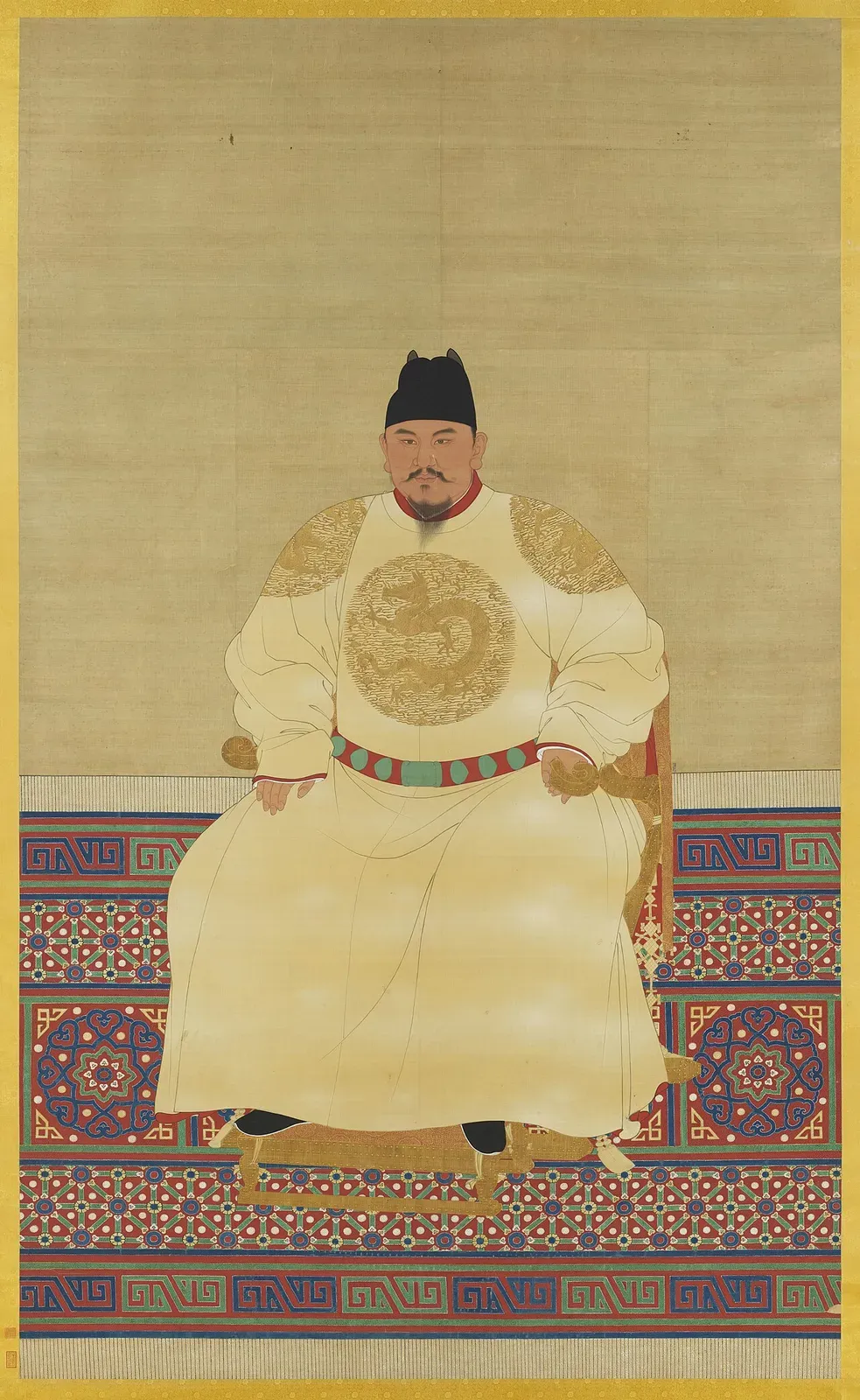
His name at birth was Zhu Chongba, meaning “double eight.” It was a name given to him because his family was too poor to afford proper names, so they numbered their children instead. His father was a tenant farmer in Anhui province, perpetually one bad harvest away from ruin. In 1344, when Zhu was sixteen, plague swept through the region and killed his parents and two of his brothers within weeks. He had no money to bury them properly. A neighbour eventually gave him a piece of cloth to wrap the bodies in. He entered a local Buddhist monastery because there was nowhere else to go.
He spent the next three years wandering as a mendicant monk, begging for food across eastern Henan and northern Anhui. He was illiterate. He owned nothing. He had no family left to speak of.
Twenty-four years later, on 23 January 1368, he proclaimed himself the Hongwu Emperor and founded the Ming dynasty, which would rule China for nearly three centuries.
The China he was born into was under Mongol rule. Kublai Khan had completed the conquest of the Southern Song in 1279, making the Yuan dynasty the first foreign regime to control all of China. By the 1340s, the Yuan was disintegrating from within - endemic corruption, catastrophic flooding along the Yellow River, a plague epidemic, and tax policies that had ground the peasantry into the earth. In 1351, the Red Turban Rebellion erupted across northern China. Zhu joined the rebels in 1352, when the Yuan army burned down his monastery on suspicion of its links to seditious societies. He arrived in the rebel camp at Haozhou with nothing but a reputation for being physically unprepossessing and unusual intelligence. He rose quickly regardless.
What set him apart from the dozens of warlords competing to carve up the collapsing Yuan empire was a quality that is rarer than battlefield courage: the ability to build institutions. Where other rebel leaders looted, Zhu taxed moderately and governed. Where they ruled through personal loyalty and family connections, he recruited Confucian scholars and built an administration. He captured Nanjing in 1356 and made it his base, and from there he operated less like a rebel than a state in formation. He minted coins in 1361. He created monopolies. He kept records. While his rivals were fighting over silk and grain, he was building a bureaucracy.
The moment that decided everything came in the summer of 1363. His principal rival, Chen Youliang, ruler of the state of Han in the central Yangtze valley, raised an army of 300,000 men and a fleet of enormous tower ships, each several storeys high, and advanced on Nanjing. Zhu met him with roughly 100,000 soldiers at Lake Poyang, in what became the largest naval battle in Chinese history. The fighting lasted thirty-six days. Chen’s ships were larger and more numerous; Zhu’s were faster and better commanded. Zhu personally directed the battle from the front, surviving at least one ambush in which his command ship ran aground. Chen Youliang was killed by an arrow during a breakout attempt. His enormous fleet surrendered. The way south and west was open.
By 1367, Zhu had eliminated Zhang Shicheng, the last serious rival in southern China, after a ten-month siege of Suzhou. Then he sent a 250,000-strong army north under his two best generals, Xu Da and Chang Yuchun. The Yuan emperor Toghon Temür fled Beijing in September 1368 without fighting. Ming forces entered the city and renamed it Beiping - “Pacified North.” The dynasty that Kublai Khan had built, and that had ruled China for eighty-nine years, simply evaporated.
Zhu named his dynasty Da Ming - “Great Radiance.” His reign name was Hongwu - “Vastly Martial.” He governed for thirty years, which is long enough to reveal the full shape of a character that is rarely simple.
The institutional instincts that had distinguished him as a rebel served him well in the first decade of his reign. He reorganised the land registers, redistributed confiscated land to peasants, kept taxes low, built 40,987 dams and canals across the empire, and established local self-government structures that survived him by two centuries. He had a genuine sympathy for the rural poor - he never stopped referring to himself as “a villager from the right bank of the Huai River” - and he pursued the wealthy with a vindictiveness that was partly ideological and partly the settled score of a man who had buried his parents in a borrowed cloth.
The darker side was there from the beginning and grew worse. He abolished the position of Grand Chancellor in 1380 after executing the incumbent on suspicion of conspiracy, then permanently banned its restoration and placed all six ministries directly under his personal control. He established the Embroidered Uniform Guard, a secret police reporting only to him. He became convinced, with some historical justification given how he himself had come to power, that his generals were plotting against him. During his thirty-year reign, approximately 100,000 people were killed in political purges - a figure that says something particular about a man who had himself risen by exactly the routes he then spent his life closing off.
He died in June 1398, aged sixty-nine, having outlived his chosen heir by six years. Within four years of his death, his fourth son Zhu Di had seized the throne from the designated successor in a civil war, burning Nanjing’s palace in the process and moving the capital to Beijing, where it would remain. The dynasty’s political arrangements did not survive him intact.
None of that should obscure what happened on 23 January 1368. A man born without a real name, who had begged for food as a teenager and entered a rebel army as a foot soldier at twenty-four, had driven the Mongols out of China and made himself its emperor. Chinese history has no shortage of founders, but it has none quite like this one. Most dynasties were founded by men of military families, or dispossessed nobles with claims to restore, or warlords who had inherited armies. The Hongwu Emperor had inherited a begging bowl and a borrowed piece of cloth. The rest he built himself.