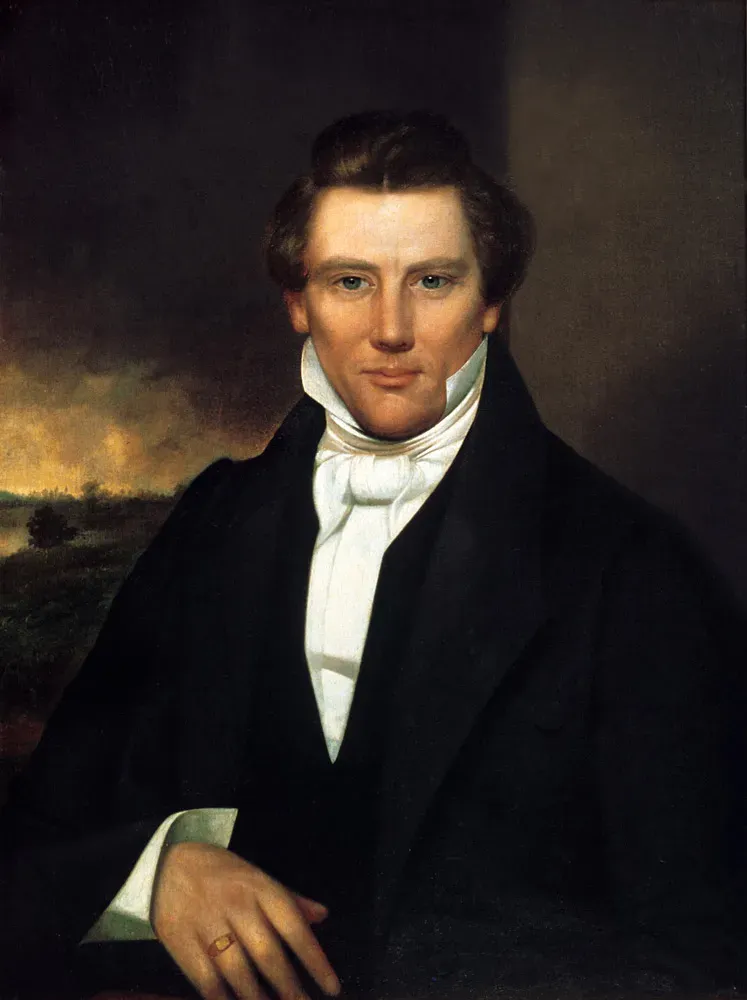
Joseph Smith was running for President of the United States when he was shot dead jumping from a second-floor window on 27 June 1844. He was also the mayor of Nauvoo, Illinois, the lieutenant-general of its 5,000-man city militia, and the prophet of God. He held all four positions simultaneously, and had found no contradiction in any of them.
The sequence of events that put him in Carthage Jail began three weeks earlier with a newspaper. The Nauvoo Expositor, founded by a group of recently excommunicated Mormons who objected to polygamy, published its first and only issue on 7 June 1844. It reported that Smith was secretly married to at least eight other men’s wives, that he was teaching a “plurality of Gods,” and that he intended to rule Nauvoo as a theocratic king. The charges were, by the historical record, substantially accurate. Smith’s response, acting in his capacity as mayor, was to convene the city council, have the Expositor declared a public nuisance, and order its printing press destroyed.
A city mayor destroying a newspaper’s printing press in 1844 Illinois caused, as you might expect, some outrage. Thomas C. Sharp, editor of the competing Warsaw Signal, published what amounted to a call for murder: “War and extermination is inevitable! Citizens ARISE, ONE and ALL!” Smith was charged with inciting a riot. He declared martial law, briefly fled across the Mississippi to Iowa, then returned when Governor Thomas Ford personally pledged the faith of the state of Illinois to his safety. On the road to Carthage, Smith told his companions: “I am going like a lamb to the slaughter; but I am calm as a summer’s morning.” These are the words of a man who had already decided on his narrative.
The governor’s assurance expired that afternoon. The Carthage Greys, the local militia assigned to protect the jail, reportedly fired blanks over the heads of the approaching mob before stepping aside. Between 150 and 200 men with blackened faces stormed the building. Hyrum was shot in the face within seconds; he fell saying, “I am a dead man!” Joseph emptied a small pepper-box pistol, smuggled into the jail under a visitor’s overcoat, into the mob - wounding three of the attackers - before moving toward the window. He was shot twice in the back before reaching the sill, and again in the chest as he fell to the ground below. He was 38 years old.
Five men were subsequently indicted for the murders. All five were acquitted by a jury from which, at the defence’s insistence, every Mormon member had been excluded. Governor Ford later wrote that it was probably for the best that Smith’s followers had been driven from Illinois. He called Smith “the most successful impostor in modern times.”
Ford was not wrong about the imposture. He was wrong about whether it mattered. What needs explaining about the Latter Day Saint movement is not that Smith convinced people he was a prophet in the 1820s - the burnt-over district of New York was crackling with religious revivalism, and Smith was skilled at working the materials of his culture. People believe prophets during religious frenzies; that is what frenzies are for. What needs explaining is that the believers kept on believing after everything fell apart. He produced his scripture by methods that invited scepticism from the start. He was charged with polygamy and perjury. He destroyed a newspaper that was reporting the truth. He declared martial law in an American city. He died in a jail, shot while trying to jump from the window. None of it dented the religion.
People tend to assume that religion requires antiquity to survive - that the reason anyone still believes in Moses or Muhammad is that we cannot interrogate those origins the way we can interrogate modern claims. Smith dismantles this assumption efficiently. His origins were subjected to scrutiny from the start. Courts tried him. Journalists exposed him. Historians have spent nearly two centuries examining his claims and the verdict has not been kind to them. None of this matters in the way the sceptics assume it should.
What killed Smith was also, precisely, what proved he was a man of his time: a newspaper willing to print what it knew, a court empowered to charge him, a mob that could reach him in a building that any sheriff could enter. Ancient prophets are insulated by distance. Smith operated in full view, in a country with a free press and elected governors, and every institution of modernity was eventually brought to bear on him. Then his church grew.
The martyrdom is not incidental to the story. It is structural. What makes a prophet credible is not evidence but suffering - preferably spectacular, public, and unjust. Jesus died on a cross. Joseph Smith fell from a jailhouse window in Illinois, in the afternoon, in front of witnesses who wrote it all down. The mob that blackened their faces and stormed Carthage Jail did the Latter Day Saint movement its greatest single favour: they gave it a martyr whose death could be dated, documented, and mourned in detail. And Smith had scripted his own exit with an instinct that is difficult not to admire. You cannot invent a better line than “I am going like a lamb to the slaughter” - even if, and especially if, you try.