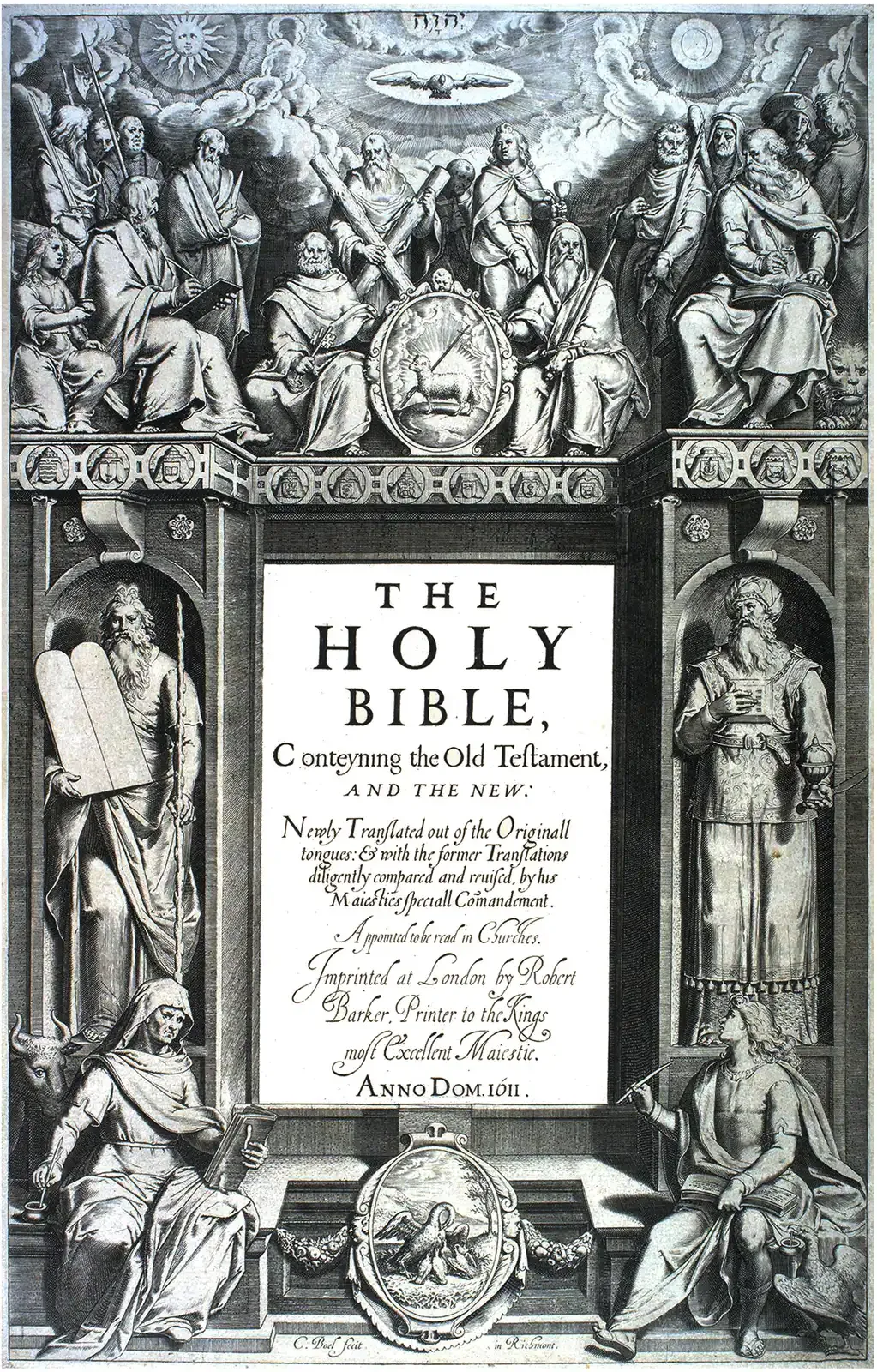
On 2 May 1611, Robert Barker - the King’s Printer - published a new English Bible from his shop on Aldersgate Street in London. The title page credited no individual translator. It offered no marginal commentary on the text inside. Both of these absences were deliberate, and both of them were consequential in ways the man who had commissioned the book did not foresee.
James I had set the project in motion at the Hampton Court Conference in January 1604. The occasion was formally a meeting to discuss Puritan grievances about the Church of England, and James largely ignored those grievances, but one complaint produced a genuine response. The Puritans wanted a new translation of the Bible. James agreed, with an enthusiasm the Puritans had not quite anticipated, because he had his own reasons. The Bible most English Protestants were actually reading - the Geneva Bible, produced by English exiles in 1560 and reprinted over a hundred and fifty times by 1611 - came with roughly sixty thousand words of marginal annotation. James had read those notes and despised them. Several of them drew attention, at the relevant passages, to the right of the faithful to resist tyrannical rulers. One annotation on Exodus 1, where the Hebrew midwives defy Pharaoh’s order to kill Jewish infants, endorsed their “commendable” disobedience. Another on 2 Chronicles 15 implied that idolatrous kings deserved to be deposed. James described the Geneva Bible’s notes at Hampton Court as “very partial, untrue, seditious, and savouring too much of dangerous and traitorous conceits.” He wanted a replacement with no marginal notes at all. Just the text, endorsed by the crown, read in every church in England.
The work took forty-seven scholars, six translation companies meeting at Westminster, Oxford, and Cambridge, and seven years. The instructions that governed them were specific: they were to follow the 1568 Bishops’ Bible as their base, alter it only where the original Hebrew and Greek required, and retain familiar ecclesiastical vocabulary - “church” not “congregation,” “charity” not “love” - so as not to disturb established practice. In principle, they were updating an existing official text. In practice, they were mostly polishing Tyndale. William Tyndale had produced the first printed English New Testament in 1526 from a printshop in Cologne, finished his Pentateuch in Antwerp, and was eventually caught, strangled, and burned at the stake in 1536 at the instruction of Thomas Cromwell - the first one, serving Henry VIII. Modern estimates put his contribution to the KJV at around eighty percent of the New Testament and a substantial portion of the Old. The phrases everyone knows - “the salt of the earth,” “the powers that be,” “a law unto themselves,” “the spirit is willing but the flesh is weak” - are almost entirely Tyndale’s, adopted and refined by men working seventy years later in his shadow. The man Henry VIII had killed for translating the Bible into English ended up supplying the backbone of the Bible his great-great-nephew commissioned to enforce religious conformity. History does not always arrange its ironies so neatly.
The forty-seven were, on the whole, unusually good at their task. Their instructions required the final text to be read aloud in church, which forced them to write for the ear rather than the eye - compressed, rhythmic, built for the spoken voice. They knew Hebrew well enough to reproduce its parallelisms and cumulative force in English. “The LORD is my shepherd; I shall not want. He maketh me to lie down in green pastures: he leadeth me beside the still waters.” The original had that structure; the translators found the English that matched it without explaining it away. For Paul’s argument in 1 Corinthians 13, they produced “Though I speak with the tongues of men and of angels, and have not charity, I am become as sounding brass, or a tinkling cymbal.” The sentence is built to be heard. This is why, four centuries later, it still sounds the way it sounds.
James got exactly the Bible he had asked for: clean, authoritative, printed by royal command, and entirely free of marginal interpretation. He did not foresee what happens to a sacred text when you strip it of its institutional glosses and hand it to the reader without a guide. The Geneva Bible told you what the difficult passages meant. The King James Bible gave you the words and left you to decide. That turned out to produce something considerably less controllable than an annotated text. The Puritans who found the Church of England too comfortable and its bishops too powerful carried the KJV to New England from the 1620s onward - it was, after all, the authorised Bible, and they were nothing if not thorough readers of it. Cromwell’s soldiers read it in the field during the English Civil War and concluded, from the unmediated text, that kings served under God and not the other way round. The men who tried Charles I in 1649 did not quote the Geneva Bible at him. They quoted the King James Version. The book James had commissioned to enforce uniformity became the primary text of every English-speaking Protestant who decided that conscience outranked a king.
It stayed the standard English Bible for over three hundred years, well past the execution of Charles I, the founding of the Massachusetts Bay Colony, and most of the nineteenth century. Lincoln drew on its cadences in the Second Inaugural. The English prose tradition of the following three centuries - its rhythms, its syntax, its habit of parallelism under pressure - is soaked in it. Tyndale had died to put the Bible into English. James I had tried to contain what that meant. On 2 May 1611, Robert Barker’s press printed the version that made containing it impossible.