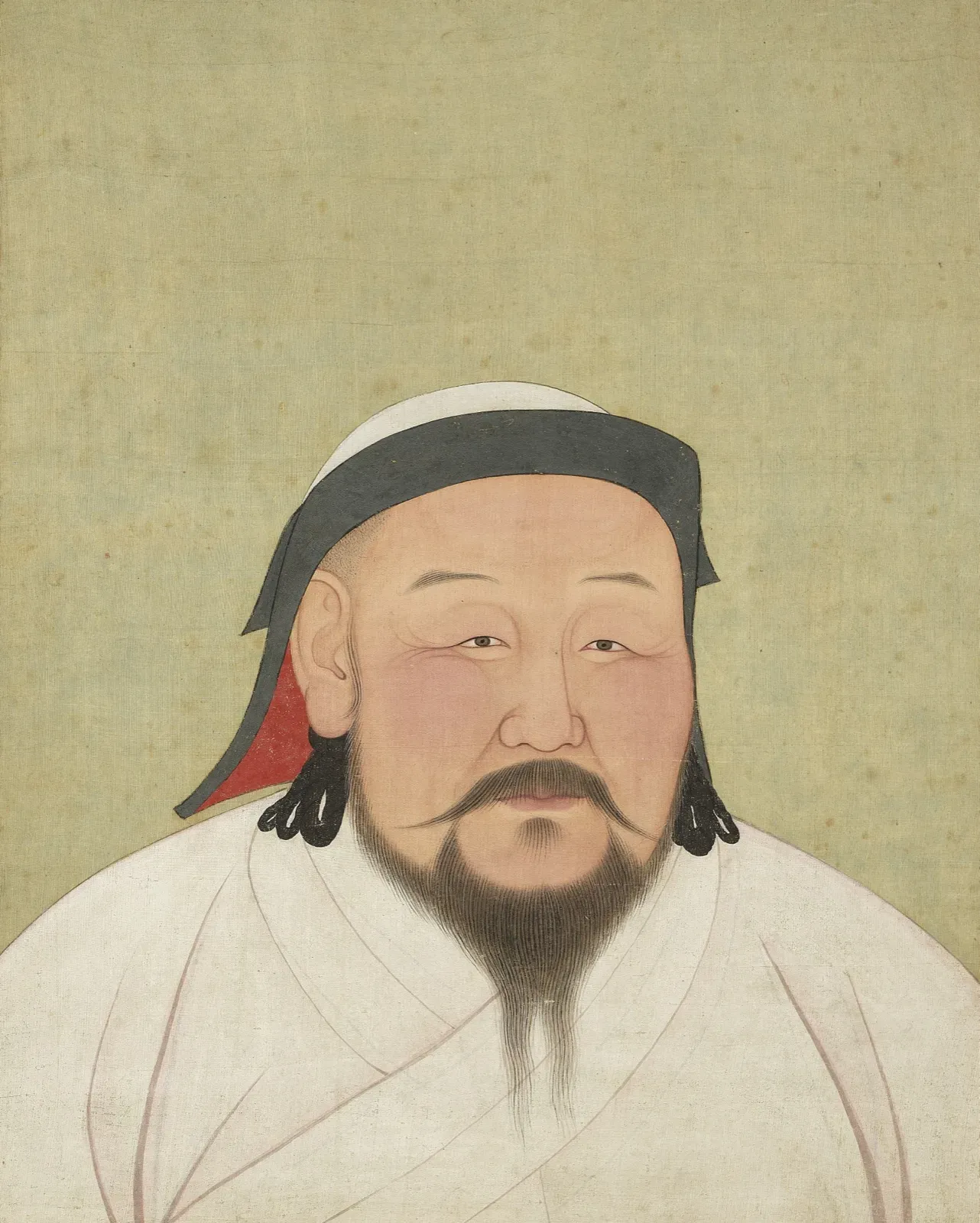
On 5 May 1260, at his summer residence at Shangdu - the place that would pass into English literature as Xanadu - Kublai Khan was proclaimed Great Khan of the Mongol Empire. The ceremony was legitimate in some respects and disputed in all the important ones. Three weeks earlier, at Karakorum, his younger brother Ariq Böke had been proclaimed Great Khan by a rival kurultai, with the support of most of the Genghisid royal family, the late Möngke Khan’s widow and sons, and the traditional Mongol military aristocracy. Two men held the same title simultaneously. Neither precedent nor succession law had an obvious answer to what happened next.
What happened next was four years of civil war that resolved the immediate question while settling nothing deeper. Ariq Böke had the more orthodox claim: elected at the proper place, by the proper people, in the proper fashion. Kublai had been elected at his own residence, by a smaller and geographically skewed coalition - his brother Hulagu, the Il-Khan in Persia, and the Mongol princes of northern China and Manchuria. The military contest went to Kublai for the reason that usually decides such contests: he controlled northern China’s agricultural wealth, which meant he controlled the food supply. He cut off Karakorum’s grain, and the old capital fell within months. Ariq Böke retook it briefly in 1261. By August 1264, he surrendered at Xanadu. Kublai pardoned him and executed his principal supporters. Ariq Böke died two years later, of causes not recorded.
But the civil war had already decided something else. The Golden Horde in the western steppes, the Il-Khans in Persia, the Chagatai Khanate in Central Asia - each had initially acknowledged Kublai’s victory and none of them ever truly subordinated itself to him afterward. The Mongol Empire, which had stretched from Korea to Poland under Möngke, was now four empires in loose contact, gradually diverging. Kublai was the Khagan of a title, not a unified world. He understood this clearly enough to concentrate on what remained: China.
Of all Genghis Khan’s grandsons, Kublai was the one who had leaned most deliberately into Chinese culture. Genghis himself had noticed something about him in 1224, when Kublai was eight or nine years old. On his return from the Khwarazmian campaign, Genghis performed the ceremony of the first hunt for his grandsons Möngke and Kublai - after they killed a rabbit and an antelope, he smeared the fat from the animals onto Kublai’s middle finger, as Mongol tradition required, and said: “The words of this boy Kublai are full of wisdom; heed them well.” He died three years later. Kublai took a Buddhist monk as his spiritual advisor, a Chinese-educated administrator named Liu Bingzhong as his strategist, and surrounded himself with Confucian scholars who taught him how Chinese governance worked. Möngke’s court regarded all this with suspicion. In 1257, Möngke sent auditors to examine Kublai’s territory and found 142 violations of Mongol regulations. Kublai went to his brother in person, was publicly forgiven, and learned from the experience that he needed to move faster.
He also understood that the Song dynasty in the south, which had survived every Mongol campaign for forty years, was not going to fall to cavalry. The Yangtze river system, the chain of fortified cities, the Song’s naval capacity - these required a different approach. After becoming Khagan, Kublai rebuilt his army around engineering. He recruited Iraqi siege engineers from the Il-Khanate in Persia, who designed and built what Chinese sources called the “Muslim trebuchet,” a counterweight catapult of a scale the region had not encountered. When the fortress of Xiangyang - the gateway to the Yangtze valley - had held out for five years against conventional siege, it was one of these trebuchets that ended the standoff. The sound of its first shot, according to one account, caused part of the city’s walls to collapse. Xiangyang surrendered in 1273.
The final campaign south took three more years. Kublai’s commander Bayan moved down the Yangtze valley with a combined land and naval force, and city after city fell or submitted. The last Song emperor was an infant, Zhao Bing, carried south by loyalists as the dynasty contracted around him. At the Battle of Yamen in March 1279, the Yuan fleet destroyed the last Song naval force. An official named Lu Xiufu, holding the eight-year-old emperor, jumped into the sea rather than submit. Kublai became the first non-Han ruler of all of China.
He had already decided what the new order would look like. In 1271, before the conquest was complete, he proclaimed the dynasty’s name as “Great Yuan” - claiming orthodox succession from previous Chinese dynasties rather than positioning himself as a foreign conqueror. He moved the imperial capital to Dadu, on the site of present-day Beijing, designed by a Turkestani architect and decorated by a Nepalese sculptor named Araniko, whose White Stupa still stands there. The summer court remained at Shangdu, 275 miles north, where Marco Polo arrived in the 1270s, spent seventeen years serving as the Khan’s foreign emissary, and returned with an account of paper money, coal burning, and the postal relay system that Europeans found too extravagant to credit for the better part of a century.
The Yuan was an empire unlike anything China had seen before. Kublai placed Mongols at the top of the administrative hierarchy, followed by Central Asians, northern Chinese, and southern Chinese - a ranking that generated constant resentment among the Han majority. But alongside this structural hierarchy, Kublai built something genuinely ambitious: 20,166 public schools (the dynasty’s own records give this figure), a rebuilt Grand Canal, extended highways, and the world’s first government-mandated paper currency, backed initially by silver and gold, enforced by confiscating the precious metals it replaced. He is, by this measure, the first fiat money maker in human history. He is also the ruler who handed the resulting inflation to his successors when fiscal discipline eventually collapsed, but the invention was real and the scale of what he built was not.
The sea kept defeating him. His invasion fleets against Japan in 1274 and 1281 were both destroyed - partly by typhoons that the Japanese called kamikaze, divine winds, and partly by ships built from river-boat designs with no ocean keels. A later archaeological investigation of the wreckage found that Kublai had given his commanders one year to assemble a task that should have taken five. In 1281, he sent 140,000 troops in a combined force from Korea and southern China; the typhoon arrived before the fleet could consolidate. He invaded Vietnam five separate times between 1257 and 1292, and secured only nominal tribute after repeated military reverses. He sent a punitive expedition to Java in 1293, in the last year of his life, and was forced out with 3,000 casualties. The armies that had ridden from the Pacific to the Danube could not hold a coastline.
The last decade was a private catastrophe. His favourite wife Chabi died in 1281. His chosen heir Zhenjin died in 1286, eight years before his father. Kublai ate and drank compulsively, grew grossly overweight, and suffered gout that eventually made movement difficult. He tried Korean shamans, Vietnamese doctors, and every remedy available to the ruler of the largest empire on earth, without success. At the end of 1293, he refused to appear at the traditional New Year’s ceremony. He died on 18 February 1294, aged seventy-eight, having outlived most of what he cared about.
The dynasty he had founded lasted until 1368 - less than a century after the Battle of Yamen. What ended it, as I wrote in another post, was a man who had started life as a plague orphan and a begging monk: Zhu Yuanzhang, who became the Hongwu Emperor and founded the Ming dynasty. His generals entered Dadu in September 1368 without a fight; the last Yuan emperor had already fled north to the steppe. The dynasty Kublai spent thirty years building evaporated in a season, retreating to the grasslands from which it had come.
Kublai’s coronation at Shangdu on 5 May 1260 was the moment at which Mongol expansion reached its peak and began its long contraction. He spent the next thirty-four years ruling something the world had no proper category for - an empire that was neither Mongol enough for the traditionalists nor Chinese enough for the Han - and never resolved the contradiction. He conquered more territory than almost any ruler in history, invented institutions that outlasted his dynasty, and died in a city of his own making while his latest seaborne campaigns failed at the edges of his empire. “In Xanadu did Kubla Khan / A stately pleasure dome decree,” Coleridge wrote in 1797, in a poem he composed in a dream and famously never finished. There is something appropriate in that: the greatest empire ever assembled, conjured in extraordinary detail, and then interrupted.