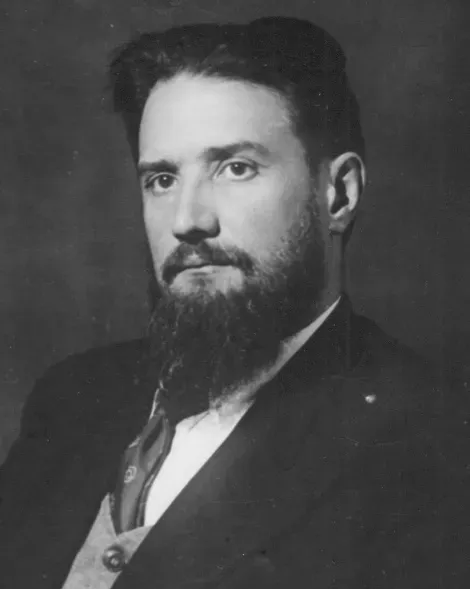
Igor Kurchatov grew a beard in 1942 and made a promise to himself: he would not shave it until the war was won. He kept the beard after the war. By the late 1940s it had become so distinctive that his colleagues simply called him Boroda - the Beard - and the nickname stuck. It is a minor biographical detail, but it captures something about the man: deliberate, stubborn, and not much given to doing things for show.
He was born in Sim, a small factory town in the southern Urals, on 12 January 1903, the son of a land surveyor. He studied physics at Crimea State University and showed enough ability that by his thirties he was running nuclear research in Leningrad, building the first cyclotron in Europe, and publishing serious enough work to be elected a corresponding member of the Soviet Academy of Sciences at thirty-six. He had ambitions for pure research. The war ended them.
In 1943, Igor Kurchatov was summoned by Lavrentiy Beria, the all-powerful head of the feared NKVD, and given a job: build the Soviet Union an atomic bomb. Kurchatov was forty years old. He accepted.
The conditions were not exactly encouraging. The Soviet scientific establishment had been gutted by a decade of purges - dozens of senior physicists arrested, shot, or sent to the labour camps in the 1930s. The country had just endured four years of industrial war that had killed twenty-seven million people and reduced large swathes of European Russia to rubble. The Americans, meanwhile, had spent two billion dollars and three years employing 130,000 people on the Manhattan Project, and had two working bomb designs. Kurchatov was starting more or less from nothing.
However, he was not starting entirely without intelligence. In 1941, Klaus Fuchs - a German-born British physicist working at Los Alamos - had begun passing detailed atomic secrets to Soviet handlers. By early 1945, Fuchs had handed over the complete design of the plutonium implosion bomb, the device dropped on Nagasaki. Kurchatov received this, studied it, and made a decision: the Soviets would build the same design. Not because he lacked the ability to devise his own - he may well have had it - but because the shortest path to a working bomb ran through a proven one. He was an engineer as much as a scientist, and engineers understand that speed matters.
The device they tested on 29 August 1949, at Semipalatinsk in the Kazakh steppe, was called RDS-1 by the Soviets. The Americans, who detected the radioactive fallout a fortnight later in air samples from a WB-29 reconnaissance plane, called it Joe-1. Its yield was approximately twenty-two kilotons. When Truman announced the test on 23 September, the dominant reaction in Washington was shock. CIA estimates had placed the first Soviet test around 1953. They were four years early. Kurchatov had been running the programme for six.
That moment ended a world. The American nuclear monopoly had underpinned Western foreign policy, explicitly or implicitly, in every confrontation since 1945. What replaced it was a balance of terror that structured the entire second half of the twentieth century - every proxy conflict, every arms negotiation, every superpower standoff conducted under the knowledge that escalation had a ceiling, and that beyond it there was nothing left to negotiate about. Kurchatov had not merely built a weapon. He had changed the architecture of global conflict.
He built more. The first Soviet hydrogen bomb - RDS-6s, a boosted fission design the Soviets called a sloika, a layered pastry - was tested on 12 August 1953, less than five months after Stalin’s death. The world’s first industrial nuclear power plant came online at Obninsk on 27 June 1954, producing five megawatts of electrical power to the Soviet grid. The Lenin, the world’s first nuclear icebreaker, launched in 1957. Each of these was Kurchatov’s project, built by a man who moved from weapon to weapon to reactor to ship with the methodical efficiency of someone who had internalised that his country’s standing depended on what he produced.
And then, in the mid-1950s, his position began to shift. On 25 April 1956, he gave a speech at the Harwell atomic research establishment in England calling for international scientific cooperation on controlled nuclear fusion and proposing that Soviet research in the field be declassified and shared with Western scientists. It was extraordinary - a Soviet physicist, at the height of the Cold War, proposing to give away research to the other side. The speech is widely credited with opening up fusion research to the kind of international collaboration that still governs the field today. He spent his final years as a vocal advocate for peaceful nuclear applications and against further weapons development, a position that sat uneasily with the programme he had spent his career building, and that he never publicly reconciled.
He died on 7 February 1960 at the Barvikha sanatorium outside Moscow, where he had gone to visit his old friend Anatoly Aleksandrov. During the conversation, he fell silent. Aleksandrov found that he had died in his chair. He was fifty-seven. He was buried in the Kremlin Wall. Soviet scientists proposed naming element 104 “kurchatovium” in his honour; the name was disputed across Cold War lines and the element is now called rutherfordium. His name remains on the Kurchatov Institute in Moscow, a lunar crater, an asteroid, and a ghost element that briefly existed in the chemistry literature before international politics took it away. It is almost too neat: the man defined by a programme that was never entirely his own, and a name on an element that was never entirely his either.
What he left behind is harder to name than any of that. The Cold War balance he helped create may well have prevented a third world war - it is difficult to know what would have happened if one side had held a nuclear monopoly through the 1950s and beyond, but it is not difficult to imagine. It is not a legacy that resolves cleanly. The Beard built something terrible that may have saved more lives than it destroyed. He knew it. That is probably what the beard was for, in the end: something to hide behind when the calculation didn’t come out.