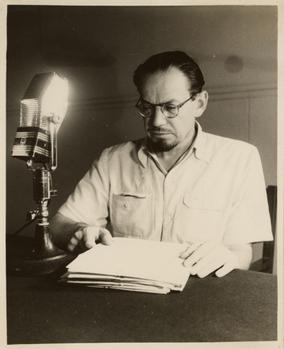
In front of the United Nations Office in Vienna there is a square named Muhammad-Asad-Platz, dedicated in 2008 to a man described at the ceremony as “a citizen of the world” and “a religious bridge-builder.” The square is not, on the face of it, a surprising location for such a tribute. What is surprising — what becomes more surprising the more you look into it — is who Muhammad Asad was before he became Muhammad Asad. No one would have predicted his most unusual path in life.
He was born Leopold Weiss, in 1900, in Lemberg, a city in what is now Ukraine. His family was Jewish. His ancestors, for generations back, had been rabbis. He grew up studying the Talmud and the Gemara. He converted to Islam at twenty-six, became a close confidant of Ibn Saud, ran a spy mission through the Arabian Desert, was recruited by the poet-philosopher Muhammad Iqbal to help think through the intellectual foundations of a future Islamic state, was interned by the British in Lahore during the Second World War while the Nazis killed his parents in Europe, and on the day Pakistan came into existence in 1947, received its first citizenship. He then advised on the country’s first constitution, served as head of its Middle East diplomacy, and represented it at the United Nations. He later produced one of the most significant English translations of the Quran of the twentieth century. He died in Andalusia in 1992 and was buried in Granada. The square in Vienna was named after him sixteen years later. Whether that is a long time or a short one depends on how you measure a life like his.
Leopold Weiss was born on 2 July 1900 in Lemberg — the city that is today Lviv, in western Ukraine, then the capital of the Austro-Hungarian province of Galicia. His family was Jewish; not merely observantly so, but professionally and dynastically so. A long line of rabbis preceded him, and his early education was shaped accordingly. By the age of thirteen he had working fluency in Hebrew and Aramaic, alongside his native German and Polish, and had studied the Tanakh, the Talmud, the Mishnah, the Gemara, and the finer points of Biblical exegesis. His father, Akiva Weiss, had broken from the family tradition to become a lawyer — the first departure in a line of departures that would define the son’s life. At fourteen, Leopold ran away from school and enlisted in the Austro-Hungarian army under a false name. He lasted about a week before his father traced him with the help of the police and brought him back to Vienna. The wandering instinct was apparently inborn.
He drifted through Vienna and then through Weimar Berlin, dropping out of the University of Vienna in 1920 without completing a degree. For a time he worked for the expressionist film director F. W. Murnau — a passing episode of the kind that scatters itself through extraordinary lives — and then as a telephone operator for an American news agency, where he secured his first published piece of journalism by simply ringing the hotel room of Maxim Gorky’s wife and asking for an interview. She said yes. That was the Weiss method: direct, uninvited, and frequently successful. In 1922, he travelled to Jerusalem at the invitation of his maternal uncle, Dorian Feigenbaum, a psychoanalyst and disciple of Freud who would later found the Psychoanalytic Quarterly. Jerusalem led to stringwork for the Frankfurter Zeitung, one of the most prestigious newspapers in Europe. His articles from Mandatory Palestine were notable for taking Arab fears seriously at a time when most European correspondents did not. He published a small book on the subject in 1924, met Chaim Weizmann, and told him, politely but without ambiguity, what he thought was wrong with the Zionist project. The Frankfurter Zeitung was impressed enough to commission him to travel the Arab world for a full-scale book. He made the trip, which lasted two years, and came back a different man.
The conversion happened in Berlin in 1926, after two years of immersion in the Arab world had turned a journalist’s professional interest into something more difficult to categorise. Weiss adopted the name Muhammad Asad — Asad being the Arabic equivalent of Leo, both meaning lion — and the name change was not cosmetic. He moved to Saudi Arabia the following year, travelling part of the route by camel across the Arabian Desert from Tayma to Mecca. He stayed for nearly six years, performed the Hajj five times, and became something he had not anticipated: a close companion of Ibn Saud, the founder of modern Saudi Arabia. The king, who was not in the habit of admitting foreigners to his confidence, quickly came to appreciate Asad’s knowledge, his language ability, and his willingness to speak directly. He was permitted to enter the Najd — the heartland region forbidden to foreigners — in the king’s company. In 1929, Ibn Saud sent him on a secret mission to Kuwait to trace the sources of British military assistance being funnelled to Faysal al-Dawish, the Ikhwan leader who had turned against the king. Asad travelled day and night through the desert without lighting fires, reached Kuwait, and concluded that the British were funding the rebellion to keep Ibn Saud weak enough to accept a railway route from Haifa to Basra. His wife Elsa died during this period; he stayed on. A Haaretz journalist, writing about him years later, reached for the obvious comparison and called him “Leopold of Arabia.” The comparison with Lawrence was apt enough to be annoying to anyone who preferred their symmetries less neat.
He left Arabia in 1932 and arrived in British India, where he met Muhammad Iqbal — the Punjabi poet, philosopher, and architect of the idea that India’s Muslims deserved a state of their own. Iqbal persuaded Asad to stay and help him think through what an Islamic state should actually look like in constitutional and intellectual terms. The collaboration was short: Iqbal died in 1938. The war that followed was more immediately disruptive. When Germany invaded Poland in September 1939, Asad was in Lahore. The British arrested him the following day as an enemy alien — he held Austrian citizenship, and Austria had been annexed by Germany in 1938, though Asad had specifically refused German nationality when offered it. He spent three years interned while his family lived under the protection of a Pakistani landowner named Chaudhry Niaz Ali Khan. His parents, still in Europe, were arrested by the Nazis and killed. He was released when the war ended in 1945 and spent the next two years watching the subcontinent move toward partition. On 14 August 1947, Pakistan came into existence. Muhammad Asad was granted its first citizenship — a decision that was more than ceremonial.
The government of Pakistan appointed him Director of the Department of Islamic Reconstruction, where he made recommendations on the drafting of the country’s first constitution. He moved to the Foreign Ministry in 1949 as head of the Middle East Division, working to build Pakistan’s relationships with the Arab states. In 1952, he was appointed Pakistan’s Minister Plenipotentiary to the United Nations — a considerable elevation for a man who had been stateless, interned, and bereaved within living memory. He resigned that same year, not from disillusionment but from a bureaucratic confrontation with his own government: he had fallen in love with Pola, a young Polish-American woman who had converted to Islam, and the Foreign Ministry rules required prior government approval to marry a non-Pakistani national. The Governor-General refused. Asad submitted his resignation, divorced his second wife, and married Pola. Pakistan’s gain had lasted five years; the next phase of his life ran to seventeen. He spent most of it producing The Message of the Qur’an — an English translation and commentary that is today considered among the most significant of the modern era, distinguished by its rationalist approach and its hostility to literalism. He dedicated his works “to people who think.” He died in Mijas, in Andalusia, in February 1992, at the age of ninety-one, and was buried in the Muslim cemetery of Granada, in the province where Islamic civilisation in Europe had made its last stand five centuries earlier. The choice of burial ground, like everything else in his life, was either a coincidence or a statement.
The boy from Lemberg — rabbinical scholar, Berlin journalist, Arabian secret agent, Pakistani founding father, Quranic translator — had been claimed, finally and somewhat tardily, by the city where he had briefly been a student and given up on the degree. His biographers have called him “Europe’s gift to Islam.” That framing, while generous, understates the traffic. He was also, depending on how you count it, Islam’s gift to Pakistan, and his own gift to the idea that a life can refuse to stay in the category it was assigned.