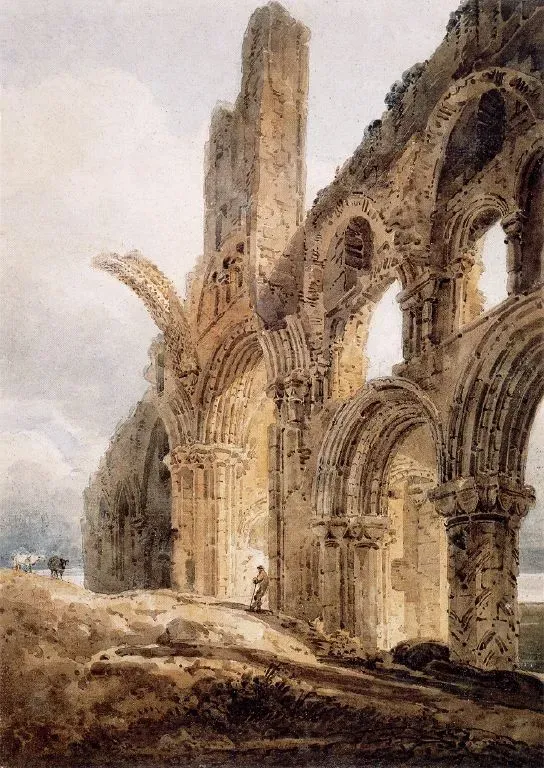
The monks at Lindisfarne had no framework for what was coming across the water on 8th June 793. Ships appeared off the Northumbrian coast. Men came ashore. Some brothers were killed where they stood; others were taken captive; the church was stripped of its silver and anything else portable. The raiders were gone before any organised response was possible. The entire episode had lasted hours.
Alcuin, the Northumbrian-born scholar then at Charlemagne’s court in Francia, wrote to the Bishop of Lindisfarne within the year: “Lo, it is nearly 350 years that we and our fathers have inhabited this most lovely land, and never before has such terror appeared in Britain as we have now suffered from a pagan race, nor was it thought that such an inroad from the sea could be made.” The crucial phrase is that last one. An inroad from the sea was not something the English had conceived of defending against. The coastline was not a frontier; it was where you went fishing.
Lindisfarne - Holy Island, off the Northumbrian coast - was an excellent target for exactly that reason. The monastery had been founded by the Irish monk Aidan in 635 and was famous across Christian Europe: the burial place of St. Cuthbert, home of the Lindisfarne Gospels, stuffed with gold and silver liturgical objects accumulated over a century and a half of donations from grateful kings and nobles. It sat on a tidal island, which its founders had thought would confer safety. It did the opposite. A ship could see it from miles offshore. There was no wall, no garrison, and no warning system. It was a warehouse for portable wealth sitting at the water’s edge.
The Norse who hit it were almost certainly from western Norway. Their ships could navigate in less than a metre of water and beach directly on shores, which meant they could appear on coasts that no military commander had thought to defend. In the decades that followed, this advantage was used repeatedly and relentlessly. Monasteries and trading settlements along the coasts of England, Ireland, and Francia were stripped in succession. By the 830s, raiding parties were staying for winter - graduating, in other words, from robbery to something more like occupation. By 865, a force the Anglo-Saxon Chronicle called the Great Heathen Army landed in East Anglia with territorial ambitions rather than loot bags. Northumbria fell to it in 867. East Anglia in 869, when its king Edmund was captured and killed. Mercia submitted in 877. Wessex was the last English kingdom standing.
Alfred, King of Wessex, came close to a premature end himself. In January 878, the Danish leader Guthrum launched a surprise winter attack on Alfred’s court at Chippenham. Alfred fled into the Somerset marshes with a handful of men. He spent months organising a counter-offensive from a hide-out at Athelney before emerging in May, defeating Guthrum at Edington, and negotiating the Treaty of Wedmore. Guthrum converted to Christianity, with Alfred as his godfather - a detail that tells you something about how the English understood victory - and the Danelaw was formalised as the dividing line of England, with Norse political control over the north and east.
Alfred’s achievement was real and remarkable. He built a network of fortified towns - burhs - spaced so that no point in Wessex was more than twenty miles from one. He reorganised the fyrd, the English militia, so that half was always available for military service while the other half farmed. He built a navy. His daughter Æthelflæd and his son Edward pushed the Danelaw back systematically over the following decades. His grandson Æthelstan completed the job, and by 927 was styling himself King of England across the whole island. What Alfred started, his descendants carried through.
Except they did not finally carry it through. In 1013, Sweyn Forkbeard of Denmark conquered all of England. His son Cnut became King of that kingdom, as well as Denmark, and Norway simultaneously in 1016 and held all three until his death in 1035. The English were ruled by a Dane for a quarter-century. The Viking problem, which Alfred had managed brilliantly, was not a problem you could solve; it was a condition you had to keep managing. Every time the English relaxed, the sea opened again.
What all of this left behind is still visible in the language and the genes. Old Norse contributed somewhere around 800 words to English, and not peripheral ones. “They,” “them,” and “their” are Norse - Old English used “hie,” “him,” and “hiera.” “Sky,” “window,” “knife,” “husband,” “egg,” “dirt,” “get,” “give,” “take,” “call,” “want,” and “die” are all Norse. The settlement of the Danelaw is written into the map: English place names ending in -by (Derby, Grimsby, Whitby), -thorpe, -thwaite, and -toft mark the extent of Norse settlement as clearly as any document. A 2020 genetic study found that Norse ancestry accounts for roughly 6% of English DNA on average - higher in northern and eastern regions, reaching 25% in parts of Yorkshire. The Viking Age did not just change who ruled England; it changed who was English.
The same story, with variations, was playing out across Europe simultaneously. Norse raiders pushed far enough up the Seine to sack Paris in 845 and were bought off with 7,000 pounds of silver - one of the larger extortion payments of the medieval period. In 911, a Norse leader called Rollo negotiated a grant of territory from Charles the Simple of France and became the first Duke of Normandy. A century and a half later, his descendant William crossed the Channel and conquered England, completing a circuit that had begun when Norse ships first appeared off Northumbria. The Normans were Vikings who had learned French and acquired Latin administrators; they came back to England in 1066 as conquerors with better paperwork and worse weather tolerance.
In Byzantium, Norse mercenaries served as the emperor’s personal bodyguard from the late 10th century - the Varangian Guard, recruited from Scandinavia and, after 1066, from dispossessed English nobles who had nowhere else to go. Harald Hardrada, who launched his own invasion of England in 1066 and was killed for his troubles at Stamford Bridge three weeks before William landed at Hastings, had served in the Guard for years. The same cultural tendency that sent ships to Lindisfarne in 793 was sending men to Constantinople as mercenaries and to North America as explorers. The Norse were not a raiding party; they were a civilisation in motion, and western Europe happened to be in their path.
What the monks of Lindisfarne could not see, looking at those ships in June 793, was that what approached them was not a raid. It was the opening of a long demographic and linguistic renegotiation of the British Isles - and a substantial portion of Europe besides. The raid ended in hours. The renegotiation took centuries and countless lives. You can still hear it every time an English speaker says “they” instead of “hie.”