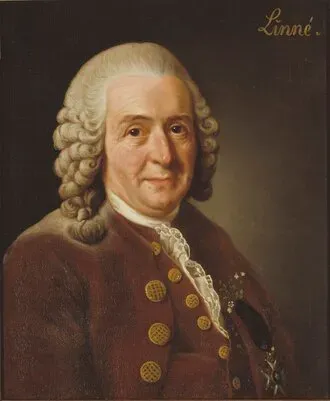
Before 10 January 1778, when Carl Linnaeus died in his chair in Uppsala, every living thing on Earth had as many names as there were languages to describe it. The dog rose - a common British hedgerow plant - was “Rosa sylvestris inodora seu canina” in one standard reference, “Rosa canina” in another, and several other things besides depending on which country you were working in. The tomato went by eight Latin words that described it rather than named it: “Solanum caule inermi herbaceo, foliis pinnatis incisis, racemis simplicibus.” Linnaeus reduced it to two: Solanum lycopersicum. That compression is the whole story.
He had been born in 1707 in Råshult, a small parish in southern Sweden, the son of a clergyman who kept a garden. His father taught him the Latin names of plants before he could read. By his mid-twenties he had surveyed Lapland on foot for the Swedish Academy, returned to Sweden, published Systema Naturae, and taken a medical degree in the Netherlands in a single remarkable sprint. Systema Naturae appeared in 1735, when he was twenty-eight. It was twelve pages. The final edition, published between 1766 and 1768, ran to more than 2,300 pages and had grown from a pamphlet into the foundational document of modern biology.
The core idea was absurdly simple. Every species gets two names: a genus and a specific epithet. The first tells you its nearest relatives; the second distinguishes it from them. Homo sapiens: the genus of the great apes, and the species that is wise. Felis catus: the genus that includes lions and leopards, and the species that sits on your lap. The names are in Latin, so they work across every language. No translation required, no regional variation, no confusion about whether two scholars are discussing the same creature. A botanist in Uppsala and a naturalist in Jamaica can correspond about Solanum lycopersicum without either having to learn the other’s language or decode the other’s nomenclature.
Linnaeus didn’t invent binomial nomenclature from nothing - the basic idea had been floating around in botany for a century - but he imposed it consistently and on a scale nobody had attempted. His Species Plantarum, published in 1753, listed 7,300 plant species, each with its two-word name. Systema Naturae’s tenth edition, published in 1758, did the same for some 4,400 animal species. Those two dates became, by international convention, the formal starting points for botanical and zoological nomenclature respectively. Every name published before them is optional. Every name published since must comply with the same rules. Linnaeus set the clock.
He was a difficult man to spend time around. His Uppsala lectures were famous - he took students on natural history walks through the surrounding countryside, crowds of them, following a man who moved fast and named everything he passed - but his private estimation of himself was not modest. He wrote that “no one has been a greater botanist or zoologist,” without apparent irony. His works were dedicated to the idea that he was unfolding the order God had built into nature; the Creator had made the world, and Carl Linnaeus was cataloguing it. He had some reason for the confidence. By the 1750s he had received specimens from Japan, North America, South Africa, and the Caribbean, had trained a generation of Swedish naturalists, and had corresponded with virtually every serious naturalist in Europe. He called his most devoted students his “apostles” and sent them on voyages that killed several of them. Daniel Rolander went to Suriname and came back mentally broken. Pehr Löfling died in Venezuela at twenty-seven. Herman Naturforskare died in Java. They collected, named, and shipped specimens back to Uppsala, and Linnaeus incorporated them into successive editions and wrote letters of condolence to their families.
His system for classifying plants used the number and arrangement of stamens and pistils - the sexual organs - as the primary sorting mechanism. This produced practical results: anyone with a specimen and a magnifying glass could work through his key and arrive at a name. It also produced a reaction from certain quarters of the clergy, who found the prospect of describing plants in terms of their reproductive arrangements somewhere between immodest and scandalous. A German botanist named Johann Gottlieb Siegesbeck called it “loathsome harlotry.” Linnaeus, who had a gift for retaliation in print, later named a small, useless weed Siegesbeckia.
The darker part of his legacy is harder to dismiss with a weed name. In Systema Naturae, Linnaeus classified humanity into four varieties - Europaeus, Americanus, Asiaticus, Afer - and assigned each a set of characteristics that extended well beyond physical description. Africans were described as sluggish, crafty, and governed by caprice; Europeans as active, acute, and governed by laws. These weren’t observations. They were prejudices given the appearance of scientific authority. Linnaeus didn’t invent European racism, but he gave it a taxonomic address, and the damage proved durable. The association of racial categories with fixed, heritable traits ran through nineteenth-century science like a fault line, and its origins are partly in those pages.
His final years were unkind. A stroke in 1774 left him impaired. A second in 1776 took more. By the time he died on 10 January 1778, he could no longer recognise his own published work. His widow sold his collections, library, and manuscripts to a twenty-four-year-old English naturalist named James Edward Smith for 1,000 guineas. The Swedish government, learning the ship carrying the cargo had already left Stockholm, dispatched a naval vessel to intercept it. The ship was faster. The Linnaean collection arrived in London; Smith founded the Linnean Society of London in 1788. It still exists, at Burlington House on Piccadilly, still holds the collections, and still awards prizes in his name.
What Linnaeus built, and what Darwin found waiting for him, is the nested hierarchy: species grouped into genera, genera into families, families into orders, classes, phyla, kingdoms. Linnaeus designed it to reflect the mind of the Creator expressed in nested categories. Darwin, who read Linnaeus as a student at Cambridge, recognised that the same hierarchy reflected something entirely different: the branching pattern of descent. Species share a genus because they share a recent common ancestor. Families share an order because they share a more distant one. The nested structure isn’t God’s filing system. It’s the shape evolution leaves behind. Linnaeus thought he was reading the mind of God. He was reading Darwin’s evidence, sixty years early.
The binomial system is still in use for every newly described species - around 15,000 to 20,000 per year. No other scientific framework from the eighteenth century operates at comparable scale today. Newton’s mechanics were superseded by relativity. Lavoisier’s chemistry was transformed out of recognition. Linnaeus’s filing system has survived, essentially intact, for two hundred and seventy years.
That is partly because it is so simple. Two words. Latin. Consistent. The man who invented it believed he was doing God’s cataloguing. What he actually did was give three centuries of scientists a common language, before anyone else understood that the absence of one was a problem at all.