Madrid did not fall because Franco finally found a brilliant way through its defences. It fell because, by March 1939, the Republic had run out of road.
The Spanish Civil War began on 18 July 1936 when a group of army officers launched a coup against the elected Popular Front government. Franco flew in from Morocco with the Army of Africa - the toughest professional force Spain possessed, hardened in colonial campaigns in the Rif - and drove north and west towards Madrid. His generals fully expected the capital to fall within weeks. The Republic’s military response was chaotic, the government uncertain whether it could trust its own armed forces, the available weapons largely obsolete or simply broken. In late July, 60,000 rifles were handed to the trade unions to defend the city. Only 5,000 were in working order.
And yet. Franco made a decision in early September 1936 that his own officers argued against: he halted the advance on Madrid to relieve a Nationalist garrison besieged at Toledo’s Alcázar fortress. The symbolism was worth the delay to him. For the Republic, it bought a month of preparation. By the time Nationalist troops reached the outskirts of Madrid in November, the defenders were no longer the armed civilians of July. They had been reinforced by Soviet tanks, Soviet aviation, and the International Brigades - 1,900 foreign volunteers from Germany, France, Britain, and a dozen other countries, who marched up the Gran Vía on the evening of 8 November in what the Madrileños, mistaking them for Russians, greeted with cries of vivan los rusos. They were not Russians. But they held the line.
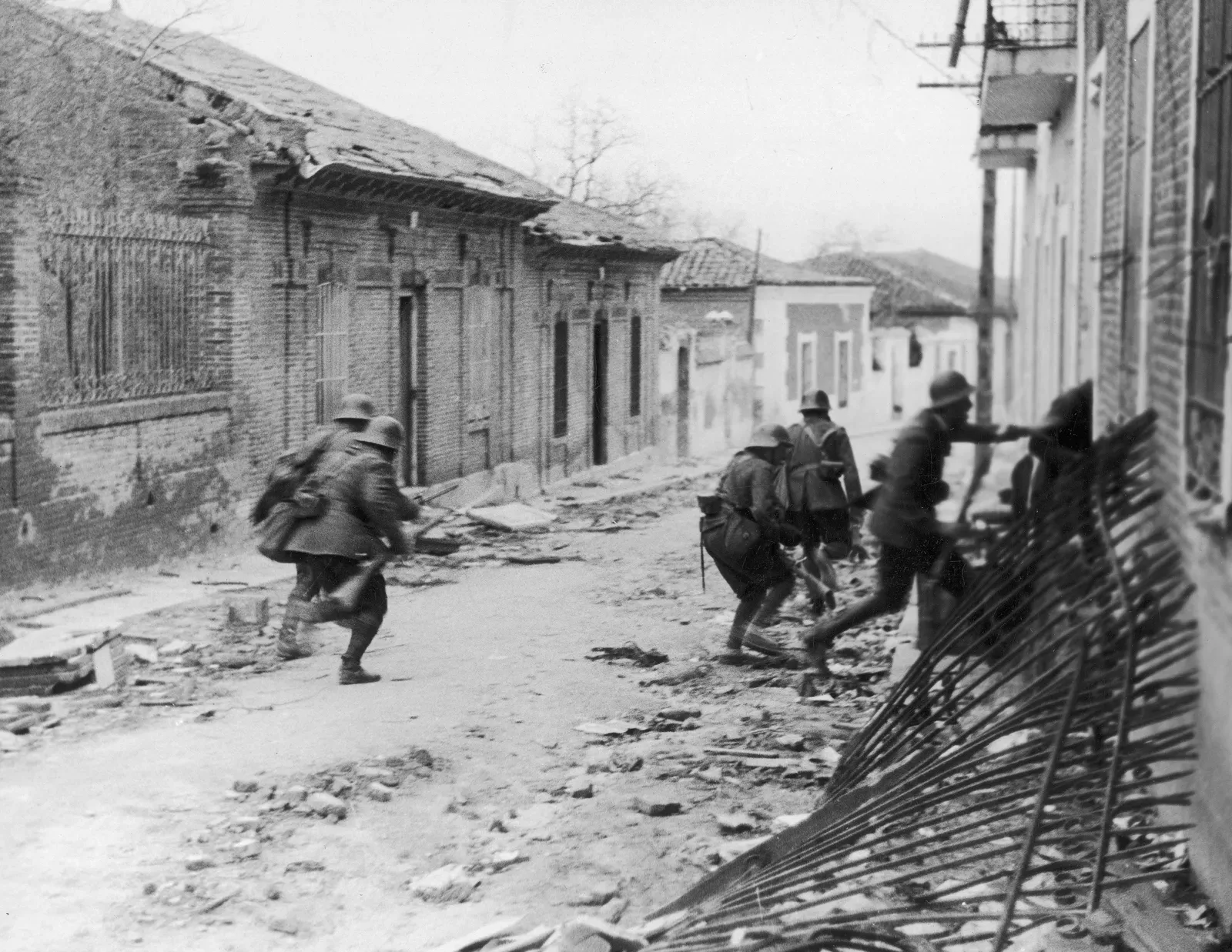
The battle for Madrid in November 1936 was fought at close quarters in the parks and university buildings on the western edge of the city, across the River Manzanares. Moroccan regulares under the German officer Wilhelm von Thoma’s armoured support broke through in places but could not clear the urban ground. On 11 November, 1,029 Nationalist prisoners were taken from the Modelo Prison and shot in the Jarama valley by Republican forces, a massacre that darkened the city’s moral account. Franco, unable to break through by assault, turned to bombing instead. German Condor Legion aircraft pounded residential districts from 19 to 23 November, one of the first deliberate aerial bombardments of a civilian population in modern warfare. Ernest Hemingway was in Madrid. He wrote about it. The population did not surrender. By December, the front had stabilised. The besiegers occupied a sliver of the University City and the western parks; the city itself remained in Republican hands. It would stay that way for over two more years.
The siege ground on through 1937 and 1938 with periodic attempts to break through or encircle the capital. At Jarama in February 1937, Franco tried to cut the road to Valencia and failed, losing roughly as many men as he killed. At Guadalajara in March, Italian forces were routed in the worst Fascist military defeat to that point in the war. Republican commanders launched their own offensives - at Brunete in July 1937, at Teruel at the year’s end - to force Franco off the Madrid front. None succeeded in holding ground, but they kept the capital supplied and out of Nationalist hands. The people of Madrid lived with artillery fire, intermittent bombing, and a worsening food shortage. Industries were moved underground into metro tunnels to keep production going. “Business as usual” became a kind of dark civic boast.
What broke the Republic was not Madrid but everything else. In April 1938, Franco’s forces split the Republican zone in two, reaching the Mediterranean coast at Vinaròs and severing Catalonia from the rest. When Catalonia fell in early 1939, the Republic lost its main industrial base. By February, roughly half a million Republican soldiers and civilians had crossed into France, where they were interned in camps on the beaches - barbed wire on the sand. What remained in the Republican zone was an army without reserves, a government without authority, and a Madrid whose survival had become an argument in itself rather than a strategic objective.
This is when the Republic turned on itself. Juan Negrín, the socialist Prime Minister, wanted to fight on - calculating, not unreasonably, that war in Europe was coming and that a German-Italian intervention in Spain could not last if France and Britain entered a wider conflict. He had been saying this for a year. It had not happened. His opponents - among them Colonel Segismundo Casado, the Republican commander in Madrid, and the anarchist leader Cipriano Mera - concluded that further resistance was pointless and that Negrín’s continuation only served the Communist Party’s interests. On 5 March 1939, Casado’s men arrested communist officers across Madrid, stripped them of command, and announced a National Defence Council to negotiate peace. Negrín and the communist leaders fled Spain from Elda the next day. Communist units around the city did not accept the Council’s authority and fought their way into Madrid. For days, Republicans fought Republicans in the streets while the Nationalist army waited. The communists were defeated. Their commander, Luis Barceló, was executed.
Casado then attempted to negotiate with Franco. Franco refused any terms beyond unconditional surrender, which was precisely what he had been saying since the previous autumn. On 26 March, he ordered a general advance. The Republican front collapsed on the 27th - not in battle but in disintegration, soldiers throwing down their weapons and walking home. On 28 March, Nationalist troops entered Madrid. The city that had held for 29 months yielded in a day. The war ended formally on 1 April, when Franco announced that all fighting had ceased.
The reprisals were systematic and deliberate. Franco’s regime executed or imprisoned its opponents in numbers that historians still debate but have never been able to lower below the catastrophic. Between 1939 and 1943, somewhere in the region of 200,000 people were executed or died in Francoist prisons. Casado’s gamble - that surrendering the city might earn mercy for those inside it - was a transaction Franco never honoured. Many of the men who had defended Madrid for nearly three years were among those killed. The slogan ¡No pasarán! had held for two and a half years. In the end, they passed. The point is not that the defenders failed. The point is what was done to them afterwards, and the care with which the Francoist state made sure those years of resistance did not survive into any usable political memory.
Madrid did hold out longer than anyone in 1936 had expected. That matters. But the fall of the city on 28 March 1939 is not only a military date - it is the hinge on which one of Europe’s longest dictatorships turned, and it settled whose version of Spain would be the official one for the next thirty-six years.