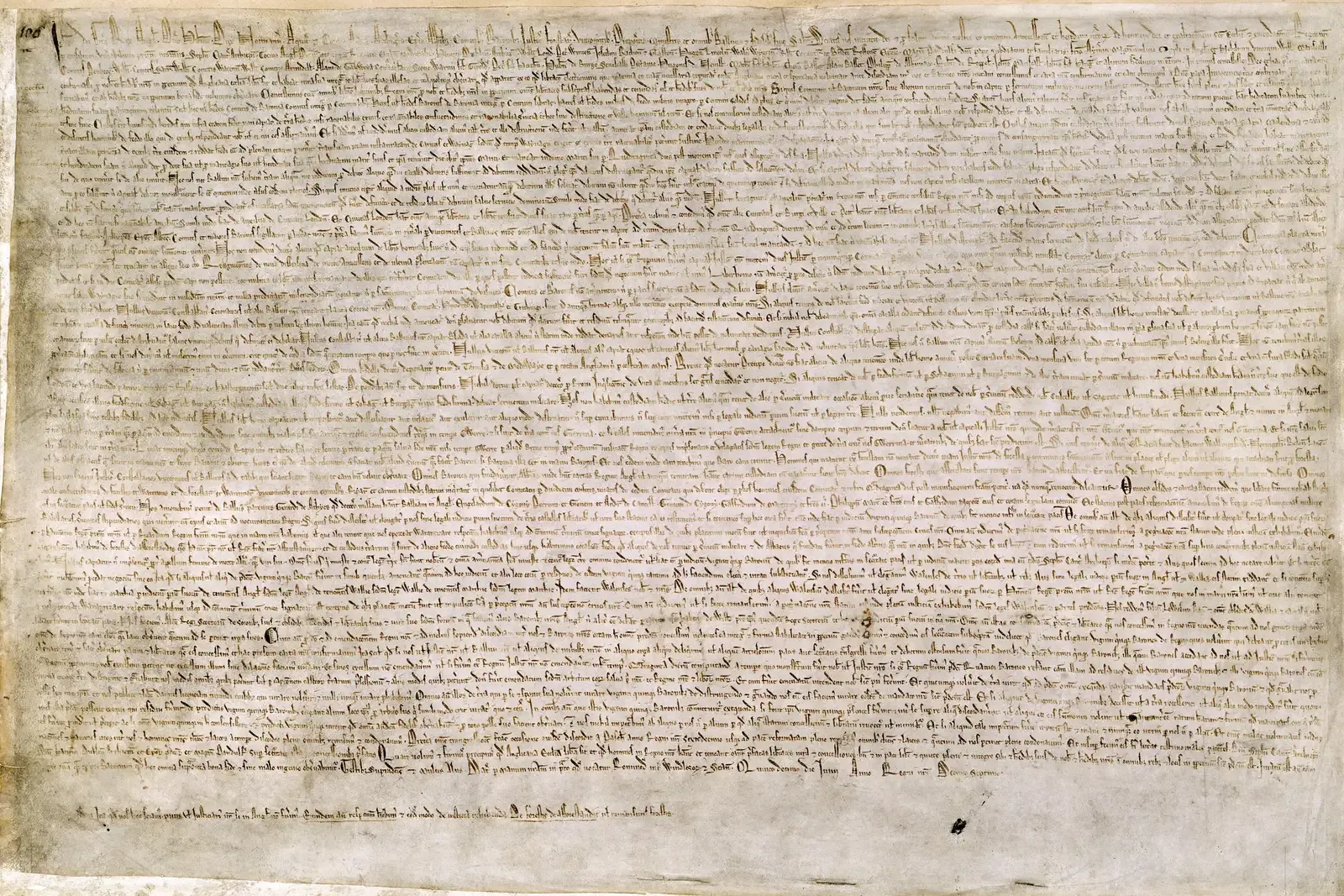
There were no signatures on Magna Carta. The document was authenticated with the royal great seal, pressed into beeswax by an official called the spigurnel - not by John himself. The barons who gathered at Runnymede, a water-meadow on the Thames near Windsor, on 15 June 1215, understood perfectly well that a seal was not a commitment. It was a formality that recorded an agreement. Whether the agreement would hold was a separate question entirely.
John had arrived at this meadow through a decade of spectacular mismanagement. He had lost Normandy to Philip II of France in 1204, and with it the Angevin empire that his father Henry II had spent a reign building. He then spent the next ten years trying to get it back, raising money through every mechanism available to a medieval English king: scutage levied eleven times in seventeen years (his three predecessors had managed eleven times combined), inflated inheritance fees, confiscated estates, and a sequence of what contemporaries described as extortionate fines. When his final attempt to retake Normandy collapsed at the battle of Bouvines in July 1214, he returned to England to find a baronial rebellion already forming. The northern barons, who had no particular interest in Normandy and substantial interest in not being bled dry to pay for it, called themselves the Army of God and marched on London in May 1215. Once they held the capital, they attracted a wave of defections from John’s own supporters. He had run out of room.
The document produced at Runnymede was drafted principally by Stephen Langton, the Archbishop of Canterbury, who had been attempting to mediate between the two sides. It was long - sixty-three clauses addressing feudal taxation, the rights of widows, the management of royal forests, the treatment of Jews, the operation of local courts, and a dozen other specific baronial grievances that had accumulated over years of what the barons considered arbitrary royal conduct. Two clauses would later attract attention as proto-constitutional principles: clause 39, which stated that no free man should be imprisoned, dispossessed, or outlawed except by lawful judgement of his peers or by the law of the land, and clause 40, which promised that the Crown would sell, deny, or delay justice to no one. Later centuries would build entire legal traditions on these two sentences. In 1215, they were primarily complaints about how John had been running his courts.
The real mechanism of the charter was clause 61. Twenty-five barons would be appointed to monitor the King’s compliance. If John failed to observe the charter’s terms within forty days of being notified, the council was empowered to seize his castles and lands until he made amends. The historian Wilfred Warren, writing about this arrangement, called it “crude in its methods and disturbing in its implications”, and concluded it was almost inevitable it would lead to war: the clause was so heavily weighted against the King that John could not realistically accept it as a permanent constitutional arrangement. The barons selected for the council were all drawn from the rebel faction, chosen by the hardliners among them. They filled the seats with their own men, refused to demobilise their forces after the charter was sealed, and declined to return London to John as the agreement required.
John was not idle either. The charter contained a clause in which he promised not to seek to have it annulled. He immediately wrote to Pope Innocent III and asked him to annul it. This was not a surprising move. John had surrendered the Kingdom of England to the papacy in 1213 as part of a settlement over a different dispute, paying a feudal tribute of 1,000 marks annually in exchange for Innocent’s political support. The Pope was technically John’s feudal lord, and the charter, John argued, undermined that relationship. Innocent responded in August 1215 with a letter declaring the document “not only shameful and demeaning but also illegal and unjust”, noting that John had been “forced to accept” it. The charter was declared null and void. The Pope excommunicated the rebel barons and suspended Langton from office for having brokered the deal.
By September 1215, less than three months after the sealing at Runnymede, England was at war. The First Barons’ War had begun. The rebels, concluding that peace with John was impossible, offered the English throne to the French prince Louis, son of Philip II. Louis crossed the Channel in May 1216, landed in Kent, and marched on London, where he was welcomed as king by much of the baronial opposition. John spent the remainder of 1216 conducting a vigorous military campaign, retaking Rochester, pushing north to isolate the rebel barons, and driving into Scotland to punish Alexander II for joining the rebel cause. He was winning. Then, in October 1216, he contracted dysentery crossing the Wash estuary, reached Newark Castle in Nottinghamshire, and died on the night of the 18th. He was forty-nine.
The charter died with John - or should have. His son was nine years old. The regency government, led by the knight William Marshal, resurrected Magna Carta in edited form as a way of drawing rebel support back to the Crown. They stripped out clause 61 and a few other provisions the papacy had found offensive, and reissued it in November 1216 as the basis for a new settlement. The move worked slowly: the war ended in 1217, the charter was reissued again, and in 1225 Henry III confirmed it in a version he declared issued of his own “spontaneous and free will”, which gave it rather more authority than the previous versions. Edward I confirmed it in 1297, and it entered statute law. From there it was reconfirmed by subsequent monarchs thirty-two times, by Edward Coke’s count, before the 16th century invented the myth that had not quite existed before: that Magna Carta was a statement of ancient English liberties, a recovery of rights lost at the Norman Conquest, the foundation of Parliament and habeas corpus and jury trial. This reading was historically wrong in almost every particular, as Victorian scholars established in painstaking detail. The 1215 charter had concerned the relationship between the monarch and the barons, not ordinary subjects; serfs did not feature. But wrong historical interpretations can carry tremendous force, and this one shaped the arguments that led to the English Civil War, informed the American colonists who went to war with Britain, and provided the language in which the Fifth Amendment of the United States Constitution was written.
Winston Churchill, not a man inclined to understate the English contribution to world history, observed that “the British nation and the English-speaking world owe far more to the vices of John than to the labours of virtuous sovereigns.” It is a good line. John’s vices produced the baronial revolt; the revolt produced the charter; the charter failed as a peace treaty and survived as a symbol; the symbol outlasted everything. The barons who forced the seal onto the document at Runnymede in June 1215 did not get what they wanted. John was excommunicating them before the summer was out. But they had produced, under duress, in a meadow beside the Thames, a piece of parchment that acquired a life entirely independent of its authors’ intentions. The peace lasted three months. The document lasted eight centuries, and counting.