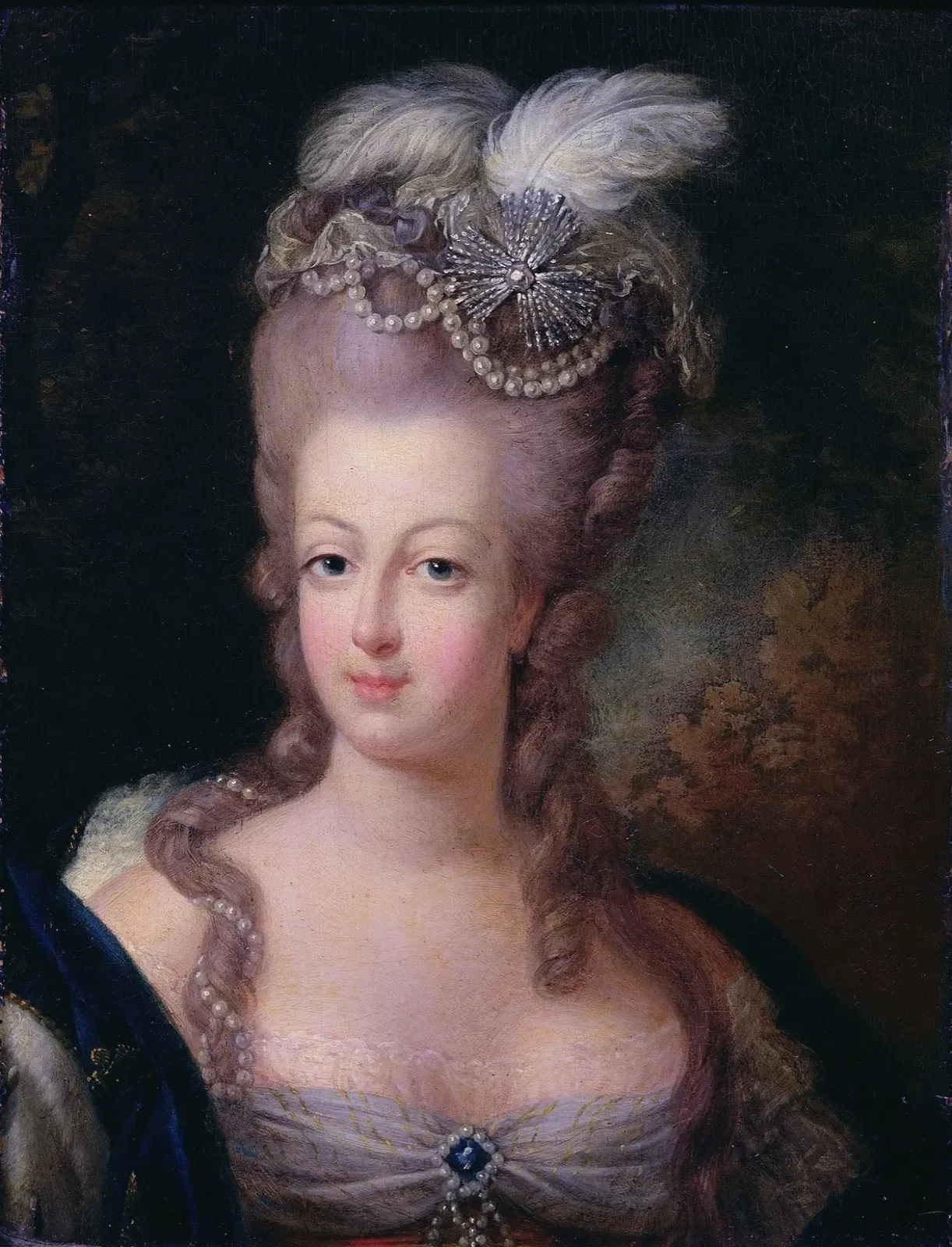
On the evening of 16 May 1770, after the fireworks and the banquet and the formal dancing, the fourteen-year-old Marie Antoinette and the fifteen-year-old Louis-Auguste were put to bed together at the Palace of Versailles in a ceremony designed to confirm that the marriage had been, or was about to be, consummated. The Archbishop of Reims blessed the bed. The King of France - Louis XV, the groom’s grandfather - handed his grandson his nightshirt. The court watched. Then everyone left, and… nothing happened. Nothing happened for the next seven years.
The marriage itself was not a love match, which surprised no one. It was a piece of foreign policy, the most consequential arrangement to emerge from the Diplomatic Revolution of 1756, when Austria and France buried a century and a half of enmity in order to face down Prussia and Britain together. Maria Theresa of Austria had been looking for a French match for her youngest daughter since the girl was a child. Louis XV had been looking for a way to cement the alliance. The two teenagers had met for the first time two days before the wedding, at the edge of the Forest of Compiègne. By the standards of dynastic marriage this was practically a long courtship.
Marie Antoinette - born Maria Antonia in Vienna, renamed in the French style upon crossing into France - had been prepared for this. French tutors had been sent to Vienna to assess and improve her. A French dentist had straightened her teeth. Her wardrobe was redesigned, her walk retrained to match the gliding style fashionable at Versailles. Her tutor found her poorly educated and somewhat lazy, but also noted that her “character and heart are excellent” and that she was “more intelligent than has been generally supposed.” She was eleven when the preparations began.
Louis-Auguste was shy to the point of social incapacity, a condition his tutors had apparently encouraged rather than corrected - one had told him that timidity was a virtue in strong monarchs, which is the sort of pedagogical advice that tends to produce weak charachter. He was good at Latin, geography, history, astronomy, and locksmithing. He was devoted to hunting. His relationship with the court, with its rituals and its spectacle and its demand for performance, was always one of barely suppressed discomfort.
The failure to consummate the marriage became a minor European scandal within a few years. Pamphlets circulated - the libelles that were the eighteenth century’s equivalent of anonymous online commentary - asking “Can the King do it? Can’t the King do it?” The courts of Europe speculated. Marie Antoinette’s mother, the Empress Maria Theresa, wrote anxious letters. The Austrian ambassador in Paris sent secret reports back to Vienna on the state of the royal couple’s conjugal relations, or lack thereof.
The explanation most people reached for was a physical one - specifically, phimosis, a condition that Stefan Zweig popularised in his 1932 biography of Marie Antoinette and that led to suggestions Louis had eventually undergone circumcision to correct it. Most modern historians now reject this. The Prussian envoy reported in 1777 that Louis had definitely declined any operation. His diary during the period when the surgery was supposedly performed records him hunting almost every day, which would have been impossible for weeks post-procedure. The more accurate answer seems to be the one Marie Antoinette’s brother, the Holy Roman Emperor Joseph II, arrived at during a frank visit to Versailles in April 1777.
Joseph, having spoken directly to Louis, described them in a letter to their brother Leopold as “a couple of complete blunderers.” He was specific. Louis, he wrote, “introduces the member” and then “stays there without moving for about two minutes,” after which he withdraws without completing the act and “bids goodnight.” Joseph characterised it less as a physical problem than a motivational and technical one. The young king, shy, awkward, and according to all accounts somewhat frightened of his vivacious and politically sophisticated Austrian wife, had simply not applied himself. With Joseph’s intervention, he began to. By August 1777, the marriage was finally consummated. Eight months later, Marie Antoinette was pregnant with their first child.
The seven-year gap had not been idle on either side. Louis had retreated into his interests - locksmithing, maps, the mechanics of ships, long hunting sessions, books. He was, by multiple accounts, genuinely kind, and genuinely well-intentioned as a ruler, and also genuinely incapable of making a decision and sticking to it. His confessor had instructed him never to let people read his mind. His mathematics tutor had praised his intelligence. His political tutors had produced a man who wanted to be loved, consulted public opinion obsessively, and then frequently did the opposite of what the moment required. Whether a more functional marriage would have made him bolder is unknowable. What is clear is that the man who ascended the throne in 1774 was already, at nineteen, someone for whom action came slowly and retreat came easily.
Marie Antoinette, marooned in a marriage that was not functioning on either physical or emotional level, and a court that was watching her for any sign of weakness or foreignness, went looking for stimulation elsewhere. She gambled. She spent heavily on fashion - hairstyles three feet high, dresses made from fabrics previously banned in France. She gathered around her a circle of favourites: the Princesse de Lamballe, the Duchess of Polignac, a succession of male admirers whose exact relationships with the queen were debated then and remain debated now. She commissioned a small rustic hamlet on the grounds of Versailles where she could play at simplicity, a retreat that became another line in the pamphlets against her. She was given the Petit Trianon by Louis - a small château Louis XV had built for one of his mistresses - and almost immediately rumours circulated that she had plastered the walls with gold and diamonds. She had not, but the rumours never stopped.
French economy was in dire straights. By the late 1780s, the finance ministers of France were coming and going like waiters at a bad restaurant, and a significant portion of the public had concluded that the queen was personally responsible for the national bankruptcy. “Madame Déficit,” they called her. She had spent heavily; she had also successfully driven out two reform-minded finance ministers and helped appoint conservatives who blocked the structural changes that might have given the regime a chance. The connection between the seven years of marital dysfunction and France’s fiscal crisis is not direct. But the extravagant, politically interventionist, increasingly unpopular queen who emerges in the 1780s is recognisably a product of the bored, frustrated teenager on the top of social pyramid, who spent the 1770s finding other ways to occupy herself.
Both of them ended up at the Place de la Révolution - Louis first, in January 1793, then Marie Antoinette in October of the same year. Louis mounted the scaffold with a prepared speech about his innocence and his forgiveness for those responsible, most of which the drums drowned out by order of the officer in command. Marie Antoinette, en route to the guillotine in an open cart rather than the carriage they had given her husband, maintained her composure while the crowd insulted her. She accidentally stepped on the executioner’s shoe as she mounted the scaffold and apologised for it: “Pardon me, sir, I did not do it on purpose.” Her last words were a courtesy to the man about to kill her, which is as good a summation of her situation as any.
Whether the unconsummated years caused the Revolution is too grand a claim. The Revolution had structural causes - debt, inequality, an Enlightenment-educated bourgeoisie running out of patience, harvests that failed at the wrong moment. But characters matter in history, and the characters of Louis XVI and Marie Antoinette - his paralysed indecision, her compulsive spending and political overreach, their mutual inability to manage the crisis once it arrived - were shaped in no small part by what happened, and what did not happen, in the bedchamber at Versailles on the evening of 16 May 1770. They had been put together by two empires and sent upstairs. The Archbishop of Reims blessed the bed. The King handed the nightshirt over. Everyone left. And one of the strangest, most consequential royal marriages in European history began its seven-year stumble toward something that, eventually, almost resembled a life together, but ended up under the guillotine.