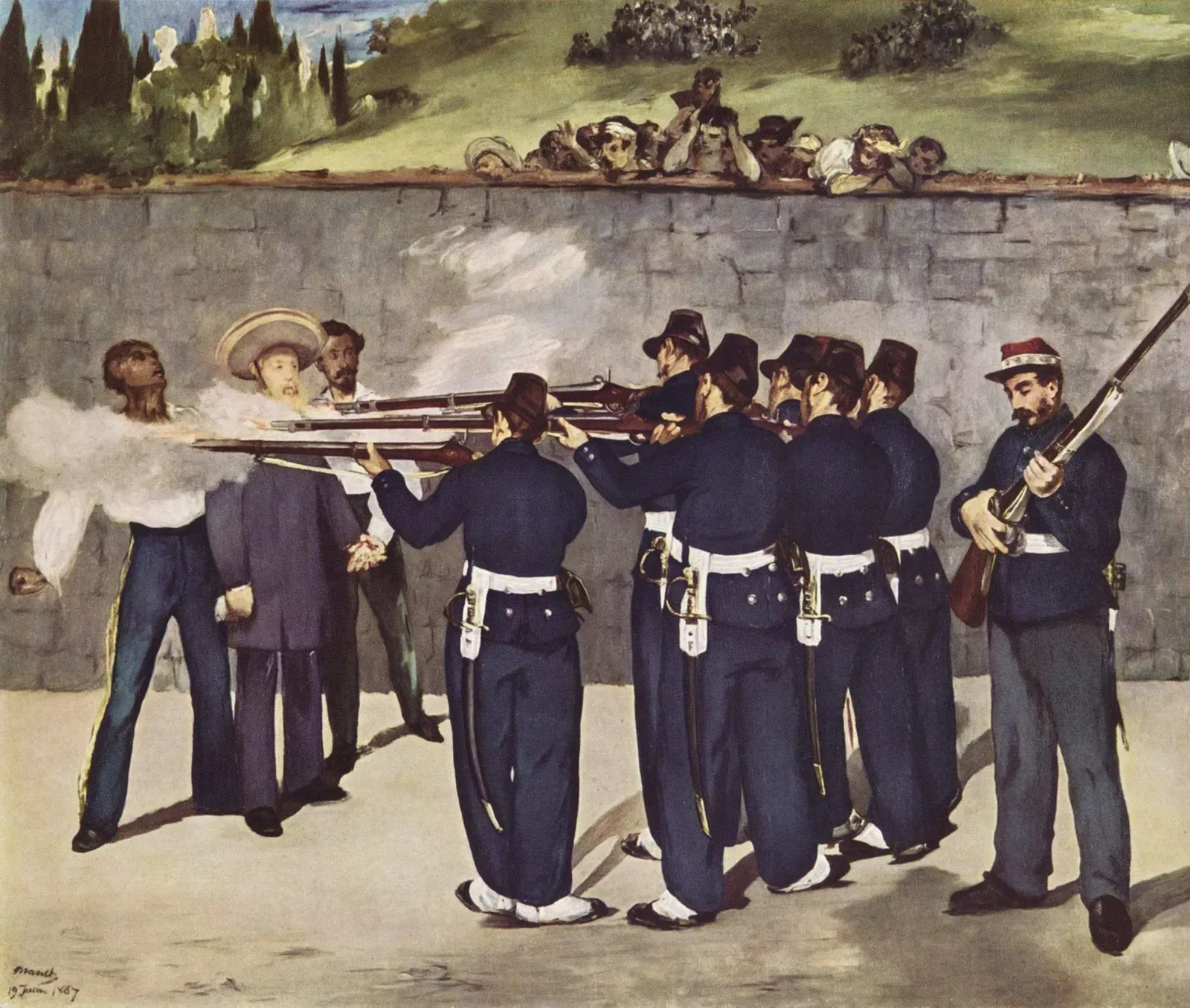
On the morning of 19 June 1867, three men stood on the Cerro de las Campanas - the Hill of the Bells - outside Querétaro, Mexico, facing a Republican firing squad. The man in the middle was thirty-four years old, fair-bearded, blue-eyed, and Viennese by birth. His name was Ferdinand Maximilian, Archduke of Austria, self-styled Emperor of Mexico. He had been emperor for three years. He had been in Mexico for three. He died because he refused to leave a country that had never asked him to come.
The story of how an Austrian archduke ended up as Emperor of Mexico is less a tale of personal ambition than of European geopolitics conducted at Mexico’s expense. The architect was Napoleon III, emperor of France and nephew of a man who had once reshaped the entire continent. By the early 1860s, Napoleon was looking for ways to extend French influence into the Americas, where the Monroe Doctrine and American expansionism had squeezed out European power. Mexico presented an opening. In 1861, the liberal President Benito Juárez suspended foreign debt payments, giving France a pretext for military intervention. Britain and Spain joined the initial expedition, assessed the situation, and went home. Napoleon sent more troops.
Behind the French bayonets stood a Mexican constituency that actually wanted this: the conservatives who had spent three years losing the Reform War to Juárez’s liberal forces. They had fought over Church property and landed privilege, they had lost, and they were now willing to accept almost any foreign sponsor who would help them reverse the result. A Mexican delegation travelled to Vienna in 1863 to offer Maximilian the crown. They brought a petition - signed by tens of thousands, they claimed - demonstrating popular support for a monarchy. The petition was essentially assembled under French military occupation, but Maximilian found it convincing enough.
He was, by all accounts, a genuinely strange choice. Not politically ambitious in the conventional sense, he was a romantic liberal: interested in botany, travel, and the idea of doing good at scale. He had governed Lombardy-Venetia for Austria and been sacked for being too sympathetic to the local population. His wife Charlotte - known in Mexico as Carlota - was the Belgian king’s daughter, and between the two of them they had assembled a household that included naturalists, archaeologists, and a genuine curiosity about Mesoamerican culture. He arrived in Mexico in 1864 with the energy of a man who believed he had been handed an opportunity to build something.
The contradiction at the heart of his reign became apparent almost immediately. The conservatives who had imported him expected him to restore Church property confiscated under Juárez’s land reforms, reverse the liberal legislation, and reinstate the privileges of the clergy. Maximilian refused. He issued the Liberal Laws of the Empire in 1865, confirming the nationalised Church lands, abolishing forced labour for peons, establishing an eight-hour working day, and introducing religious tolerance. The conservatives were appalled. They had brought him 7,000 miles to undo exactly this, and he was implementing it himself. His liberal backers in Europe admired the decrees; his conservative backers in Mexico began to wonder what they had imported.
The Republicans were never going to accept him regardless of his policies. Juárez continued governing from wherever his army was camped, refusing to recognise the empire as anything other than a foreign occupation. The war continued throughout Maximilian’s reign, funded partly by American sympathy and then, after April 1865, by active American pressure. The United States government, freed from its own Civil War, had no intention of tolerating a French client state on its southern border and made the point clearly to Paris. The cost of the Mexican intervention, already running at tens of millions of francs per year, was becoming politically impossible to justify in France. In 1866, Napoleon began withdrawing his troops. By early 1867, they were gone entirely.
At this point, virtually everyone told Maximilian to abdicate and leave. His advisers, the Austrian and Belgian courts, Carlota’s frantic missions to European capitals - all pointed in the same direction: go. He had a ship ready. His commanders told him the cause was lost. He had multiple chances. He did not take them. The reasons were partly personal honour - he had made a commitment to Mexico, and departure felt like abandonment - and partly the pressure of Mexican conservatives who persuaded him the Republicans could still be beaten. One suspects, too, an inability to accept that the project was simply over. He was thirty-four and had staked his identity on being emperor. Going back to Austria meant admitting the whole enterprise had been a mistake.
The Republicans captured him at Querétaro in May 1867 after a seventy-one-day siege, when an officer reportedly opened a gate in the city’s defences. The trial was brief and the outcome was never in doubt. Juárez turned down clemency appeals from Victor Hugo, Giuseppe Garibaldi, and most of the European crowned heads. His reasoning was clear: Mexico needed to demonstrate, to itself and to Europe, that foreign-imposed regimes would not be tolerated and their leaders would not be permitted to simply go home when the experiment failed. Maximilian was not just a man on trial; he was a message.
The three men were executed on the morning of 19 June. Maximilian reportedly gave each member of the firing squad a gold coin, asked them to aim at his chest and not his face, and said - according to most accounts - “I forgive everyone, and I ask everyone to forgive me. May my blood, which is about to be shed, be for the good of this land. Viva México!” Whether those precise words were spoken or later improved by sympathetic chroniclers, the gesture was consistent with the man: generous, theatrical, and wholly disconnected from the political reality that had been consuming him for three years.
The event produced an immediate artistic response. Édouard Manet painted the execution four times between 1867 and 1869, working from newspaper accounts and photographs. The soldiers in the foreground of his largest canvas are dressed in uniforms that look conspicuously European rather than Mexican - a choice Manet may have made deliberately, to place the responsibility where it belonged. The largest version, six metres wide, hangs in the Städel Museum in Frankfurt. The death of a romantic Austrian archduke in a foreign country turned out to be rich material.
What the execution settled was the question of whether Mexico would be governed by Mexicans. The conservatives who had invited Napoleon and Maximilian into the country had lost everything - their last foreign patron, their last hope of reversing the Reform, their political credibility. Juárez governed until his death in 1872. The monarchist faction never recovered. The Republic that was restored in 1867 was the same Republic that had existed before the French arrived, and it kept going.
There is a particular melancholy to Maximilian’s story that separates it from the uncomplicated tale of a foreign conqueror receiving his due. He was not a conqueror in any meaningful sense; he was a pawn who convinced himself he was a player. He genuinely liked Mexico - its landscape, its history, its people. He implemented reforms his own conservative backers despised. When the man who had put him there pulled out his support, Maximilian stayed, alone, on borrowed time, fighting a war he could not win. On the Hill of the Bells, outside Querétaro, the man who wouldn’t go home finally ran out of somewhere to stand.